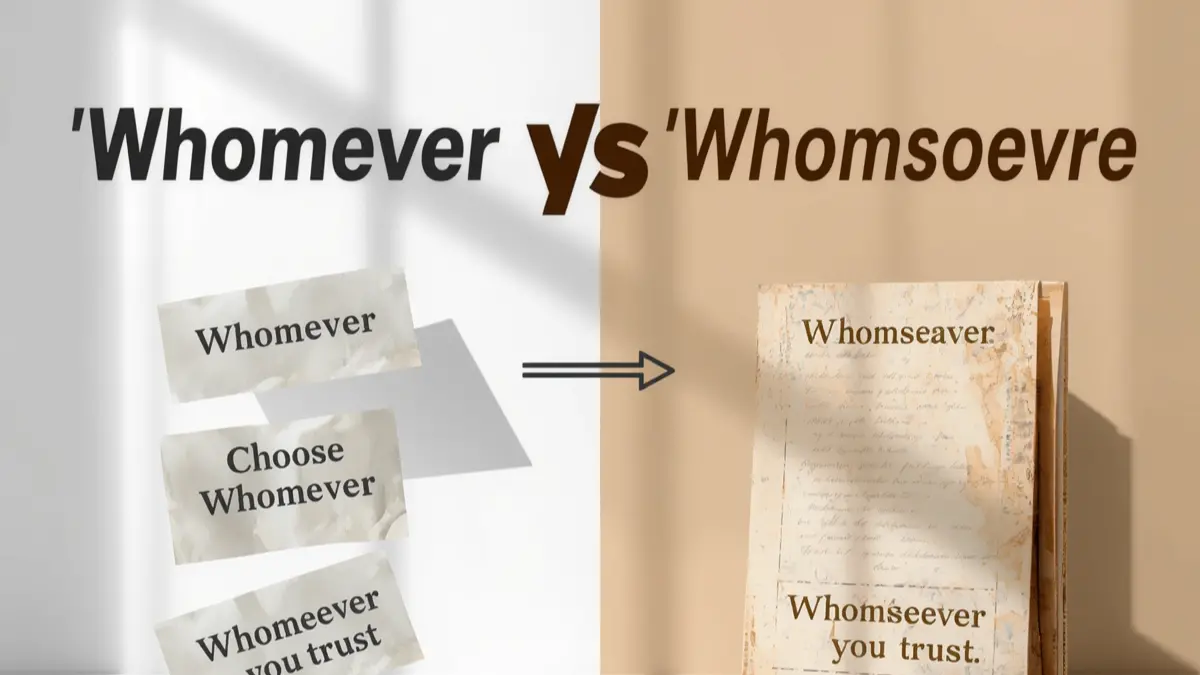
Many English learners and even native speakers get confused between whomever and whomsoever. These words look formal, old, and slightly difficult. Because of this, people often wonder if they mean the same thing or if one is more correct than the other.
The confusion usually happens when writing formal emails, legal documents, or academic text. Both words come from “whom,” which is the object form of “who,” but their usage rules are not always clear. Some people think whomsoever is outdated, while others believe whomever is always the modern choice.
This article solves that confusion in a very simple way. You will learn the meaning, origin, spelling differences, and correct usage of both words. You will also see real examples, common mistakes, and clear guidance on when to use each one. By the end, you will know exactly how to choose between whomever and whomsoever without hesitation.
Whomever or Whomsoever – Quick Answer
Whomever and whomsoever both mean “any person who” or “the person who (as an object).” They are object forms of “whoever” and “whosoever.”
Simple rule:
- Whomever → modern, more common in everyday formal English
- Whomsoever → very formal, old-fashioned, often used in legal or religious writing
Examples:
- You may invite whomever you like.
- Whomsoever the committee selects will receive the award.
👉 In most modern writing, whomever is preferred.
Read more: Upmost or Utmost: What’s the Difference and Which One Is Correct
The Origin of Whomever or Whomsoever
Both words come from Old English roots.
- “Whom” = object form of “who”
- “-ever” / “-soever” = suffix meaning “any person at all”
Historical background:
- Whomsoever appeared earlier in Middle English and was commonly used in religious and legal texts.
- Whomever developed later as English became simpler and more modern.
- Over time, everyday English dropped many “-soever” forms because they sounded too formal.
Why spelling differs:
The difference is not just spelling—it is style:
- -ever → modern English simplification
- -soever → archaic, formal, ceremonial tone
Read more: Master’s or Masters: What’s the Correct Form
British English vs American English Spelling
Unlike many words, whomever and whomsoever are not strongly divided by region. The difference is more about formality than geography.
However, usage trends still vary slightly:
- British English tends to preserve more formal/archaic wording in legal writing.
- American English prefers simpler and shorter forms.
Comparison Table
| Feature | Whomever (Modern) | Whomsoever (Formal/Old) |
| Usage frequency | High | Low |
| Tone | Formal, modern | Very formal, archaic |
| Common in US | Yes | Rare |
| Common in UK | Yes | Used in legal/religious |
| Everyday writing | Preferred | Avoided |
| Legal documents | Sometimes used | Still seen |
Which Spelling Should You Use?
Choosing between the two depends on your audience.
Use whomever if:
- You are writing emails
- You are writing essays
- You are writing blogs or articles
- You want simple, modern English
Use whomsoever if:
- You are writing legal documents
- You are writing religious or ceremonial text
- You want a very formal or traditional tone
Global advice:
For most global communication, whomever is the safest choice. It is clearer and easier for readers.
Common Mistakes with Whomever or Whomsoever
1. Using “who” instead of “whomever”
❌ Give the job to who you like.
✔ Give the job to whomever you like.
2. Using “whom” incorrectly in casual writing
❌ Whom is coming to the party?
✔ Who is coming to the party?
3. Mixing tone
❌ I will support whomsoever you choose (in casual chat).
✔ I will support whomever you choose.
4. Overusing “whomsoever”
Many writers use it to sound smart, but it often feels unnatural.
Whomever or Whomsoever in Everyday Examples
Email example:
- Please assign the task to whomever is available today.
Academic writing:
- The scholarship will be awarded to whomever meets the criteria.
Legal writing:
- The property shall pass to whomsoever is named in the will.
Social media:
- I’ll support whomever wins the competition!
News style:
- The award will be given to whomever the judges select.
Whomever or Whomsoever – Google Trends & Usage Data
Search trends show clear patterns:
- Whomever → higher search volume globally
- Whomsoever → lower volume, mostly niche searches
Country-based trend insights:
- 🇺🇸 USA → High usage of whomever
- 🇬🇧 UK → Mixed usage, formal texts use whomsoever
- 🇮🇳 India, Pakistan, Philippines → Mostly whomever in education and online writing
- Legal/religious sectors worldwide → still use whomsoever
Context trends:
- Education → whomever
- Legal writing → whomsoever
- Digital content → whomever dominates
Comparison Table: Whomever vs Whomsoever Variations
| Word Form | Type | Meaning | Usage Level |
| Who | Subject | person doing action | Common |
| Whom | Object | person receiving action | Formal |
| Whoever | Modern | any person (subject) | Common |
| Whomever | Modern obj | any person (object) | Common |
| Whosoever | Old form | any person (subject) | Rare |
| Whomsoever | Old form | any person (object) | Very rare |
FAQs About Whomever or Whomsoever
1. Are whomever and whomsoever the same?
Yes, both mean “any person who,” but whomever is modern and whomsoever is formal.
2. Is whomsoever still used in English?
Yes, but only in legal, religious, or very formal writing.
3. Which is correct: whomever or whomsoever?
Both are correct, but whomever is more common today.
4. Can I use whomever in speaking English?
Yes, but in spoken English, most people prefer “whoever.”
5. Is whomsoever outdated?
Not fully outdated, but rarely used in modern casual writing.
6. What is the easiest way to remember the difference?
Use whomever for everyday writing and whomsoever only for formal or legal tone.
7. Why does English have such confusing words?
Because English evolved from many languages and kept older formal structures alongside modern simplifications.
Conclusion
Understanding the difference between whomever and whomsoever is not difficult once you break it down. Both words come from the same grammatical family and carry the same basic meaning. However, their usage style is very different.
Whomever is the modern, simple, and widely accepted form in everyday English. It fits emails, essays, blogs, and general communication. On the other hand, whomsoever belongs to older, more formal English and is mostly found in legal, religious, or ceremonial contexts.
If you are unsure which one to use, always choose whomever. It is clearer, easier, and more natural for today’s readers. Only use whomsoever when you need a highly formal or traditional tone. By following this simple rule, you can avoid mistakes and write more confidently in English.

Henry is a passionate English professor, language specialist, and the founder of SpellCompare.com. With years of academic experience and a deep understanding of grammar, vocabulary, and linguistic nuances, he has dedicated his career to helping students and writers master the English language with clarity and confidence.
As an expert in word comparisons, spelling differences, and grammar rules, Henry simplifies complex language concepts into easy-to-understand explanations. His mission is to eliminate confusion between commonly misused words and provide accurate, research-based guidance that improves writing skills for learners worldwide.
Through SpellCompare.com, Henry combines academic expertise with practical examples, creating content that is clear, reliable, and reader-friendly. His work focuses on precision, correctness, and helping others communicate effectively in both academic and professional settings.
When he’s not teaching or writing, Henry continues researching evolving language trends to ensure his content remains current, helpful, and authoritative.