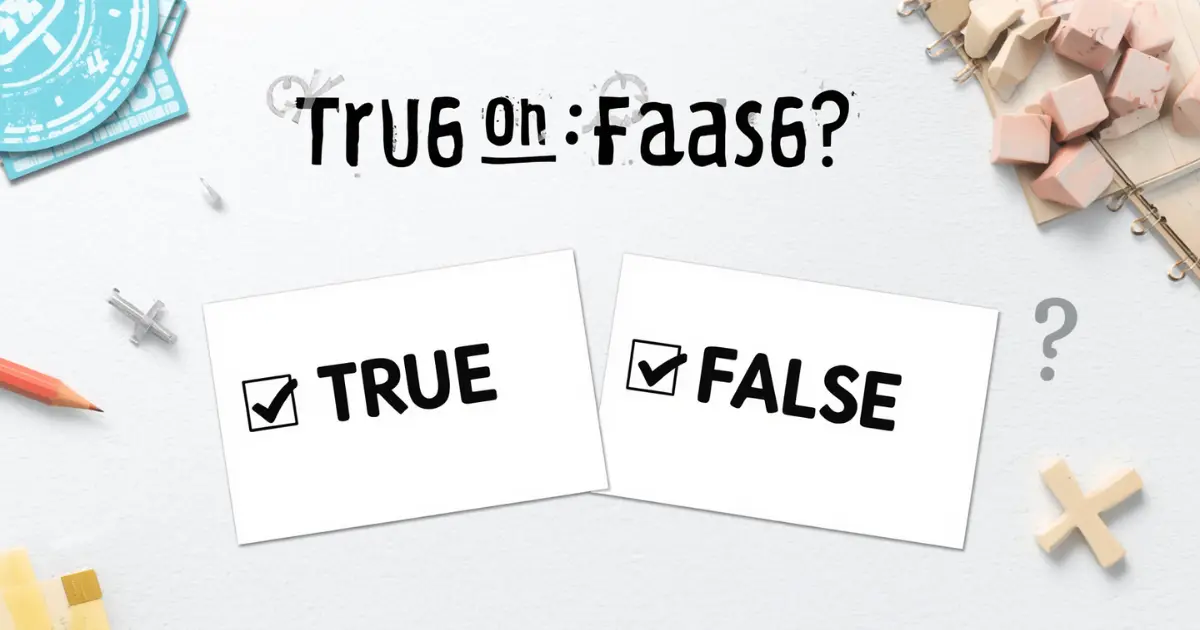
Imagine a teacher writing a simple statement on the board: “The Earth moves around the Sun.” Then she asks the class, “True or false?” Everyone has only two choices, but the answer still depends on knowing the fact.
This is the basic idea behind true or false. People search for true or false for many reasons. Students want to understand questions in exams. Teachers want to create quizzes. Readers want to check claims. Online users also see the phrase in games, polls, news, and fact-checking discussions.
The phrase looks very simple, but it can create confusion. Is true or false a question, a phrase, or a special grammar form? Should it be written with a hyphen? Is there a British or American spelling? And does “false” always mean that someone is lying?
In this guide, we will answer these questions in simple English. You will learn what true or false means, how to use it, common mistakes, everyday examples, and the best form to use in professional writing.
True or False – Quick Answer
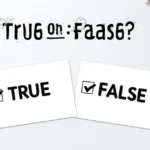
True or false is a phrase used to ask whether a statement is correct or incorrect.
- True = the statement is correct or agrees with the facts.
- False = the statement is incorrect or does not agree with the facts.
Example 1
Statement: The Earth is a planet.
Answer: True.
Example 2
Statement: The Earth is a star.
Answer: False.
The phrase is common in exams, quizzes, games, learning activities, logic, and fact-checking. It is also commonly written as true/false when space is limited.
A true-or-false question normally gives the reader a statement and asks them to decide whether it is true or false. (Dictionary.com)
The Origin of True or False
The words true and false are much older than the modern quiz format.
True comes from Old English trēowe, which was linked with ideas such as being faithful, trustworthy, or reliable. False came into English through Old French from Latin falsus, meaning untrue or deceptive.
The basic idea of deciding whether something is true or false has a long history in logic and philosophy. The modern true-or-false question became especially useful in education because it gave students a simple choice and allowed teachers to check answers quickly.
The format became increasingly common in educational testing during the 20th century. True-or-false questions were being used as examination questions by the early 1900s, and their use became more widespread in schools and formal tests during the middle of the century. (Dictionary.com)
The phrase also became important in computing. In Boolean logic, a value can be represented as true or false, often associated with the binary values 1 and 0.
So, today’s simple classroom question has connections to language, education, logic, mathematics, and computer science.
British English vs American English Spelling
One useful thing about true or false is that there is no major British-American spelling difference.
Both British English and American English use:
true or false
Comparison Table
| Feature | British English | American English |
| Correct phrase | true or false | true or false |
| Spelling of true | true | true |
| Spelling of false | false | false |
| Meaning | Same | Same |
| Quiz form | true or false | true or false |
| Short form | true/false | true/false |
| Hyphen before a noun | true-or-false | true-or-false |
Examples
British English:
“Students answered ten true or false questions.”
American English:
“Students answered ten true or false questions.”
The spelling does not change.
Which Spelling Should You Use?
The safest form is:
true or false
Use it in normal sentences, articles, emails, lessons, quizzes, and general writing.
For a US audience
Use:
true or false
Example:
Choose true or false for each statement.
For a UK or Commonwealth audience
Use:
true or false
Example:
Decide whether each statement is true or false.
For a global audience
Again, use:
true or false
There is no need to change the spelling for British or American readers.
When the phrase comes directly before a noun as a combined modifier, a hyphen can be useful:
a true-or-false question
But when the phrase is used normally as an answer choice or statement, write:
True or false?
This distinction is about grammar and sentence structure, not British versus American spelling.
Common Mistakes with True or False
1. Writing “truefalse”
❌ truefalse
✅ true or false
The standard phrase contains three separate words.
2. Writing “true or fals”
❌ true or fals
✅ true or false
The word false ends with e.
3. Using “true and false” when asking for a choice
If you want someone to choose one answer, use:
✅ True or false?
“True and false” has a different meaning. It normally refers to both ideas together.
4. Treating an opinion as a fact
Consider:
Chocolate is the best food.
This is usually an opinion, so it is not a strong true-or-false question.
A clearer factual statement would be:
Chocolate is made using cocoa.
5. Writing unclear statements
Consider:
Cars are fast.
This is too broad. Some cars are fast, while others are not.
A better statement might be:
Some sports cars can travel at more than 200 km/h.
Clear wording makes a true-or-false question easier to answer fairly.
6. Assuming false means “lying”
A false statement does not always mean that someone lied.
A person can make a false statement because they are mistaken or have incorrect information.
For example:
“The meeting starts at 9.”
If the meeting actually starts at 10, the statement is false. The speaker may simply have the wrong information.
True or False in Everyday Examples
The phrase appears in many parts of daily life.
In Emails
A teacher might write:
Please answer each statement as true or false.
A manager might write:
True or false: The meeting will begin at 10 a.m.
In News
News and fact-checking often discuss whether a claim is true or false.
Example:
The report examined whether the claim was true or false.
Here, the phrase is used to discuss the accuracy of information.
On Social Media
People often ask:
Is this story true or false?
Or:
True or false? This animal can survive without water for several weeks.
Such posts encourage people to check information before accepting it.
In Formal Writing
The phrase can be used in academic or professional material.
Example:
The questionnaire contained several true-or-false questions.
Here, true-or-false works as a compound adjective before questions.
In Education
Teachers use the format to test basic knowledge.
Example:
Water freezes at 0°C under standard conditions. True or false?
The student evaluates the statement and selects the appropriate answer.
True or False – Google Trends & Usage Data
True or false is a broad search phrase, so its search intent can change depending on the user.
People may search it for:
- School quizzes
- Online quizzes
- Trivia games
- General knowledge
- Fact-checking
- Social media claims
- English learning
- Logic and programming
- Worksheets
- Exam preparation
The phrase has remained useful because it is simple and works across many subjects. It is especially common in educational and quiz-related content. The format has also moved into popular online culture and social media. (Dictionary.com)
Popularity by Country
English-speaking countries naturally generate substantial English-language use of the phrase, including:
- United States
- United Kingdom
- Canada
- Australia
It is also widely understood and used in international English-learning and educational content, including India and other countries where English is widely taught.
However, it would be misleading to give a fixed ranking of countries without a specific Google Trends date range and search settings. Google Trends reports relative search interest, not the total number of searches, and its results change according to location, time period, category, and search type. (Transparency Center)
Usage by Context
| Context | Common Use |
| Education | Very common |
| Online quizzes | Very common |
| Trivia | Very common |
| Social media | Common |
| Fact-checking | Common |
| Workplace training | Common |
| Formal research | Moderate |
| Programming | Common as true/false values |
True vs False: Comparison Table
| Feature | True | False |
| Basic meaning | Correct or accurate | Incorrect or untrue |
| Opposite | False | True |
| Used in quizzes | Yes | Yes |
| Used in logic | Yes | Yes |
| Used in programming | Yes | Yes |
| Can describe a statement | Yes | Yes |
| Can describe information | Yes | Yes |
| Example | The answer is true. | The answer is false. |
| Emotional meaning | Usually neutral | Usually neutral |
| Spelling | true | false |
Phrase Variations
| Variation | Correct? | Common Use |
| true or false | ✅ | Normal phrase |
| true/false | ✅ | Forms, quizzes, short labels |
| true-or-false | ✅ | Before a noun |
| true and false | ✅ | Discussing both concepts |
| truefalse | ❌ | Not standard English |
| true or fals | ❌ | Spelling error |
| true or falses | ❌ | Incorrect form |
Frequently Asked Questions
1. What does “true or false” mean?
True or false asks you to decide whether a statement is correct or incorrect.
Example:
The Sun is a star. True or false?
Answer: True.
2. Is “true or false” one word?
No.
The standard phrase contains three separate words:
true + or + false
3. Is “true/false” also correct?
Yes. True/false is a common shortened form, especially in tests, forms, tables, and computer interfaces.
Example:
True/False Question
4. Is there a British spelling of “true or false”?
No special British spelling exists. British and American English both use:
true or false
5. Should “true or false” be hyphenated?
Usually, no.
Write:
Is this statement true or false?
But when the phrase works as an adjective before a noun, a hyphen can be used:
This is a true-or-false question.
6. Does false mean someone is lying?
No.
A statement can be false because someone made a mistake or had incorrect information. A lie usually involves deliberate deception.
7. What is the difference between “true or false” and “true and false”?
True or false presents two choices.
Is the statement true or false?
True and false refers to both concepts.
The test includes both true and false statements.
Conclusion
True or false is a simple phrase with many uses. It asks whether a statement is correct or incorrect and appears in school tests, online quizzes, games, fact-checking, social media, workplace training, and computer logic.
The correct standard spelling is true or false, and there is no British-American spelling difference. You may also see true/false in short labels and true-or-false when the phrase works as a compound adjective before a noun.
The biggest mistake is treating every statement as a simple fact. Good true-or-false questions should be clear and specific. Opinions, vague claims, and unclear wording can make a question difficult to judge.
Also remember that a false statement does not always mean someone is lying; it may simply be incorrect. Whether you are writing an exam question, creating a quiz, writing an email, or checking information online, true or false remains a clear and useful way to present two possible answers.

My name is SwiftSphere, and I am a passionate English language author and the creator of Spellcompare.com. I specialize in word comparisons, grammar clarity, and simplifying confusing English terms for readers around the world.
As a professional writer, I focus on breaking down commonly misunderstood words, phrases, and language rules into clear, practical explanations. My goal is to make English easier, more accurate, and more accessible for students, professionals, and everyday learners.
Through Spellcompare.com, I provide well-researched, easy-to-understand content that helps readers confidently choose the right words in writing and speech. Whether it’s comparing similar spellings, explaining grammar rules, or clarifying tricky vocabulary, I am committed to delivering precise and reliable guidance.
I believe that strong language skills create strong communication — and strong communication creates opportunity. That belief drives my work every day.