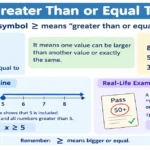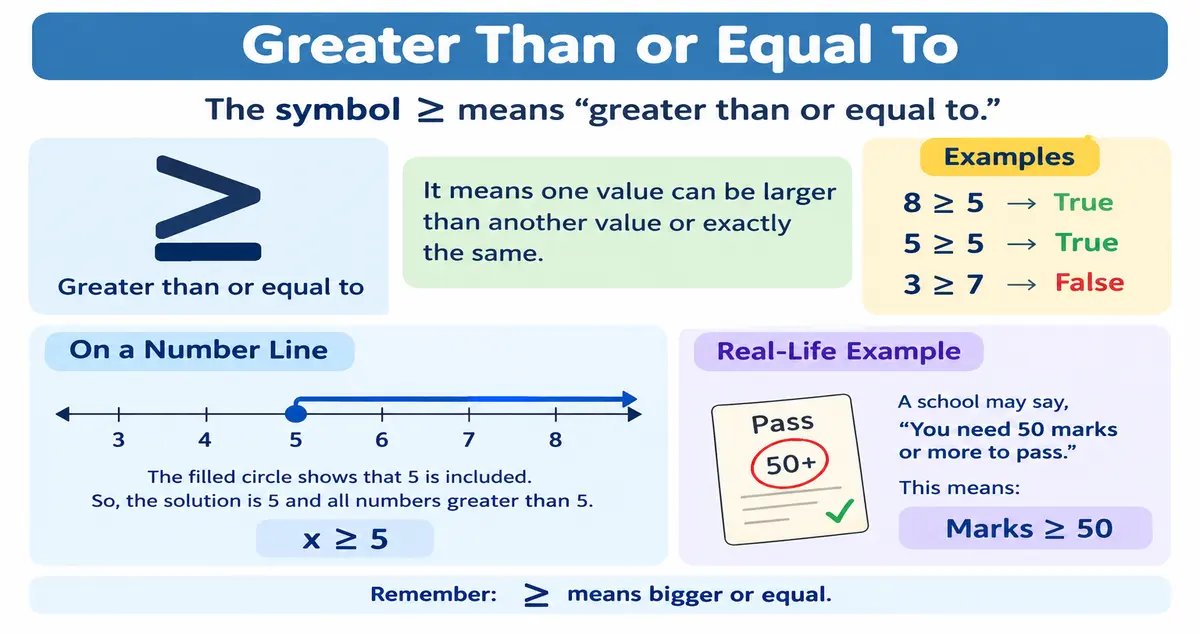
Imagine a teacher telling her students, “You need 50 marks or more to pass the test.” One student gets exactly 50 marks, while another gets 72. Both students pass because the rule includes 50 and every number above it. In mathematics, we express this idea with greater than or equal to (
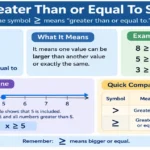
≥). It means that one number is either bigger than another number or exactly the same. The phrase greater than or equal to appears in schoolwork, business, science, measurements, statistics, and computer programming.
Understanding greater than or equal to is especially important when a rule has a minimum limit. It is also easy to confuse greater than (>) with greater than or equal to (≥). Once you understand greater than or equal to, you can read inequalities with much more confidence.
Key Difference Between Greater Than and Greater Than or Equal To
The main difference is whether equality is allowed.
- Greater than (>) means one value is bigger than another.
- Greater than or equal to (≥) means one value is bigger or exactly the same.
For example:
- 9 > 5 = True
- 9 ≥ 5 = True
- 5 > 5 = False
- 5 ≥ 5 = True
The small line under the > symbol is important because it adds the meaning “or equal to.”
Why Is Their Difference Necessary to Know?
Knowing the difference between these two expressions is useful for both learners and experts. A single line can change the meaning of a mathematical statement.
Think about a school that says, “Students must score 60 or more.” A student with exactly 60 marks meets the requirement. If the rule instead says “Students must score more than 60,” a score of exactly 60 is not enough.
The same idea appears in shops, workplaces, science, construction, sports, finance, and technology. People use minimum and maximum limits every day. Understanding these symbols helps us read rules correctly and make fewer mistakes.
Pronunciation of Greater Than and Greater Than or Equal To
Greater Than
US English: GRAY-ter than
UK English: GRAY-tuh than
Greater Than or Equal To
US English: GRAY-ter than or EE-kwuhl too
UK English: GRAY-tuh than or EE-kwuhl too
The words are pronounced almost the same in American and British English. The main difference comes from the normal accent differences between US and UK English.
Now that we understand the basic meaning, let us look at how greater than and greater than or equal to behave in different situations.
Difference Between Greater Than and Greater Than or Equal To
1. Greater Than Does Not Allow Equality
The symbol > means that the first number must be larger.
If the two numbers are exactly the same, the statement is false.
Examples:
- 8 > 4 is true.
- 8 > 8 is false.
So, when using greater than, the two values cannot be equal.
2. Greater Than or Equal To Allows Equality
The symbol ≥ gives us two possibilities. The first number can be larger, or it can be exactly equal to the second number.
Examples:
- 10 ≥ 6 is true.
- 10 ≥ 10 is also true.
This is the most important difference to remember.
3. The Symbols Are Different
The symbol for greater than is:
>
The symbol for greater than or equal to is:
≥
The second symbol has a small horizontal line underneath it.
Examples:
- 15 > 10
- 15 ≥ 10
That extra line tells us that equality is allowed.
4. Greater Than Is a Strict Inequality
A strict inequality does not include the boundary number.
For example:
x > 20
This means that x must be greater than 20. The number 20 itself is not included.
Examples:
- 21 > 20 is true.
- 20 > 20 is false.
This is why > is called a strict inequality.
5. Greater Than or Equal To Includes the Boundary
When we write:
x ≥ 20
the number 20 is included.
The statement allows 20 and every number above it.
Examples:
- 20 ≥ 20 is true.
- 25 ≥ 20 is true.
This makes ≥ useful when describing minimum requirements.
6. They Describe Different Number Ranges
Consider these two statements:
x > 5
This means:
5.1, 6, 7, 8, 10, and so on.
But 5 is not included.
Now consider:
x ≥ 5
This includes:
5, 5.1, 6, 7, 8, 10, and so on.
Examples:
- 5.5 satisfies both conditions.
- 5 satisfies only x ≥ 5.
The difference is the boundary value.
7. They Look Different on a Number Line
Number lines make the difference easy to see.
For x > 5, we normally use an open circle at 5. This shows that 5 is not included.
For x ≥ 5, we use a filled circle at 5. This shows that 5 is included.
Examples:
- x > 5 → open circle at 5
- x ≥ 5 → filled circle at 5
This is a useful visual trick for students.
8. They Can Change the Meaning of a Rule
Imagine a gym has a rule about age.
If the rule says:
Age > 18
an 18-year-old does not meet the condition.
If the rule says:
Age ≥ 18
an 18-year-old does meet the condition.
Examples:
- Age 19 → satisfies both.
- Age 18 → satisfies only age ≥ 18.
The correct symbol depends on whether the boundary is included.
9. Greater Than Means More Than
In everyday language, greater than is often similar to more than.
For example:
“The company has more than 500 customers.”
In mathematics, we can write:
Customers > 500
Examples:
- 600 > 500
- 750 > 500
The number must be above 500.
10. Greater Than or Equal To Means At Least
One of the easiest ways to understand ≥ is to connect it with the phrase at least.
If someone says:
“You need at least 50 points.”
we can write:
Points ≥ 50
Examples:
- 50 ≥ 50
- 75 ≥ 50
Both satisfy the condition because 50 is included.
Nature and Behaviour of Greater Than
Greater than (>) is used when we want to show that one value is definitely larger than another.
It does not accept equality.
For example:
12 > 8
is true because 12 is larger than 8.
But:
8 > 8
is false because the two numbers are equal.
The nature of > is therefore strict. It draws a clear line between values that are larger and values that are not.
Nature and Behaviour of Greater Than or Equal To
Greater than or equal to (≥) is more flexible because it accepts two situations:
- The first value is larger.
- Both values are equal.
For example:
12 ≥ 8 is true.
And:
8 ≥ 8 is also true.
This makes ≥ useful for minimum limits and requirements.
A simple way to remember it is:
≥ = greater + equal
Why Do People Get Confused About Their Use?
Many learners find these symbols confusing at first. There are several simple reasons.
The symbols look almost the same
The only major visual difference is the line under the greater-than sign.
The names are very similar
“Greater than” and “greater than or equal to” start with the same words.
The boundary causes mistakes
Students may understand that 10 is greater than 5 but forget that:
5 ≥ 5
is also true.
Everyday language can be unclear
Words such as more than, over, at least, and no less than can have slightly different meanings in casual conversation.
Number lines can be confusing
Some learners forget that ≥ needs a filled circle because the boundary is included.
The easiest memory trick is:
> means bigger only.
≥ means bigger or the same.
Difference and Similarity Between Greater Than and Greater Than or Equal To
| Feature | Greater Than (>) | Greater Than or Equal To (≥) |
| Basic meaning | Larger than | Larger than or equal to |
| Equality allowed | No | Yes |
| Symbol | > | ≥ |
| Type | Strict inequality | Non-strict inequality |
| Boundary included | No | Yes |
| Example | 8 > 5 | 8 ≥ 5 |
| Equal example | 5 > 5 is false | 5 ≥ 5 is true |
| Number line | Open circle | Filled circle |
| Common phrase | More than | At least |
| Used for limits | Yes | Yes |
| Used in mathematics | Yes | Yes |
| Used in programming | Yes | Yes |
Which Is Better in What Situation?
When Is Greater Than Better?
Greater than (>) is the right choice when the exact boundary value should not be included. For example, if a competition says a participant must be older than 18, then someone who is exactly 18 does not meet the condition. Similarly, a rule saying a machine must operate at a temperature greater than 100°C excludes exactly 100°C. In these situations, > gives a clear and strict limit. It is not generally “better” than ≥; it is simply the correct choice when the value must be strictly above another value.
When Is Greater Than or Equal To Better?
Greater than or equal to (≥) is useful when the minimum value is allowed. For example, if a teacher says students need at least 50 marks, then 50 is enough. We can write marks ≥ 50. The same idea works for age, weight, quantity, salary, temperature, and many other measurements. Whenever a rule means “this value or anything above it,” greater than or equal to is usually the expression you need. The important point is not which symbol is better, but whether the boundary value should be included.
How Are Greater Than and Greater Than or Equal To Used in Metaphors and Similes?
These expressions are mainly mathematical, but greater than can also be used naturally in figurative English.
Greater Than as a Metaphor
“Her courage was greater than her fear.”
Here, nobody is measuring courage with numbers. The sentence compares the strength of two feelings.
Greater Than in a Simile
“His excitement was greater than a child’s excitement on the first day of school.”
The sentence uses comparison to make the feeling easier to imagine.
Greater Than or Equal To in Figurative Writing
The complete phrase greater than or equal to is rarely used as a metaphor or simile. It is mainly used when a writer needs to express a precise mathematical or logical condition.
Connotative Meaning of Greater Than
Greater than is normally neutral when used in mathematics.
Example:
“The temperature is greater than 30°C.”
There is no emotional meaning here.
However, greater than can sound positive in ordinary English.
Example:
“Her love for her family was greater than her fear.”
Here, the phrase suggests that love was stronger.
It can also sound negative depending on context.
Example:
“The cost was greater than the customer expected.”
So, its emotional meaning depends on the sentence.
Connotative Meaning of Greater Than or Equal To
Greater than or equal to is usually neutral.
It simply gives a mathematical condition.
Example:
“The required score is greater than or equal to 70.”
There is no positive or negative feeling in the phrase itself.
Its meaning is practical and exact.
Idioms and Proverbs Related to These Words
There are no common traditional idioms that use the complete mathematical phrase greater than or equal to. However, English has several expressions involving greater and equal.
“Greater than the sum of its parts”
This means that something becomes more valuable or effective when its parts work together.
Example:
“Our team is greater than the sum of its parts.”
“Equal to the task”
This means someone is capable of dealing with a particular job or challenge.
Example:
“She showed that she was equal to the task.”
“Equal to the occasion”
This means someone performs well during an important event.
Example:
“The young speaker was equal to the occasion.”
These expressions use greater and equal in their normal English meanings rather than as mathematical symbols.
Works in Literature Related to the Keywords
Exact literary titles using the complete phrase “Greater Than or Equal To” are uncommon. However, some works use greater than or related wording in their titles.
- Greater Than Angels — Historical fiction, Carol Matas, 1998.
- Greater Than Ever: New York’s Big Comeback — Nonfiction, Daniel Doctoroff, 2017.
- Equal to Everything: Judge Brenda and the Supreme Court — Children’s nonfiction/biographical picture book, Afua Hirsch, 2019.
These titles show how words such as greater and equal can move from mathematical language into ordinary and literary language.
Movies Related to the Keywords
Movies with the exact mathematical title “Greater Than or Equal To” are uncommon. Some movie titles use the words greater than or equal in a broader sense.
- Greater Than Fame — 1920, United States.
- Greater Than Love — 1921, United States.
- Greater Than Gold — 1983, United States.
- Greater Than — 2014, Canada.
In these titles, greater than is used as ordinary English rather than as a mathematical inequality.
Frequently Asked Questions
1. What does greater than or equal to mean?
It means that one value is larger than another value or exactly equal to it.
For example:
10 ≥ 10
is true.
2. What is the difference between > and ≥?
The symbol > means greater than only.
The symbol ≥ means greater than or equal to.
For example:
7 > 7 = False
7 ≥ 7 = True
3. What does the line under ≥ mean?
The line means equal to.
Without the line:
> = greater than
With the line:
≥ = greater than or equal to
4. Is “at least” the same as greater than or equal to?
Yes. In mathematical statements, at least normally includes the number that follows it.
For example:
“At least 20” means:
x ≥ 20
So 20, 21, 22, and higher values are included.
5. How can I easily remember the symbol?
Think of the two symbols this way:
> = bigger
≥ = bigger or equal
The extra line in ≥ reminds you that the two numbers can be equal.
How Both Are Useful in Our Surroundings
Greater-than comparisons are part of everyday life.
A shop might have an offer for customers who buy more than 10 items.
A school might require at least 50 marks.
A company might accept applicants who are 18 or older.
A factory may need a machine to reach a certain temperature.
A farmer may compare the weight of two crops.
A business owner may compare this month’s sales with last month’s sales.
Even websites and computer programs use these comparisons. For example, a program may check whether a customer’s age is above a certain number or whether an order contains at least a required quantity.
So, these symbols are not only classroom tools. They help us describe limits, requirements, measurements, and comparisons in the real world.
Final Words for Greater Than and Greater Than or Equal To
The difference between greater than and greater than or equal to is small but very important.
Greater than (>) means one value must be larger.
Greater than or equal to (≥) means one value can be larger or exactly equal.
The easiest example is:
5 > 5 = False
but:
5 ≥ 5 = True
Whenever you see a minimum requirement such as at least, think about ≥. When a condition requires a value to be strictly above another value, use >.
Once you understand the role of the extra line, these two symbols become much easier to remember.
Conclusion
Understanding greater than or equal to is much easier when you compare it with greater than. The symbol > tells us that one value is strictly larger, while ≥ also accepts equality. For example, 8 > 5 is true, but 5 > 5 is false. On the other hand, 8 ≥ 5 and 5 ≥ 5 are both true. This difference is important in mathematics, education, science, business, technology, and everyday rules.
A useful memory trick is to think of > as “bigger” and ≥ as “bigger or the same.” Whenever you see phrases such as at least, minimum, or no less than, check whether the boundary value is included. This simple idea can make inequalities much easier to understand and use correctly.
Would you like me to make this article sound even more natural and conversational while keeping the same structure?

SwiftHarbor is a dedicated English professor, language researcher, and the founder of SpellCompare.com. With years of academic experience in English grammar, vocabulary development, and linguistic comparison, SwiftHarbor specializes in simplifying complex language rules into clear, practical explanations.
As an expert in word usage, spelling differences, and commonly confused terms, SwiftHarbor has helped thousands of learners improve their writing accuracy and communication skills. Through SpellCompare.com, he provides detailed comparisons, easy examples, and research-based insights that make English learning accessible for students, writers, and professionals worldwide.
Known for a clear teaching style and structured explanations, SwiftHarbor focuses on eliminating confusion between similar words, improving grammar confidence, and promoting precise communication. His mission is simple: to make English easier, clearer, and more powerful for everyone.