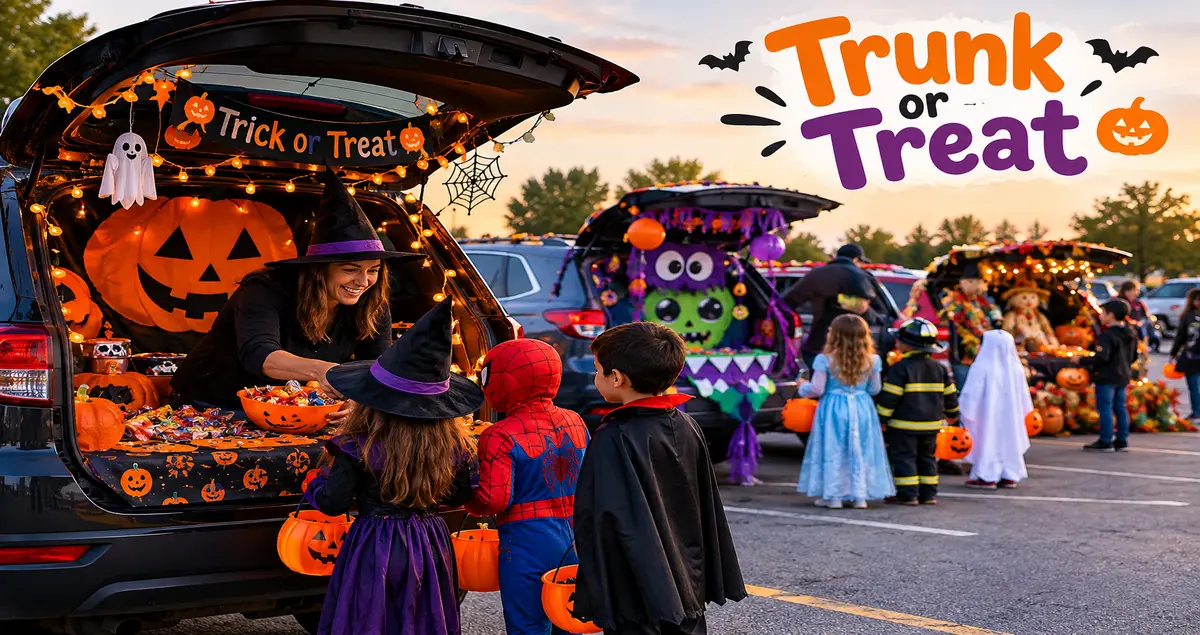
Picture a school parking lot on Halloween afternoon. Cars are lined up in rows, but they do not look like normal cars. One trunk has been turned into a pumpkin patch.
Another looks like a haunted house. A third is covered with superheroes. Children in costumes walk from one car to the next, laughing and collecting candy.
That is trunk or treat.
The phrase is easy to understand once you know the two words. A trunk is the storage space at the back of a car in American English, while a treat is something enjoyable, such as candy, food, or a small gift. Put them together, and trunk or treat describes a Halloween event where treats are handed out from decorated car trunks.
Unlike traditional trick-or-treating, trunk or treat usually takes place in one organized location, such as a school, church, or community parking lot. The idea has become a recognizable Halloween tradition in parts of North America.
Key Difference Between Trunk and Treat
The difference is actually quite simple.
Trunk is mainly a noun. In American English, it commonly means the rear storage area of a car. It can also mean the main stem of a tree or an elephant’s long nose.
Treat can be a noun or a verb. As a noun, it can mean something enjoyable or special. As a verb, it can mean to behave toward someone in a particular way or to give medical care.
In trunk or treat, the word trunk tells us where the activity happens, while treat tells us what children receive.
Why Is It Important to Understand Trunk or Treat?
For English learners, expressions like trunk or treat can be confusing because the individual words may be familiar while the complete phrase is new.
Knowing the expression also helps learners understand American culture and everyday conversations about Halloween. A student might know that trunk means part of a car and treat means something enjoyable, but still wonder why the two words are connected.
It is also useful to know the regional difference. American speakers usually say trunk, while British speakers normally say boot for the back storage area of a car.
Most importantly, language becomes easier when we learn words in real situations. Trunk or treat is a good example of how ordinary words can create a new meaning when they are used together.
Pronunciation of Trunk and Treat
Trunk
- US English: /trʌŋk/
- UK English: /trʌŋk/
- Easy pronunciation: trunk
Treat
- US English: /triːt/
- UK English: /triːt/
- Easy pronunciation: treet
Trunk or Treat (trunk or treet)
The pronunciation is almost the same in standard American and British English. The main regional difference is the word trunk. American English uses trunk for a car, while British English usually uses boot.
Now that the basic meaning is clear, let’s look at the two words separately.
Difference Between Trunk and Treat
1. Their Basic Meanings Are Different
A trunk is generally a physical part of something. In everyday American English, it often means the storage area at the back of a car.
Example 1:
I left my jacket in the trunk.
Example 2:
The groceries are in the trunk.
A treat is usually something enjoyable or special.
Example 1:
The children received a sweet treat.
Example 2:
Dinner at that restaurant was a real treat.
So, a trunk is usually a thing, while a treat is usually something enjoyable.
2. Trunk Is Mainly a Noun
We normally use trunk as a noun.
Example 1:
The trunk is full of bags.
Example 2:
The tree has a thick trunk.
It names a physical object or part of something.
Treat is different because it can be both a noun and a verb.
Example 1:
The cake was a special treat.
Example 2:
They treat their guests with respect.
This makes treat more flexible in everyday English.
3. Trunk Has a Strong Connection With Cars
When an American English speaker talks about a car’s trunk, they mean the storage compartment at the back.
Example 1:
Please put the boxes in the trunk.
Example 2:
He opened the trunk to get the bags.
The word treat has no special connection with cars.
Example 1:
Ice cream is my favorite treat.
Example 2:
The children received a treat after the game.
In trunk or treat, however, the two ideas come together.
4. Trunk Can Mean the Main Part of a Tree
The word trunk is not only used for cars. It can also mean the thick central stem of a tree.
Example 1:
The tree has a huge trunk.
Example 2:
A bird was sitting on the tree trunk.
Treat has no similar meaning.
Example 1:
The puppy received a treat.
Example 2:
The concert was a wonderful treat.
Context tells us which meaning of trunk is intended.
5. Trunk Can Refer to an Elephant
Another familiar meaning of trunk is the long nose of an elephant.
Example 1:
The elephant lifted its trunk.
Example 2:
The elephant used its trunk to pick up the fruit.
The word treat does not have an animal-related meaning like this.
Example 1:
The horse received a treat.
Example 2:
The dog was happy with its treat.
This is why English learners should not memorize only one meaning of trunk.
6. Treat Can Mean Something Special
As a noun, treat often refers to something that gives pleasure.
Example 1:
The birthday cake was a wonderful treat.
Example 2:
A day at the beach was a real treat.
The word trunk does not normally express this idea.
Example 1:
My shoes are in the trunk.
Example 2:
The tree trunk is covered with rough bark.
This is an important difference in feeling as well as meaning.
7. Treat Can Be a Verb
One of the biggest differences is that treat can be used as a verb.
It can describe how someone behaves toward another person.
Example 1:
She treats everyone kindly.
Example 2:
We should treat people with respect.
It can also refer to medical care:
The doctor treated the injured man.
Trunk is normally not used as an everyday verb.
Example 1:
The luggage is in the trunk.
Example 2:
The tree trunk is very strong.
8. Trunk or Treat Has a Special Halloween Meaning
When the two words appear together, they become part of a specific Halloween expression.
Example 1:
Our school is having a trunk-or-treat event.
Example 2:
The children enjoyed trunk or treat last year.
In this expression, trunk means the trunk of a decorated vehicle, and treat means candy, food, toys, or another small gift.
9. Trunk and Boot Show a Regional Difference
American English commonly uses trunk for the rear storage area of a car.
Example 1:
The suitcase is in the trunk.
Example 2:
The trunk is already full.
British English normally uses boot.
Example 1:
The suitcase is in the boot.
Example 2:
The boot is full of shopping bags.
This is one reason trunk or treat feels especially American.
10. Their Emotional Meanings Are Different
Trunk is usually neutral.
The keys are in the trunk.
The word simply tells us where something is.
Treat, especially as a noun, often has a positive feeling.
The children received a delicious treat.
It suggests pleasure, reward, or enjoyment.
So, although both are simple words, they create very different images in the reader’s mind.
The Nature and Behavior of “Trunk”
The word trunk is mostly concrete and descriptive.
It can refer to:
- a car’s storage area
- the main stem of a tree
- an elephant’s nose
- the central part of something in certain contexts
The surrounding words usually make the meaning obvious.
Compare these sentences:
Put the bags in the trunk.
Here, it means a car’s storage area.
The elephant moved its trunk.
Here, it means the elephant’s nose.
The old tree has a thick trunk.
Here, it means the central stem of the tree.
The spelling stays the same, but the meaning changes with the context.
The Nature and Behavior of “Treat”
Treat is more flexible.
As a noun, it can mean something enjoyable:
The chocolate cake was a special treat.
As a verb, it can describe behavior:
She treats everyone fairly.
It can also refer to medical care:
The doctor treated the patient.
There is also a useful expression:
Treat yourself.
This means to give yourself something enjoyable.
In trunk or treat, however, the meaning is much narrower. A treat is normally something given to children, such as candy, snacks, small toys, or other gifts.
Why Do People Get Confused About Trunk and Treat?
There are several reasons.
First, trunk has several meanings. A learner may know it as a car word but later see it used for a tree or an elephant.
Second, treat can be a noun or a verb. That makes it more complicated than it first appears.
Third, trunk or treat sounds very similar to trick or treat. Both expressions belong to Halloween, so new learners can easily mix them up.
Traditional trick-or-treating usually involves children visiting homes and asking for treats. Trunk-or-treating usually brings children together at one location where decorated vehicles provide the treats. The best way to avoid confusion is to look at the whole sentence instead of translating each word separately.
Trunk vs. Treat: Difference and Similarity
| Feature | Trunk | Treat |
| Main meaning | Storage area of a car | Something enjoyable |
| Common part of speech | Noun | Noun and verb |
| Halloween meaning | Car trunk where treats are given | Candy or another small gift |
| Car connection | Direct | Indirect |
| Tree meaning | Main stem | None |
| Animal meaning | Elephant’s nose | None |
| Emotional tone | Usually neutral | Often positive |
| Can be a verb? | Usually no | Yes |
| US pronunciation | /trʌŋk/ | /triːt/ |
| UK car word | Boot | Treat |
| Used in “trunk or treat” | Yes | Yes |
What Do They Have in Common?
Both words are common English vocabulary. Neither word is limited to Halloween.
They also become connected in one particular expression: trunk or treat.
The important point is that their meanings remain different even when they appear together.
Which Is Better in What Situation?
When Is Trunk or Treat a Good Choice?
A trunk-or-treat event can be a practical way for a school, church, neighborhood group, or community organization to bring families together in one place. Cars can be decorated before the event, and children can walk from one vehicle to another to collect treats. Organizers can also add games, music, food, costume contests, and other activities. The format gives families a chance to be creative because every car can have a different theme. For children, the fun comes from seeing the decorations as much as from collecting candy.
When Is Traditional Trick-or-Treating a Better Fit?
Traditional trick-or-treating works well for families who enjoy the classic Halloween experience of walking through their neighborhood and visiting different homes. Every house can offer a different decoration or treat, and children get to spend time outside as they move from one place to another. It can feel more adventurous and personal than a single organized event. Of course, the choice depends on the neighborhood, local arrangements, family preferences, and the kind of Halloween experience people want.
How Are Trunk and Treat Used in Metaphors and Similes?
Both words can be used creatively outside their literal meanings.
Trunk as a Metaphor
A tree trunk is strong and supports the branches above it. Because of this, trunk can be used as a metaphor for a central support.
Example:
The coach was the trunk of the team.
The coach is being compared to the central support of a tree.
Trunk as a Simile
Example:
His arms were as thick as tree trunks.
This comparison helps the reader imagine how thick his arms were.
Treat as a Metaphor
Example:
The quiet weekend was a treat after a stressful month.
The weekend is not literally a piece of candy. It is being described as something enjoyable.
Treat as a Simile
Example:
The holiday felt like a treat after weeks of hard work.
The holiday is compared with something pleasant and rewarding.
Connotative Meaning of Trunk and Treat
Connotation of Trunk
Trunk is generally neutral.
For example:
The keys are in the trunk.
There is no strong positive or negative feeling.
But when we talk about a large tree, the word can suggest strength, age, or stability.
The ancient tree stood firmly on its enormous trunk.
Here, the word helps create an image of strength.
Connotation of Treat
Treat is usually positive when it is used as a noun.
The children were excited about their Halloween treats.
It suggests pleasure and happiness.
As a verb, however, treat can be positive or negative.
Positive:
She treats everyone with kindness.
Negative:
He treated his workers unfairly.
So the emotional meaning of treat depends heavily on the context.
Idioms and Expressions Related to Treat
There are not many traditional idioms specifically connected with trunk or treat, but treat appears in several common expressions.
1. Treat yourself
It means to give yourself something enjoyable.
Example:
I worked hard all week, so I decided to treat myself to dinner.
2. Treat someone well
It means to behave kindly toward someone.
Example:
Good friends treat each other well.
3. A real treat
It means something especially enjoyable.
Example:
Seeing my old teacher again was a real treat.
4. Treat someone badly
It means to behave badly toward someone.
Example:
Everyone deserves respect and should not be treated badly.
There is no equally common everyday idiom based specifically on trunk, although phrases such as tree trunk and trunk of a tree are very common.
Works in Literature Related to “Trunk or Treat”
Because trunk or treat is a fairly modern cultural expression, it does not have a long list of classic literary works built around it.
However, it has already appeared as the main subject of modern children’s literature.
- Trunk or Treat — children’s lift-the-flap board book by Hannah Eliot, illustrated by Lydia Jean, published in 2024. The book takes young readers through a playful Halloween trunk-or-treat experience. (Simon & Schuster Parents)
- Trunk-or-Treat! — children’s picture book by Chris Ayala-Kronos, illustrated by Rea Zhai, published in 2024. The story follows a family visiting a community trunk-or-treat event in a parking lot. (Cedar Park Public Library)
- Trunk Or Treat: A Christian Women’s Club Mystery — contemporary cozy mystery by Riley Blake, published in 2024. The story uses a church trunk-or-treat event as part of its mystery plot. (Google Books)
These examples are useful because they show that trunk or treat has moved beyond everyday conversation and into modern children’s books and contemporary fiction.
Movies Related to “Trunk or Treat”
There is not a well-established list of major feature films made specifically about trunk or treat. It would therefore be misleading to present unrelated movies as if they were films about the expression.
Instead, movies often provide themes for trunk-or-treat decorations. A family might turn a car into a scene from a superhero movie, an animated film, or a spooky Halloween story. Trunk-or-treat events can also use themes from children’s literature, movies, television, and other popular culture.
This is why you may see a car decorated like a movie scene at a trunk-or-treat event, even though the movie itself has nothing to do with trunk-or-treating.
5 Frequently Asked Questions
1. What does trunk or treat mean?
Trunk or treat is a Halloween activity where children receive candy or other treats from decorated car trunks, usually at one organized location.
2. Is trunk or treat the same as trick or treat?
No. They are related, but the setting is different. Traditional trick-or-treating usually involves going from house to house, while trunk or treat usually takes place around decorated vehicles gathered in one location.
3. Why is it called a trunk or treat?
The name comes from the idea of getting Halloween treats from car trunks. It is also a playful variation of the familiar phrase trick or treat.
4. Is trunk or treat one word?
No. Trunk or treat is normally written as three words. When used as a compound adjective before another noun, you may also see trunk-or-treat, as in a trunk-or-treat event.
5. Is trunk or treat American English?
The expression is strongly associated with American Halloween culture. One reason is vocabulary: American English commonly uses trunk for the back storage area of a car, while British English normally uses boot.
How Are Trunk and Treat Useful in Our Surroundings?
We use trunk in everyday situations, especially when talking about cars.
Put the shopping bags in the trunk.
We also use it when talking about nature.
The tree has a strong trunk.
Treat is even more common.
We use it for food:
The children received a sweet treat.
We use it when talking about behavior:
Treat people with respect.
We also use it in healthcare:
The doctor treated the patient.
And during Halloween, the two words come together:
Our school is organizing a trunk-or-treat event.
This is a good reminder that vocabulary becomes much easier when we learn it through real situations instead of memorizing isolated definitions.
Final Words
At first, trunk or treat may sound like a strange combination of words. Once you break it down, however, the meaning is easy.
A trunk can be the back storage area of a car. A treat can be something enjoyable, such as candy or a small gift. Put the two together, and you get a Halloween activity in which decorated car trunks become the places where children collect their treats.
The individual words are also useful far beyond Halloween. Trunk can describe a car, tree, or elephant, while treat can work as both a noun and a verb.
So, the next time you hear someone say trunk or treat, you will not need to guess what they mean. You will understand both the words and the cultural idea behind them.
Conclusion
Trunk or treat is a fun example of how simple English words can create a phrase with a special cultural meaning. Trunk usually refers to a car’s rear storage area in American English, while treat can mean something enjoyable or can describe the way someone behaves toward another person. Together, they describe a Halloween activity where children collect treats from decorated vehicles.
The phrase is also useful for English learners because it teaches more than vocabulary. It shows how context changes meaning and how American and British English can use different words for the same thing.
Once learners understand the meanings of trunk and treat, the expression becomes much easier to remember. Whether you are reading about Halloween, planning a community event, or simply learning everyday English, trunk or treat is a useful phrase to know.

Henry is a passionate English professor, language specialist, and the founder of SpellCompare.com. With years of academic experience and a deep understanding of grammar, vocabulary, and linguistic nuances, he has dedicated his career to helping students and writers master the English language with clarity and confidence.
As an expert in word comparisons, spelling differences, and grammar rules, Henry simplifies complex language concepts into easy-to-understand explanations. His mission is to eliminate confusion between commonly misused words and provide accurate, research-based guidance that improves writing skills for learners worldwide.
Through SpellCompare.com, Henry combines academic expertise with practical examples, creating content that is clear, reliable, and reader-friendly. His work focuses on precision, correctness, and helping others communicate effectively in both academic and professional settings.
When he’s not teaching or writing, Henry continues researching evolving language trends to ensure his content remains current, helpful, and authoritative.