Have you ever seen a math problem with a strange symbol that looks like > with a small line underneath it? You are not alone. Many students search for the greater than or equal to sign because they know the greater-than symbol but are not sure what the extra line means or how to type it on a keyboard.
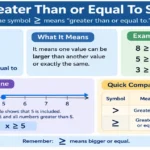
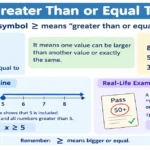
The greater than or equal sign is ≥, and it means that one value is either larger than another value or exactly the same. For example, 10 ≥ 10 is true, and 15 ≥ 10 is also true. People often search for the greater than or equal to sign when doing homework, writing equations, creating spreadsheets, coding, or working with formulas.
The greater than or equal to sign can also be written as >= in many computer programs. Once you understand what the sign means and when to use it, it becomes much easier to read inequalities and write them correctly.
Greater Than or Equal To Sign – Quick Answer
The greater than or equal to sign is:
≥
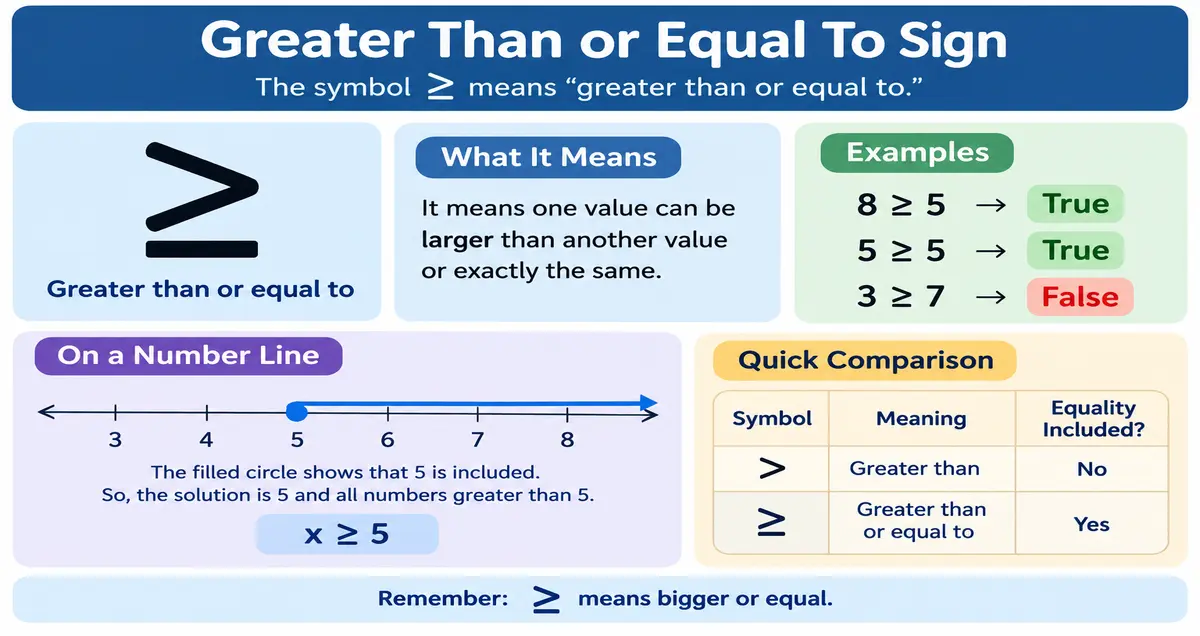
It means “greater than or equal to.”
For example:
- 8 ≥ 5 → True
- 8 ≥ 8 → True
- 4 ≥ 8 → False
The sign has two parts:
- > means greater than
- = means equal to
Together, ≥ means that the value on the left can be greater than or exactly equal to the value on the right.
Simple Example
If you see:
x ≥ 10
it means:
x can be 10 or any number greater than 10.
So 10, 11, 20, and 100 all satisfy the condition.
The Origin of the Greater Than or Equal To Sign
The greater than or equal to sign comes from the idea of combining two mathematical relationships: greater than and equal to.
The greater-than symbol is:
>
The equal sign is:
=
When equality must also be included, mathematics uses a combined symbol:
≥
The greater-than and less-than symbols became part of mathematical notation centuries ago. The equal sign was introduced later as a simple way to show that two quantities have the same value.
As mathematics developed, people needed an easy way to express conditions such as:
A number is bigger than 5 or exactly 5.
The symbol ≥ solves that problem in one mark.
Today, the symbol is common in mathematics, statistics, science, engineering, education, spreadsheets, and programming.
British English vs American English Spelling
Unlike words such as color/colour or center/centre, there is no British or American spelling difference for the greater than or equal to sign.
The mathematical sign remains:
≥
The phrase is also written the same way:
greater than or equal to
Comparison Table
| Feature | British English | American English |
| Written phrase | greater than or equal to | greater than or equal to |
| Symbol | ≥ | ≥ |
| Meaning | Greater than or equal to | Greater than or equal to |
| Common text form | ≥ | ≥ |
| Programming form | >= | >= |
| Short mathematical form | ≥ | ≥ |
So, whether you are writing for readers in the UK, USA, Canada, Australia, or another English-speaking country, you can use greater than or equal to without changing the spelling.
Which Spelling Should You Use?
There is actually no spelling choice here.
Use:
greater than or equal to
when writing the phrase in normal English.
Use:
≥
when writing mathematics.
Use:
>=
when working in many programming languages or systems that use plain keyboard characters.
For Students
Use ≥ in mathematical equations when your teacher expects mathematical symbols.
For Websites and Articles
Write greater than or equal to in the text and show ≥ when explaining the symbol.
For Programmers
Use the comparison operator required by your programming language. In many common languages, that is:
>=
For Global Readers
The phrase greater than or equal to is clear and widely understood. The mathematical symbol ≥ is even more universal.
Common Mistakes With the Greater Than or Equal To Sign
1. Using > Instead of ≥
A common mistake is writing:
x > 5
when you actually mean that 5 should also be included.
Incorrect for “5 or more”:
x > 5
Correct:
x ≥ 5
2. Forgetting the Equal Line
Some learners write > when they need ≥.
Remember:
> = greater than
≥ = greater than or equal to
The line underneath matters.
3. Thinking ≥ Means Only Greater Than
The symbol includes equality.
So:
7 ≥ 7
is true.
A learner who thinks ≥ means only “greater than” may incorrectly mark this as false.
4. Reversing the Comparison
Look carefully at:
10 ≥ 5
This is true.
But:
5 ≥ 10
is false.
Always compare the number on the left with the number on the right.
5. Confusing ≥ With ≤
These two symbols have opposite meanings.
≥ = greater than or equal to
≤ = less than or equal to
For example:
10 ≥ 5 → True
5 ≤ 10 → True
6. Using “Greater Than” When You Mean “At Least”
“At least 20” includes 20.
So:
x ≥ 20
is correct.
Writing:
x > 20
would exclude 20.
Greater Than or Equal To Sign in Everyday Examples
The symbol may look like a classroom tool, but its meaning appears in everyday situations.
In an Email
A teacher might write:
Students must score ≥ 60 to pass.
This means students need 60 or more.
In a News Report
A report might say:
The company received ≥ 1,000 applications.
This means the number was 1,000 or higher.
On Social Media
Someone might post:
You need ≥ 10 votes to enter the next round.
The person needs at least 10 votes.
In Formal Writing
A scientific report might state:
The temperature must remain ≥ 20°C.
This means the temperature must be 20°C or higher.
In Business
A company could write:
Orders of ≥ 100 units qualify for the offer.
An order of exactly 100 units qualifies.
In Education
A school might use:
Attendance ≥ 80%
This means students need 80% attendance or more.
Greater Than or Equal To Sign – Google Trends & Usage Data
People search for greater than or equal to sign for several different reasons. The search intent is usually practical rather than linguistic.
Common reasons include:
- Finding the ≥ symbol
- Copying and pasting the symbol
- Learning what ≥ means
- Learning how to type it
- Using it in Microsoft Word
- Using it in Google Docs
- Finding a keyboard shortcut
- Using it in Excel
- Using it in programming
- Understanding inequality homework
Search interest can also change by audience. Students may search for the term during school or exam periods, while programmers and office workers may search for it when working with formulas or code.
Google Trends is useful for comparing interest between related searches, but it should not be treated as an exact measure of the number of searches. Search interest can change by country, time period, device, and wording.
For SEO, useful related phrases include greater than or equal to symbol, greater than or equal sign, ≥ symbol, how to type ≥, and greater than or equal to meaning.
Greater Than or Equal To Sign Variations
| Variation | Meaning | Common Use |
| ≥ | Greater than or equal to | Mathematics |
| greater than or equal to | Full phrase | Articles and explanations |
| greater than or equal sign | Shorter wording | Search queries |
| greater than or equal symbol | Refers to the character | Search queries |
| >= | Keyboard/code version | Programming |
| at least | Plain-English meaning | Everyday language |
| x ≥ 5 | x is 5 or greater | Algebra |
| x >= 5 | x is 5 or greater | Programming |
How to Type the Greater Than or Equal To Sign
Sometimes people search for this keyword simply because they cannot find ≥ on their keyboard.
The easiest option is to copy it:
≥
You can also insert the symbol through the special-character or symbol menu in many applications.
In Microsoft Word
You can use Word’s symbol tools to insert mathematical symbols.
You can also use a Unicode-based method in Word:
2265 + Alt + X
This can convert the code into:
≥
In HTML
The character can be represented with:
≥
or:
≥
In LaTeX
Use:
\geq
or:
\ge
In Programming
Many programming languages use:
>=
For example:
x >= 10
This means that x is greater than or equal to 10.
Greater Than or Equal To Sign in Mathematics
The sign is especially important when working with inequalities.
Consider:
x ≥ 4
This means:
x can be 4 or anything greater than 4.
Possible values include:
- 4
- 5
- 6
- 10
- 100
But these do not satisfy the condition:
- 3
- 2
- 0
- -5
Another Example
x ≥ 20
The smallest allowed value is 20.
Therefore:
20 ≥ 20 → True
21 ≥ 20 → True
19 ≥ 20 → False
Greater Than or Equal To on a Number Line
A number line can make the meaning very clear.
Suppose we have:
x ≥ 5
The number 5 is included, so we use a filled circle at 5.
Then the line continues toward larger numbers.
This means:
5 and every number greater than 5.
Compare that with:
x > 5
Here, 5 is not included, so we use an open circle.
This is one of the easiest visual ways to remember the difference.
Greater Than vs Greater Than or Equal To
| Symbol | Meaning | Is Equality Included? | Example |
| > | Greater than | No | 8 > 5 |
| ≥ | Greater than or equal to | Yes | 8 ≥ 5 |
| < | Less than | No | 5 < 8 |
| ≤ | Less than or equal to | Yes | 5 ≤ 8 |
The most important pair to remember is:
> → bigger only
≥ → bigger or equal
Frequently Asked Questions
1. What is the greater than or equal to sign?
The greater than or equal to sign is ≥. It means that one value is greater than another value or exactly equal to it.
Example:
10 ≥ 10
2. What does ≥ mean?
The symbol ≥ means greater than or equal to.
For example:
12 ≥ 8
means 12 is greater than 8.
It can also be used when both values are equal:
8 ≥ 8
3. How do you type the greater than or equal to sign?
You can copy and paste it here:
≥
You can also insert it through the symbol menu in applications such as Microsoft Word and Google Docs.
4. What is the difference between ≥ and >?
> means greater than only.
≥ means greater than or equal to.
Therefore:
5 > 5 is false.
But:
5 ≥ 5 is true.
5. What does “at least” mean in mathematics?
“At least” usually means greater than or equal to.
For example:
You need at least 50 points.
Mathematically:
x ≥ 50
The number 50 is included.
6. Is >= the same as ≥?
In many programming languages, >= represents the same mathematical relationship as ≥.
For example:
age >= 18
means:
age ≥ 18
The exact syntax can depend on the programming language or software.
7. Is there a British or American version of the sign?
No. The mathematical sign is the same in both British and American English:
≥
The phrase is also spelled the same:
greater than or equal to
There is no UK/US spelling difference.
Why the Greater Than or Equal To Sign Is Useful
The symbol helps us express limits in a short and clear way.
Instead of writing:
The student must score 70 marks or more.
we can write:
Marks ≥ 70
Instead of:
The temperature must be 25 degrees or higher.
we can write:
Temperature ≥ 25°C
Instead of:
A customer must be 18 years old or older.
we can write:
Age ≥ 18
This makes mathematical writing shorter and easier to understand.
The symbol is useful in:
- Mathematics
- Algebra
- Statistics
- Science
- Engineering
- Economics
- Business
- Education
- Excel
- Programming
- Data analysis
Conclusion
The greater than or equal to sign is a simple but important mathematical symbol. Written as ≥, it tells us that one value can be greater than another value or exactly equal to it. The easiest example is x ≥ 5, which means x can be 5 or any number above 5.
The symbol is different from >, because greater than does not include equality. It is also different from ≤, which means less than or equal to. There is no British or American spelling difference because the mathematical phrase and symbol remain the same in both forms of English.
If you are writing normally, use greater than or equal to. In mathematics, use ≥, and in many programming languages, use >=. Once you remember that the extra line means “equal,” the symbol becomes easy to read, type, and use.

SwiftHarbor is a dedicated English professor, language researcher, and the founder of SpellCompare.com. With years of academic experience in English grammar, vocabulary development, and linguistic comparison, SwiftHarbor specializes in simplifying complex language rules into clear, practical explanations.
As an expert in word usage, spelling differences, and commonly confused terms, SwiftHarbor has helped thousands of learners improve their writing accuracy and communication skills. Through SpellCompare.com, he provides detailed comparisons, easy examples, and research-based insights that make English learning accessible for students, writers, and professionals worldwide.
Known for a clear teaching style and structured explanations, SwiftHarbor focuses on eliminating confusion between similar words, improving grammar confidence, and promoting precise communication. His mission is simple: to make English easier, clearer, and more powerful for everyone.