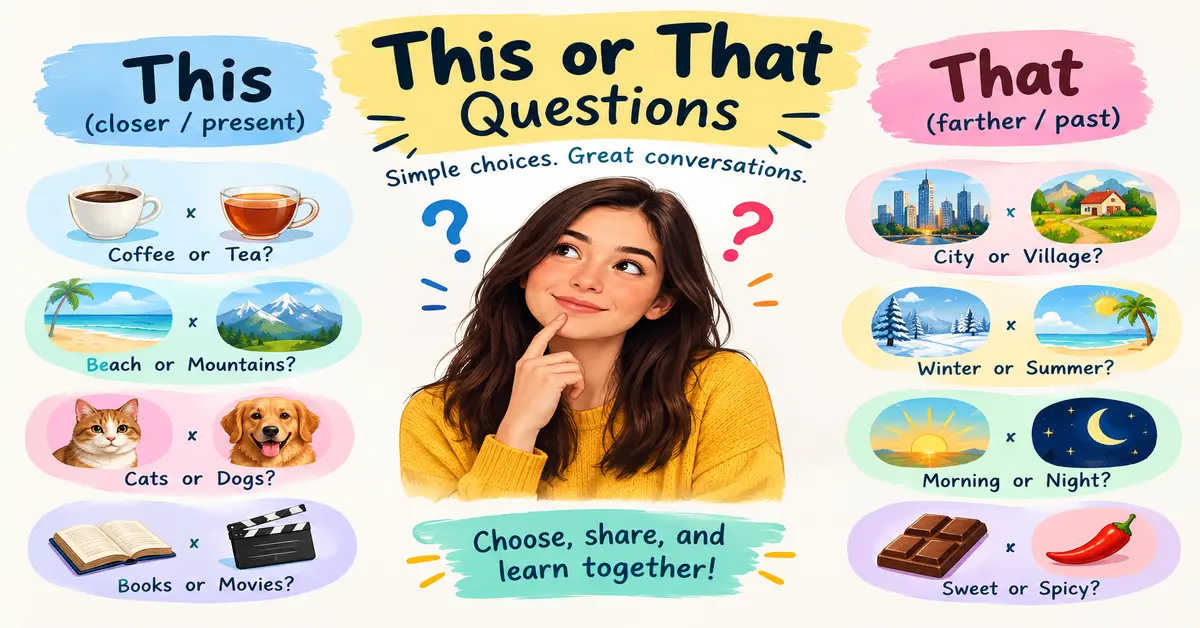
Imagine sitting with a group of friends at a dinner table. Someone suddenly asks, “Coffee or tea?” Another person laughs and asks, “City life or village life?” Soon everyone is choosing one option, explaining their reasons, and learning something new about each other. This simple activity is the idea behind this or that questions.
This or that questions give people two choices and invite them to select one. They can be funny, serious, personal, educational, or completely random. Teachers use them as icebreakers, friends use them to start conversations, and families use them to understand each other’s preferences.
In everyday English, the words this and that also help us show whether something feels close or distant. Understanding this or that questions therefore helps learners use English more naturally while making conversations more engaging.
What Is the Key Difference Between This and That?
The main difference is distance and focus.
This usually points to something that is close to the speaker, either physically or mentally. That normally points to something farther away, or something already separated from the speaker’s immediate situation.
For example:
- This book is in my hand.
- That book is on the table across the room.
The same idea can work with time, ideas, experiences, and conversations. English speakers do not always mean physical distance. Sometimes this creates a feeling of closeness, while that creates a feeling of distance.
Why Is It Important to Know the Difference?
Knowing the difference between this and that is important for both English learners and experienced speakers. These small words appear constantly in everyday communication.
A learner who understands them can describe objects, people, places, ideas, and events more accurately. An advanced speaker can use them to control emphasis, create emotional distance, and make a conversation sound more natural.
They are also important in society because communication depends on shared understanding. In classrooms, workplaces, shops, families, and public conversations, speakers constantly point to things, introduce ideas, refer back to information, and compare choices.
That is why this or that questions are useful beyond simple games. They teach people to make choices, express preferences, listen to different opinions, and explain their thinking.
Pronunciation of This and That
In both American and British English, this is pronounced with a voiced /ð/ sound at the beginning.
- This — US: /ðɪs/ | UK: /ðɪs/
- That — US: /ðæt/ | UK: /ðæt/
The pronunciations are essentially the same in standard American and British English. The main difference learners notice is usually accent and rhythm rather than the pronunciation of these two words themselves.
The th sound can be difficult for some English learners. Place the tongue lightly between or just behind the teeth and use your voice.
Now that we understand the basic idea, we can look more closely at how this and that behave in real English.
Difference Between This and That
1. This Shows Closeness
This normally refers to something close to the speaker.
The closeness can be physical. If you are holding a phone, you can say:
This phone is new.
The phone is close to you.
Example 1:
This chair is comfortable.
Example 2:
I like this shirt.
In both examples, the speaker presents the object as something nearby or immediately connected to the situation.
2. That Shows Distance
That usually refers to something farther away.
The distance can be physical or conceptual.
Example 1:
That house belongs to my uncle.
Example 2:
Look at that bird in the tree.
The speaker is directing attention toward something that is not immediately beside them.
3. This Can Refer to the Present
This can connect an idea with the speaker’s current time or situation.
Example 1:
This week has been very busy.
Example 2:
I am enjoying this moment.
The word creates a sense of something happening now or being closely connected with the present.
4. That Can Refer to the Past
That is often used for something already experienced or discussed.
Example 1:
That day changed my life.
Example 2:
I remember that conversation.
Here, that creates some distance between the speaker and the earlier event.
However, this is not an absolute rule. English speakers can use this for past events when they want to make those events feel vivid or immediate.
5. This Introduces Something
This is often used when introducing a person, object, or idea.
Example 1:
This is my friend, Ahmed.
Example 2:
This is the problem we need to solve.
It brings the subject into the listener’s attention.
6. That Can Identify Something
That can be used when identifying or pointing out something.
Example 1:
That is my car.
Example 2:
That is the restaurant I told you about.
The speaker assumes that the listener can identify the thing being discussed.
7. This Can Create Emotional Closeness
This sometimes makes an idea feel personal or emotionally close.
Example 1:
This is my favorite memory.
Example 2:
I really love this place.
The speaker is not simply identifying something. They are showing a personal connection.
8. That Can Create Emotional Distance
That can sometimes create emotional or psychological distance.
Example 1:
I don’t want to discuss that problem again.
Example 2:
That was a difficult period in my life.
The word itself is not negative. The emotional meaning comes from the context.
9. This Is Common in Demonstrative Questions
We often use this when asking about something close to us.
Example 1:
What is this?
Example 2:
Is this your phone?
These questions usually focus on something directly available to the speaker.
10. That Is Common When Pointing Something Out
We use that when referring to something farther away or already identified.
Example 1:
What is that?
Example 2:
Who is that man?
English learners can remember the basic pattern as:
This = closer
That = farther
This simple rule is a useful starting point, although context can change how native speakers use these words.
Nature and Behavior of “This”
The word this is a demonstrative determiner or pronoun. It points toward a singular countable noun or an uncountable noun.
Examples include:
- this book
- this car
- this water
- this idea
- this problem
Its behavior is strongly connected with closeness, attention, introduction, and present focus.
It can also make an idea feel more immediate:
This is exactly what I mean.
The speaker brings the idea directly into the conversation.
Nature and Behavior of “That”
That is also a demonstrative determiner or pronoun. It normally points toward a singular noun or an uncountable noun that is more distant.
Examples include:
- that house
- that car
- that idea
- that problem
- that music
Its behavior is often connected with distance, reference, identification, and previous information.
For example:
I remember that story.
The story is not physically present. The speaker is referring back to something known from an earlier context.
Why Are People Confused About Their Use?
People often confuse this and that because English does not always use physical distance as the only guide.
Consider:
This is a great idea.
The idea is not something you can physically hold. Here, this means the idea currently being discussed.
Now consider:
That was a great idea.
The speaker may be referring to an idea mentioned earlier.
The difference is therefore sometimes about conversation and mental distance, not just physical location.
Another reason for confusion is that both words can be translated similarly in some languages. Learners may know the general meaning but struggle to decide which word sounds natural in a particular situation.
This or That: Difference and Similarity
| Feature | This | That |
| Basic meaning | Refers to something close | Refers to something farther away |
| Number | Singular | Singular |
| Physical distance | Usually near | Usually farther away |
| Time | Often present/current | Often past or more distant |
| Conversation | Introduces or focuses attention | Refers back or points out |
| Emotional effect | Can suggest closeness | Can suggest distance |
| Example | This book is mine. | That book is yours. |
| Can be a pronoun? | Yes | Yes |
| Can come before a noun? | Yes | Yes |
| Can refer to ideas? | Yes | Yes |
| Can refer to people? | Yes | Yes |
| Can appear in questions? | Yes | Yes |
Both words are demonstratives, and both help speakers direct the listener’s attention. The biggest difference is the relationship between the speaker and the thing being discussed.
Which Is Better in What Situation?
When Is “This” Better?
Use this when something is close, current, newly introduced, or strongly connected with the speaker’s present situation.
For example, if you are holding a pen, saying “This pen is blue” sounds natural. If you have just explained an idea, you can say, “This is what I mean.” In both cases, the word brings something into immediate focus.
This is also useful when you want to make an experience sound personal or vivid.
When Is “That” Better?
Use that when something is farther away, already mentioned, previously experienced, or mentally separated from the current situation.
For example, you might say, “That building is very old” while pointing across the street. You could also say, “That was a difficult time” when talking about a past experience.
The best choice depends on the relationship between the speaker, listener, and subject.
This or That Questions in Everyday Conversation
This or that questions are especially useful because they turn ordinary preferences into conversation starters.
For example:
- Tea or coffee?
- Summer or winter?
- Books or movies?
- City or village?
- Morning or night?
- Cats or dogs?
- Sweet or spicy?
- Beach or mountains?
The purpose is not always to find a correct answer. Instead, the question encourages a person to choose and explain a preference.
That makes this or that questions useful for friends, classrooms, interviews, parties, family discussions, and social-media content.
A good question can also reveal personality. Someone who chooses “mountains” may explain that they enjoy peace and nature, while another person may choose “beach” because they love the sound of the sea.
How This and That Are Used in Metaphors and Similes
This and that are not normally metaphors or similes by themselves. However, writers and speakers can use them inside figurative expressions.
For example:
This city is a sleeping giant.
Here, this city identifies the subject, while “sleeping giant” is the metaphor.
Another example:
That memory was like a shadow following me.
Here, that memory points to a particular experience, while the comparison creates a simile.
In literature, demonstratives can also help control perspective. This can make an image feel immediate, while that can make it seem distant or remembered.
Connotative Meaning of This and That
Connotation of “This”
The basic meaning of this is neutral. However, it can carry a positive or warm connotation when it expresses closeness.
Positive example:
I will always remember this beautiful moment.
Here, this makes the moment feel immediate and personal.
Neutral example:
This table is made of wood.
Connotation of “That”
The basic meaning of that is also neutral. However, it can sometimes create emotional distance.
Positive example:
That was the best day of my life.
Negative example:
I don’t want to remember that terrible experience.
Neutral example:
That house belongs to my neighbor.
Therefore, neither word is automatically positive or negative. Context determines the emotional meaning.
Idioms and Expressions Related to This and That
“This and that”
This expression means various things or a mixture of subjects.
Example:
We talked about this and that during dinner.
“That’s that”
This means something is finished, settled, or decided.
Example:
We have made our decision, and that’s that.
“This too shall pass”
This traditional saying means that difficult situations are temporary.
Example:
Things are difficult right now, but remember: this too shall pass.
“That takes the cake”
This idiom means that something is especially surprising, impressive, or extreme.
Example:
I have heard some strange excuses, but that takes the cake.
These expressions show that this and that can do more than simply point to physical objects. They can also carry meaning in fixed expressions.
Works in Literature Featuring “This” or “That”
Several important literary works have this or that in their titles.
- This Side of Paradise — F. Scott Fitzgerald, 1920 — Bildungsroman/novel. The novel explores youth, love, ambition, and social change in post-World War I America.
- That Hideous Strength — C. S. Lewis, 1945 — Science fiction/dystopian novel. It is the final novel in Lewis’s Space Trilogy and explores a conflict between good and evil.
These titles demonstrate how small words such as this and that can contribute to a work’s perspective and emotional tone.
Movies Featuring “This” or “That” in the Title
- This Is Spinal Tap — 1984 — United States — A mockumentary comedy directed by Rob Reiner.
- That Thing You Do! — 1996 — United States — A comedy-drama written and directed by Tom Hanks about a fictional one-hit rock band.
- This or That — 2020 — United States — A comedy-romance film directed by Dennis Harmon Jr.
These titles show how this and that naturally appear in creative language, especially when a title needs to establish focus, identity, or a particular subject.
Five Frequently Asked Questions
1. What is the main difference between “this” and “that”?
This usually refers to something close to the speaker, while that usually refers to something farther away or more distant in the conversation.
2. Can “this” and “that” refer to ideas?
Yes. They can refer to physical objects as well as ideas, situations, events, and experiences.
For example:
This is a good idea.
That was an interesting suggestion.
3. Are “this” and “that” singular or plural?
This and that are singular demonstratives. Their plural forms are these and those.
For example:
This book is interesting.
These books are interesting.
4. What are this or that questions?
They are questions that give a person two choices and ask them to select one.
For example:
Would you choose tea or coffee?
They are often used as conversation starters, games, classroom activities, and social activities.
5. Are “this” and “that” always about physical distance?
No. They can also express mental, emotional, conversational, or time-related distance.
For example:
This is my favorite song.
The song does not have to be physically close. This can simply show that it is the speaker’s current focus.
How This and That Are Useful for Our Surroundings
Our surroundings constantly contain objects, people, places, sounds, and events that we need to identify.
Imagine walking through a market with a friend. You might say:
Look at this shirt.
Then you point toward a building:
What is that building?
These two small words help organize attention. They tell the listener what to look at and how it relates to the speaker.
The same principle works in classrooms, offices, homes, shops, and public places. This and that make communication quicker because speakers do not always need to give a long description.
They are small words, but they perform an important job: they connect language with the world around us.
Final Words for This and That
The difference between this and that may seem small, but it is extremely useful in everyday English.
Think of this as a word that often brings something closer to your attention. Think of that as a word that often points toward something farther away, already mentioned, or mentally separated.
Once you understand this basic relationship, many everyday sentences become easier to understand.
The same idea makes this or that questions so effective. They give people a simple choice while encouraging conversation, explanation, humor, and personal expression.
Conclusion
Learning the difference between this and that is one of those small grammar lessons that can make everyday English much clearer. This generally points to something close, current, or immediately connected with the speaker, while that often points to something farther away, previously mentioned, or mentally distant.
However, context is important, because English speakers use these words for ideas, memories, emotions, and situations as well as physical objects. This or that questions take the same basic contrast and turn it into an engaging way to communicate.
They can help friends connect, help teachers start discussions, and help learners practice expressing preferences. Once you understand how these words work, you can use them naturally in conversations, writing, questions, and everyday situations.

SwiftHarbor is a dedicated English professor, language researcher, and the founder of SpellCompare.com. With years of academic experience in English grammar, vocabulary development, and linguistic comparison, SwiftHarbor specializes in simplifying complex language rules into clear, practical explanations.
As an expert in word usage, spelling differences, and commonly confused terms, SwiftHarbor has helped thousands of learners improve their writing accuracy and communication skills. Through SpellCompare.com, he provides detailed comparisons, easy examples, and research-based insights that make English learning accessible for students, writers, and professionals worldwide.
Known for a clear teaching style and structured explanations, SwiftHarbor focuses on eliminating confusion between similar words, improving grammar confidence, and promoting precise communication. His mission is simple: to make English easier, clearer, and more powerful for everyone.