Have you ever typed grey or gray and stopped to wonder which spelling is correct? You are not alone. Both forms appear in books, newspapers, websites, clothing descriptions, design tools, and everyday conversations. The good news is simple: both grey and gray are correct.
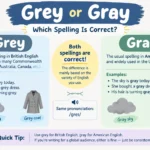
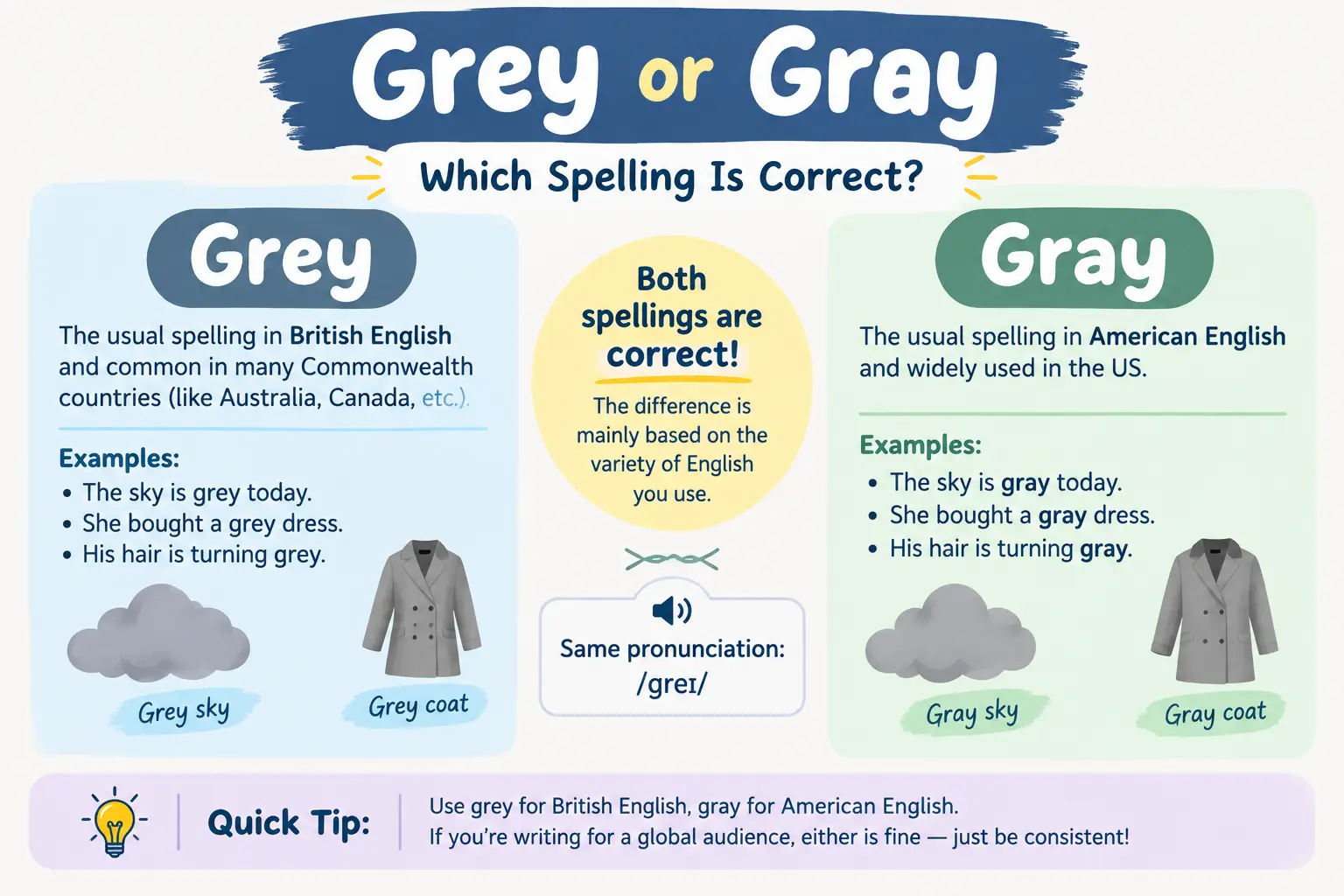
The difference is mainly based on the variety of English you use. Gray is the usual spelling in American English, while grey is mainly used in British English and is also common in several Commonwealth varieties. Both words have the same meaning and pronunciation. (Cambridge Dictionary)
People often search for grey or gray when writing an email, school assignment, blog post, business document, or social media caption. They want to know which form looks correct for their readers.
This guide explains the difference in simple terms. You will learn where the word came from, why the spelling changed, which version to use, common mistakes, everyday examples, and how regional usage affects search behavior.
Grey or Gray – Quick Answer
Grey and gray are two correct spellings of the same word.
The main difference is regional:
- Gray → preferred in American English
- Grey → mainly preferred in British English
- Grey → also common in Australian and other Commonwealth English varieties
- Pronunciation → the same: /ɡreɪ/
Examples
American English:
The sky is gray today.
British English:
The sky is grey today.
Both sentences have the same meaning.
The word can describe a color between black and white, gray or grey hair, cloudy weather, or something unclear, such as a gray area or grey area. (Cambridge Dictionary)
So, neither spelling is simply “wrong.” Your choice should match your audience and your chosen style of English.
The Origin of Grey or Gray
The history of grey or gray goes back much further than modern British and American English.
The word comes from the Old English grǣg, which was used for the color we now call gray or grey. It is related to similar words in other Germanic languages, including German grau and Old Norse grár. (Etymology Online)
Over time, English spelling changed in different places. Both grey and gray became established forms.
The spelling difference between British grey and American gray developed more clearly in modern English. Today, the two spellings are not different words. They are regional spelling forms of the same word. (Etymology Online)
This is similar to other British-American spelling differences:
- colour → color
- favour → favor
- centre → center
- theatre → theater
However, grey and gray do not differ in meaning.
A useful point about history
It is sometimes said that one spelling was completely invented by one person. The real history is more gradual. English spelling developed over centuries, and regional standards became stronger as British and American English developed separately.
British English vs American English Spelling
The easiest rule is:
British English → grey
American English → gray
Cambridge Dictionary lists grey as the mainly British form and gray as the US form. Both are pronounced /ɡreɪ/. (Cambridge Dictionary)
Comparison Table
| Feature | Grey | Gray |
| Main usage | British English | American English |
| Meaning | Color between black and white | Color between black and white |
| Pronunciation | /ɡreɪ/ | /ɡreɪ/ |
| UK writing | Common | Less common |
| US writing | Less common | Common |
| Hair | Grey hair | Gray hair |
| Weather | Grey sky | Gray sky |
| Area | Grey area | Gray area |
| Verb | Grey | Gray |
| Example | A grey coat | A gray coat |
British English Examples
She bought a grey dress.
The sky became grey before the rain.
His hair is turning grey.
American English Examples
She bought a gray dress.
The sky became gray before the rain.
His hair is turning gray.
The meaning stays the same. Only the spelling changes.
Which Spelling Should You Use?
The best spelling depends on who will read your writing.
For American readers
Use gray.
Example:
The company changed its logo to a dark gray color.
This is the natural choice for American websites, school work, business documents, and publications.
For British readers
Use grey.
Example:
The company changed its logo to a dark grey colour.
This fits British English spelling conventions.
For Australian and Commonwealth readers
Grey is widely used in countries that follow British spelling traditions. However, English usage can vary by country, organization, and context.
For a global audience
Either spelling can work. The important thing is consistency.
For example, if your article starts with:
The grey sky looked beautiful.
Try not to change later to:
The gray sky looked beautiful.
Choose one style and keep it throughout the article.
For SEO writing, you can mention both forms naturally near the beginning. This helps readers understand the regional difference without making the article sound forced.
Common Mistakes with Grey or Gray
1. Thinking one spelling is wrong
Incorrect idea:
Grey is always wrong.
That is not true.
Grey is a standard spelling in British English.
Likewise, gray is the standard American spelling.
2. Mixing spellings in the same document
You may write:
The gray walls matched the grey sofa.
This is not necessarily grammatically wrong, but it can look inconsistent if both words are intended to follow the same English variety.
For professional writing, choose one style.
3. Using “gray” for a British audience without a reason
American spelling may still be understood in Britain, but grey is the normal British form.
For British readers:
The grey building was renovated.
is the more natural choice.
4. Forgetting related spellings
The difference continues in related forms.
American:
- gray
- graying
- grayish
- grayness
British:
- grey
- greying
- greyish
- greyness
Cambridge lists graying as the US spelling and greying as mainly the UK spelling. (Cambridge Dictionary)
5. Confusing “grey” or “gray” with “colour” or “color”
Remember that two spelling differences may appear together.
British:
The wall is grey in colour.
American:
The wall is gray in color.
Both follow their respective spelling systems.
Grey or Gray in Everyday Examples
The word appears in many types of writing.
In Emails
British English:
Please change the background to light grey.
American English:
Please change the background to light gray.
In News
British English:
Grey clouds covered the city this morning.
American English:
Gray clouds covered the city this morning.
On Social Media
You may see:
I love this grey outfit!
or:
I love this gray outfit!
Both are correct. The writer’s English variety usually determines the spelling.
In Formal Writing
British style:
The study examined the effect of grey surfaces.
American style:
The study examined the effect of gray surfaces.
Talking About Hair
British:
My grandfather’s hair is turning grey.
American:
My grandfather’s hair is turning gray.
Talking About Unclear Situations
British:
The law contains a grey area.
American:
The law contains a gray area.
The phrase has the same meaning in both varieties.
Grey or Gray – Google Trends & Usage Data
Google Trends can help show how search interest changes by country, region, time, and search term. However, Google Trends does not provide a simple worldwide count of users who spell a word one way or another. Its results are relative and depend on the selected location and time period. (Google Trends)
For grey or gray, search behavior generally follows the same regional pattern seen in dictionaries:
- United States: gray is strongly associated with American English.
- United Kingdom: grey is the usual form.
- Australia: grey is widely used.
- Canada: both forms appear, with grey commonly associated with Canadian/British spelling.
- International searches: both forms can appear because people use different English varieties.
Search context also matters. Someone searching for gray hair, grey hair, gray paint, or grey paint may be following the spelling used by a particular website, store, software program, or country.
So Google Trends should be used to understand relative search behavior, not as proof that one spelling is universally correct.
For SEO, the practical approach is simple: use the spelling that matches your main audience and naturally mention the alternative when discussing the difference.
Comparison Table: Grey vs Gray
| Grey | Gray |
| Mainly British English | Mainly American English |
| Correct spelling | Correct spelling |
| Same meaning | Same meaning |
| Same pronunciation | Same pronunciation |
| Grey sky | Gray sky |
| Grey hair | Gray hair |
| Grey coat | Gray coat |
| Grey area | Gray area |
| Greying hair | Graying hair |
| Common in UK writing | Common in US writing |
Are they different colors?
No.
In normal modern English, grey and gray refer to the same color range between black and white. Some writers or designers may use the words for particular shades, but there is no general spelling rule that makes grey one color and gray another. (Cambridge Dictionary)
FAQs About Grey or Gray
1. Is grey or gray correct?
Both are correct. Gray is mainly used in American English, while grey is mainly used in British English.
2. Is gray American or British?
Gray is the standard American English spelling.
3. Is grey British English?
Yes. Grey is the mainly British spelling and is also widely used in several Commonwealth English varieties. (Cambridge Dictionary)
4. Do grey and gray mean the same thing?
Yes. In ordinary English, they mean the same color and have the same pronunciation.
5. Should I use grey or gray in an American essay?
Use gray if you are following American English.
6. Should I use grey or gray in British English?
Use grey for standard British English writing.
7. Can I use both grey and gray in one article?
You can, especially when explaining the difference. But when writing in one English variety, it is better to choose one spelling and use it consistently.
8. Is it grey hair or gray hair?
Both are correct.
- British English: grey hair
- American English: gray hair
Conclusion
The grey or gray question has a simple answer: both spellings are correct. They describe the same color, have the same pronunciation, and can be used as adjectives, nouns, and verbs.
The main difference is regional. Gray is the normal spelling in American English, while grey is mainly used in British English and is also common in several Commonwealth varieties. (Cambridge Dictionary)
If you are writing for American readers, choose gray. If your audience follows British English, choose grey. If you write for an international audience, either form can be understood, but consistency is important.
The same difference appears in related words. American English uses graying, while British English commonly uses greying. (Cambridge Dictionary)
Most importantly, do not think of one spelling as right and the other as wrong. The spelling depends on your audience and English style. Once you know this simple regional rule, choosing between grey or gray becomes easy.

SwiftHarbor is a dedicated English professor, language researcher, and the founder of SpellCompare.com. With years of academic experience in English grammar, vocabulary development, and linguistic comparison, SwiftHarbor specializes in simplifying complex language rules into clear, practical explanations.
As an expert in word usage, spelling differences, and commonly confused terms, SwiftHarbor has helped thousands of learners improve their writing accuracy and communication skills. Through SpellCompare.com, he provides detailed comparisons, easy examples, and research-based insights that make English learning accessible for students, writers, and professionals worldwide.
Known for a clear teaching style and structured explanations, SwiftHarbor focuses on eliminating confusion between similar words, improving grammar confidence, and promoting precise communication. His mission is simple: to make English easier, clearer, and more powerful for everyone.