Many students and professionals get confused between master’s or masters when talking about higher education degrees. This small apostrophe often causes big uncertainty in writing, applications, resumes, and academic documents.
People search for this keyword because they want to know the correct grammar for formal writing. For example, should you write “I am doing my masters in English” or “I am doing my master’s in English”? Both look similar, but only one is correct in standard English.
This confusion is important because using the wrong form can make your writing look informal or incorrect, especially in academic and professional settings. Universities, employers, and official documents usually expect precise grammar.
In this guide, you will learn the correct usage of master’s or masters, its origin, differences in English styles, common mistakes, real-life examples, and global usage rules. By the end, you will clearly understand how to use it correctly in any situation.
Master’s or Masters – Quick Answer
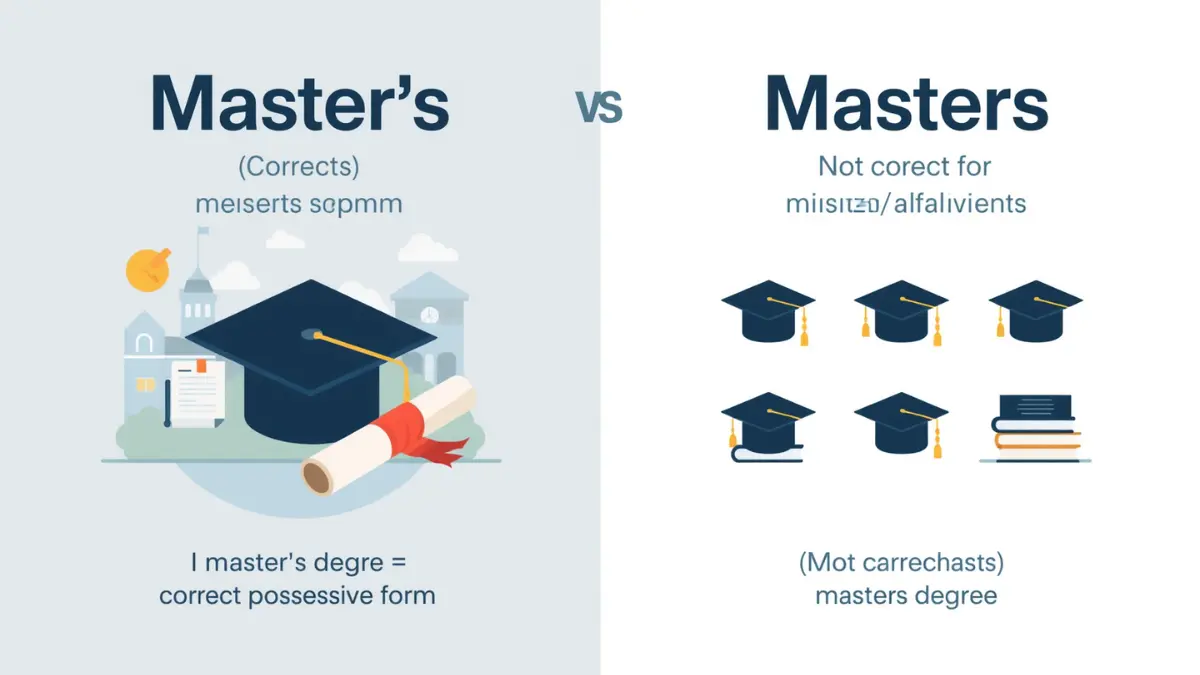
The correct form is master’s when referring to a degree.
Correct Usage:
- I have a master’s degree in Business.
- She is doing her master’s in Computer Science.
Incorrect Usage:
- ❌ I have a masters degree.
- ❌ I am doing my masters in English.
Read more: Difference Between BiPAP and CPAP: Complete Guide ?
Simple Rule:
- Use master’s (with apostrophe) for the degree.
- “Masters” without apostrophe is informal or incorrect in academic writing.
The Origin of Master’s or Masters
The word master comes from the Latin magister, meaning “teacher” or “leader.”
In medieval universities, a “master” was a person qualified to teach. Over time, the phrase master’s degree developed to show possession—meaning “the degree of a master.”
The apostrophe shows ownership:
- Master’s degree = degree belonging to a master
Without the apostrophe, “masters” simply becomes a plural noun, which is not correct in this context.
British English vs American English Spelling
There is no difference between British and American English for this rule. Both use master’s degrees.
Read more: Difference Between Twin and Full: Which Bed Size Is Right ?
Comparison Table
| Meaning | British English | American English |
| Correct academic form | Master’s degree | Master’s degree |
| Informal plural (incorrect) | Masters | Masters |
Examples
- UK: She completed her master’s degree in London.
- US: He finished his master’s degree in New York.
Both follow the same grammar rule.
Which Spelling Should You Use?
Use “master’s” when:
- Writing academic papers
- Creating resumes or CVs
- Filling university applications
- Writing formal emails
Avoid “masters” when:
- Writing professional content
- Submitting assignments
- Applying for jobs or visas
Global Rule:
Always use a master’s degree in formal English worldwide.
Common Mistakes with Master’s or Masters
Mistake 1
❌ I completed my masters in education
✔ I completed my master’s in education
Mistake 2
❌ She has a masters degree
✔ She has a master’s degree
Mistake 3
❌ I am doing Masters in Physics
✔ I am doing a master’s in Physics
Quick Fix Rule:
| Wrong | Correct |
| masters degree | master’s degree |
| doing masters | doing a master’s |
| Masters in Science | master’s in Science |
Master’s or Masters in Everyday Examples
Emails
- I am applying for a master’s program in Business Administration.
Academic Writing
- She holds a master’s degree in Computer Science from Oxford University.
Social Media
- Excited to start my master’s journey this year!
News Writing
- The student completed her master’s degree with distinction.
Master’s or Masters – Google Trends & Usage Data
Search trends show strong global interest in this keyword.
Observations:
- “Master’s degree” is most commonly used worldwide.
- “Masters” appears mostly in informal speech or social media.
- Students frequently search this term before applying to universities.
Country Usage
| Country | Correct Usage Popularity |
| USA | Very High |
| UK | Very High |
| India | High |
| Pakistan | High |
| Canada | High |
Universities worldwide prefer the apostrophe form.
Master’s vs Masters Comparison Table
| Feature | Master’s | Masters |
| Grammar | Possessive form | Plural noun |
| Correct in education | Yes | No |
| Used in degree name | Yes | Rare/informal |
| Example | master’s degree | ❌ masters degree |
FAQs
1. Is it master’s or masters degree?
Correct form is master’s degree.
2. Why is there an apostrophe in master’s?
It shows possession—degree of a master.
3. Can I write masters without apostrophe?
No, it is incorrect in formal writing.
4. Is master’s the same in UK and US English?
Yes, both use master’s degree.
5. What is the short form of master’s degree?
M.A., M.Sc., or MBA depending on subject.
6. Is it correct to say “doing masters”?
Informally yes, but formally it should be doing a master’s.
7. Which is more professional?
Master’s degree is always more professional.
Conclusion
The difference between master’s or masters is small but very important in English writing. The correct form is always master’s with an apostrophe when referring to an academic degree. This shows possession, meaning the degree belongs to a master level of study.
Using “masters” without an apostrophe is common in casual speech, but it is not correct in formal writing. Whether you are writing a resume, applying to a university, or preparing academic documents, using the correct form improves your professionalism.
There is no difference between British and American English in this case, which makes it easier to remember. Both follow the same rule: always use master’s degree.
By learning this simple grammar rule, you can avoid common mistakes and write more clearly and confidently. It also helps you look more professional in academic and career settings.

SwiftHarbor is a dedicated English professor, language researcher, and the founder of SpellCompare.com. With years of academic experience in English grammar, vocabulary development, and linguistic comparison, SwiftHarbor specializes in simplifying complex language rules into clear, practical explanations.
As an expert in word usage, spelling differences, and commonly confused terms, SwiftHarbor has helped thousands of learners improve their writing accuracy and communication skills. Through SpellCompare.com, he provides detailed comparisons, easy examples, and research-based insights that make English learning accessible for students, writers, and professionals worldwide.
Known for a clear teaching style and structured explanations, SwiftHarbor focuses on eliminating confusion between similar words, improving grammar confidence, and promoting precise communication. His mission is simple: to make English easier, clearer, and more powerful for everyone.