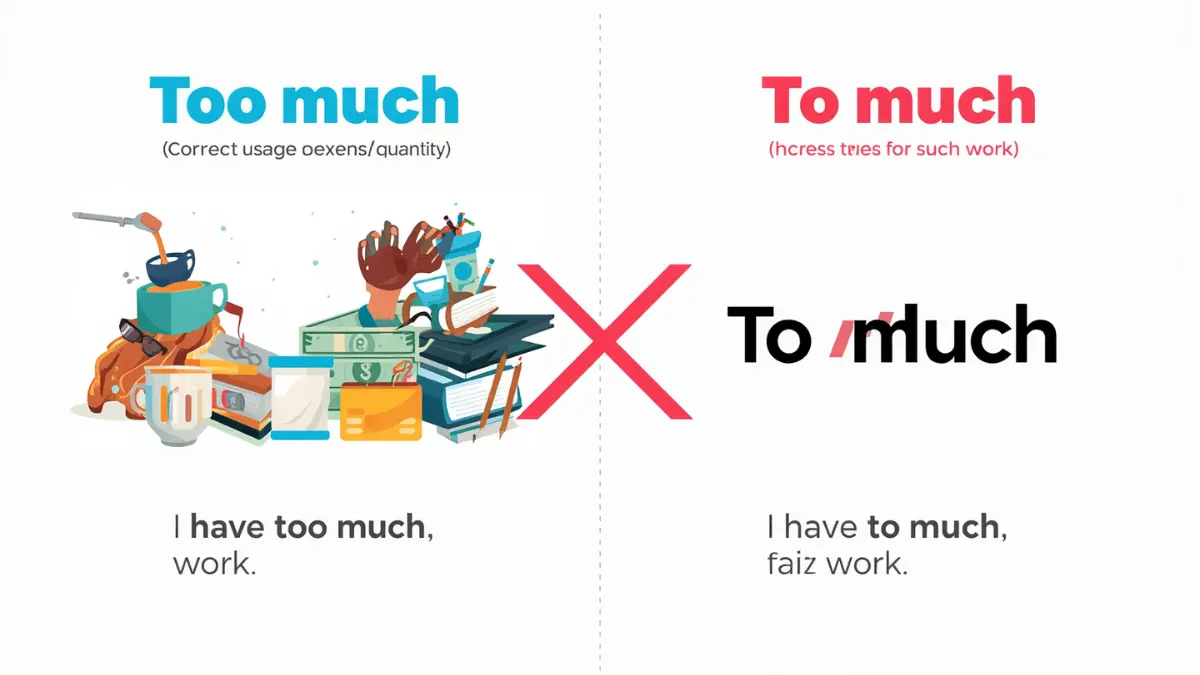
Have you ever written a sentence like “I have too much work” and paused, wondering if it looks right? Many English learners face this confusion daily, which is why people often search for “too much or to much” online. The problem is simple but important one tiny extra “o” completely changes the correctness of the sentence.
This mistake happens in emails, essays, social media posts, and even professional writing. “Too much” expresses excess or over-quantity, while “to much” is a spelling error that breaks grammar rules. Understanding too much or to much helps you write clearly, confidently, and professionally.
Even native speakers sometimes type it quickly without thinking. But in formal writing, this small error can make your English look weak or unpolished.
In this guide, you will learn the correct usage of too much or to much, their origin, grammar rules, common mistakes, real-life examples, FAQs, and expert tips. By the end, you will never confuse them again.
Too Much or To Much – Quick Answer
Simple Rule
- Too much = correct (means excess or more than needed)
- To much = incorrect spelling
Examples
✅ I have too much homework.
❌ I have to much homework.
✅ She talks too much.
❌ She talks to much.
Easy Memory Trick
- Too = Extra
- To = Direction or preposition (not used here)
Read more: Difference Between TransUnion and Equifax:
The Origin of Too Much or To Much
The confusion comes from the evolution of English words.
Origin of “Too”
The word too comes from Old English tō, meaning “also” or “in excess.” Over time, it developed a strong meaning of “more than needed.”
Origin of “To”
The word to comes from Old English tō, meaning direction, movement, or relationship between words.
Why Confusion Exists
The mistake happens because:
- “Too” and “to” sound the same
- Fast typing leads to missing an “o”
- Learners confuse grammar roles
- Auto-correct sometimes fails
But only “too much” is grammatically correct when expressing excess.
British English vs American English Spelling
There is no difference between British and American English for “too much.” Both use the same spelling and rule.
Read more: Difference Between Rabbit and Hare: Easy Guide ?
Comparison Table
| Usage | British English | American English |
| Correct form | Too much | Too much |
| Incorrect form | To much (wrong) | To much (wrong) |
| Meaning | Excess | Excess |
| Formal writing | Too much | Too much |
Examples
British English
- There is too much noise in the classroom.
American English
- There is too much traffic today.
Both follow the same grammar rule.
Which Spelling Should You Use?
The answer is simple: always use “too much.”
Use “Too Much” When:
- Talking about quantity
- Describing excess
- Writing formal or informal English
Examples
- There is too much sugar in the tea.
- He has too much work to finish.
- She spends too much time online.
Never Use “To Much”
- It is always incorrect in standard English
- It does not follow grammar rules
- It is considered a spelling mistake
Global Advice
No matter where you are:
- Always write too much
- Avoid “to much” completely
Common Mistakes with Too Much or To Much
Mistake 1
❌ I have to much stress.
✅ I have too much stress.
Mistake 2
❌ She eats to much sugar.
✅ She eats too much sugar.
Mistake 3
❌ There is to much noise here.
✅ There is too much noise here.
Mistake 4
❌ He talks to much in class.
✅ He talks too much in class.
Too Much or To Much in Everyday Examples
In Emails
- There is too much delay in the project.
- We have too much work pending.
In News Writing
- The city is facing too much pollution.
- There is too much pressure on the healthcare system.
On Social Media
- Too much coffee today ☕
- I studied too much for the exam 📚
In Formal Writing
- The system has too much load during peak hours.
- The report contains too much unnecessary data.
Too Much or To Much – Google Trends & Usage Data
Searches for “too much or to much” are very common because it is one of the most frequent spelling mistakes in English.
Popular Countries
| Country | Search Interest |
| India | Very High |
| United States | High |
| United Kingdom | High |
| Pakistan | Very High |
| Philippines | High |
Why People Search It
People search this keyword when:
- Writing essays
- Typing emails
- Posting on social media
- Preparing exams
- Learning English grammar
Common Contexts
| Situation | Usage Type |
| Academic writing | Too much |
| Casual speech | Too much |
| Social media | Too much |
| Professional writing | Too much |
Comparison Table: Too Much vs To Much
| Feature | Too Much | To Much |
| Correctness | Correct | Incorrect |
| Meaning | Excess amount | No meaning |
| Grammar use | Standard English | Mistake |
| Example | Too much noise | To much noise ❌ |
| Usage | Formal + informal | Never used |
FAQs About Too Much or To Much
What is the correct form: too much or to much?
The correct form is too much.
Why is “to much” wrong?
Because “to” and “too” have different meanings, and “to much” has no grammatical function.
Can I ever use “to much”?
No, it is always incorrect in standard English.
What does “too much” mean?
It means more than necessary or an excessive amount.
Is “too much” formal or informal?
It can be used in both formal and informal writing.
Why do people confuse too and to?
Because they sound the same in speech.
How can I remember the difference?
Think: Too = Extra, To = Direction
Conclusion
Understanding too much or to much is important for writing clear and correct English. Although the difference is small just one letter it completely changes the correctness of a sentence. “Too much” is the only correct form used to express excess or over-quantity, while “to much” is always a spelling mistake.
This error is very common in emails, essays, and social media posts because “too” and “to” sound identical. However, in professional writing, using the correct form helps you look more confident and polished.
The rule is simple: whenever you want to express something that is more than needed, always use too much. Never use “to much” in any situation.
With regular practice, this mistake becomes easy to avoid. Mastering small grammar details like this improves your English clarity and makes your communication more effective in both personal and professional life.

Henry is a passionate English professor, language specialist, and the founder of SpellCompare.com. With years of academic experience and a deep understanding of grammar, vocabulary, and linguistic nuances, he has dedicated his career to helping students and writers master the English language with clarity and confidence.
As an expert in word comparisons, spelling differences, and grammar rules, Henry simplifies complex language concepts into easy-to-understand explanations. His mission is to eliminate confusion between commonly misused words and provide accurate, research-based guidance that improves writing skills for learners worldwide.
Through SpellCompare.com, Henry combines academic expertise with practical examples, creating content that is clear, reliable, and reader-friendly. His work focuses on precision, correctness, and helping others communicate effectively in both academic and professional settings.
When he’s not teaching or writing, Henry continues researching evolving language trends to ensure his content remains current, helpful, and authoritative.