Have you ever seen someone write “Geez!” while another person wrote “Jeez!” and wondered which spelling is correct? This is a common question among English learners, writers, bloggers, and social media users. Both words appear frequently in conversations, movies, online comments, and everyday writing, which can make the choice confusing.
The confusion exists because geez and jeez sound exactly the same. They are both used to express surprise, annoyance, frustration, disbelief, or excitement. However, many people are unsure whether one spelling is more correct, more formal, or more common than the other.
The good news is that both forms are recognized in English. Still, one spelling is used far more often than the other in modern writing. Understanding the difference can help you communicate naturally and choose the spelling that fits your audience.
In this guide, you’ll learn the meaning of geez or jeez, their origins, usage differences, examples, popularity trends, and professional advice on which spelling you should use.
Geez or Jeez – Quick Answer
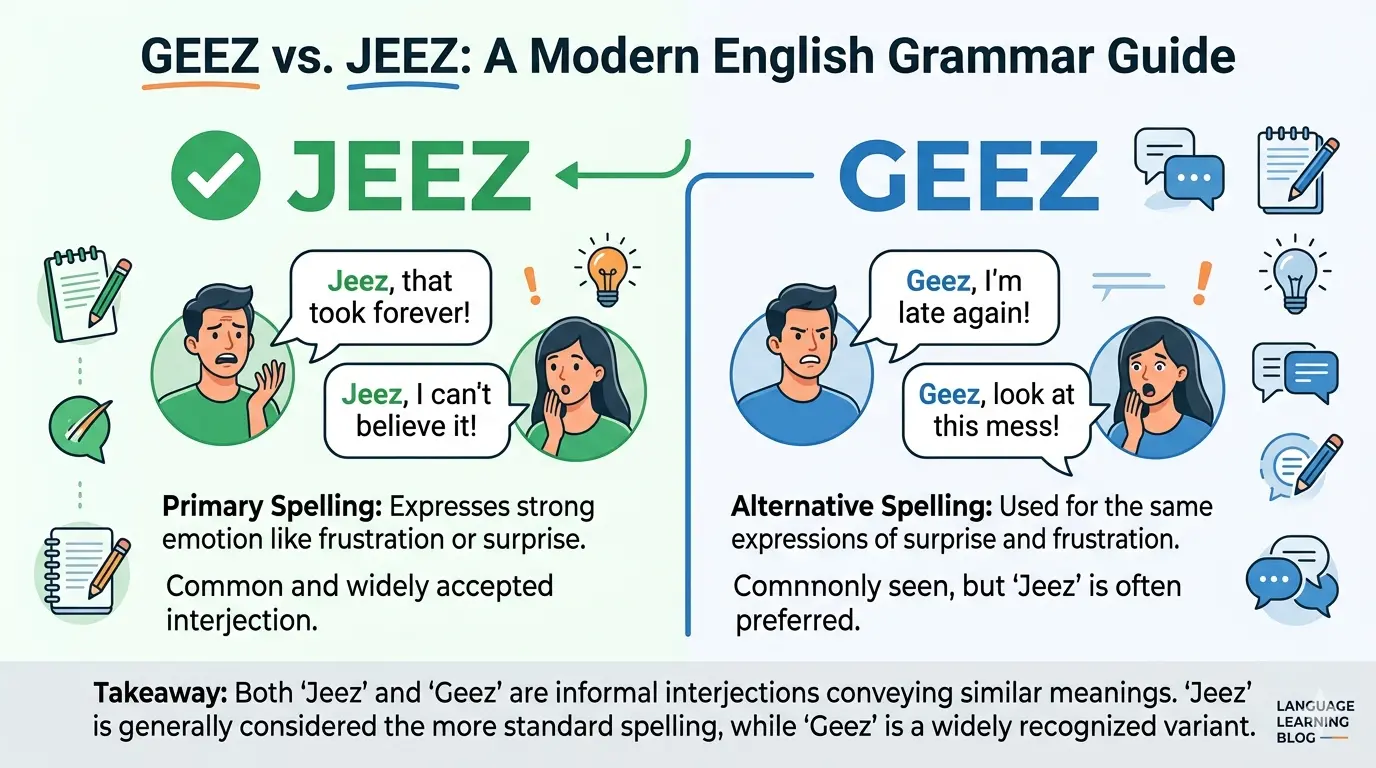
Both geez and jeez are correct.
However, jeez is much more common in modern English.
Both words are mild exclamations used to show:
- Surprise
- Frustration
- Annoyance
- Amazement
- Disbelief
Examples
✅ Jeez, that was close!
✅ Jeez, I forgot my keys again.
✅ Geez, that’s a lot of homework.
✅ Geez, can you slow down?
In everyday writing, jeez is usually the preferred spelling.
Read more; Master’s or Masters: What’s the Correct Form
The Origin of Geez or Jeez
The words geez and jeez developed as mild substitutes for the name Jesus.
Historically, English speakers often created softer versions of religious expressions to avoid using sacred names directly.
Examples include:
| Original Expression | Mild Substitute |
| Jesus! | Jeez! |
| God! | Gosh! |
| Damn! | Darn! |
Over time, jeez became the dominant spelling because it better reflects pronunciation in modern English.
The spelling geez also developed naturally since the “g” sound can sometimes represent the same sound in English words.
Read more: Difference Between Couch and Sofa: Simple Guide for Everyday
As language evolved, both spellings became accepted, though jeez gained wider popularity.
British English vs American English Spelling
Unlike words such as colour/color or organise/organize, there is no strict British-American spelling rule for geez and jeez.
Both forms can appear in British and American English.
Comparison Table
| Expression | British English | American English |
| Jeez | Common | Very Common |
| Geez | Less Common | Less Common |
Examples
British English
- Jeez, that’s expensive.
American English
- Jeez, I can’t believe that happened.
While both spellings exist, jeez is more widely used in both regions.
Which Spelling Should You Use?
The best choice depends on your audience and writing style.
For US Audiences
Use jeez. It is the most familiar spelling.
For UK Audiences
Use jeez. Readers will recognize it immediately.
For Canada, Australia, and New Zealand
Use jeez for consistency and clarity.
For Global Audiences
Use jeez because it is the most common version worldwide.
When Can You Use Geez?
You can use geez in informal writing, personal messages, or creative dialogue. However, it may look unusual to some readers.
Common Mistakes with Geez or Jeez
Many writers make simple errors when using these expressions.
Mistake 1: Thinking One Is Wrong
❌ Geez is incorrect.
✅ Both geez and jeez are accepted spellings.
Mistake 2: Using Them in Formal Reports
❌ Jeez, the company lost money.
✅ The company reported financial losses.
Mistake 3: Overusing Exclamations
❌ Jeez! Jeez! Jeez!
✅ Jeez, that’s surprising.
Mistake 4: Using Them in Academic Writing
❌ Geez, the results were unexpected.
✅ The results were unexpected.
Geez or Jeez in Everyday Examples
“Jeez, I completely forgot about the meeting.”
News Conversation
“Jeez, that’s a surprising result.”
Social Media
“Jeez, what a game!”
Text Message
“Geez, traffic is terrible today.”
Casual Conversation
“Jeez, that movie was amazing.”
Informal Blog Writing
“Geez, learning English can be confusing sometimes.”
Geez or Jeez – Google Trends & Usage Data
Usage data consistently shows that jeez is more popular than geez.
Popularity by Country
| Country | Most Common Form |
| United States | Jeez |
| United Kingdom | Jeez |
| Canada | Jeez |
| Australia | Jeez |
| New Zealand | Jeez |
Why Jeez Is More Popular
- It matches modern pronunciation.
- It appears more often in media and entertainment.
- Dictionaries commonly list it first.
- Social media users prefer it.
- Readers recognize it more quickly.
Although geez still appears online, jeez dominates everyday usage.
Geez vs Jeez Comparison Table
| Feature | Geez | Jeez |
| Correct Spelling | ✅ Yes | ✅ Yes |
| Modern Popularity | Moderate | High |
| Common in Social Media | Yes | Very Common |
| Informal Writing | Yes | Yes |
| Formal Writing | Not Recommended | Not Recommended |
| Global Recognition | Good | Excellent |
| Preferred Choice | Sometimes | Usually |
Frequently Asked Questions (FAQs)
1. Is geez or jeez correct?
Both spellings are correct, but jeez is more common.
2. Which spelling is more popular?
Jeez is significantly more popular in modern English.
3. Is geez a real word?
Yes. It is a recognized informal exclamation.
4. Can I use jeez in professional writing?
It is best avoided in formal or professional documents.
5. Why do people say jeez?
People use it to express surprise, frustration, shock, or disbelief.
6. Do British people use jeez?
Yes. Both British and American speakers use jeez.
7. Is jeez offensive?
Generally, no. It is considered a mild and informal expression.
Conclusion
The choice between geez and jeez is easier than many people think. Both spellings are accepted in English and both express surprise, annoyance, frustration, or amazement. However, jeez has become the dominant spelling in modern writing and speech. It appears more often in books, websites, social media posts, movies, and everyday conversations.
While geez is not incorrect, it is less common and may look unusual to some readers. If your goal is clear communication and broad audience recognition, jeez is usually the safest choice. This applies to American English, British English, Canadian English, Australian English, and most other English-speaking regions.
Remember that both words are informal expressions. They work well in casual conversations, text messages, social media posts, and creative writing. For professional, academic, or formal communication, it is usually better to choose a more neutral language. When in doubt, use jeez and your writing will sound natural, modern, and widely understood.

SwiftHarbor is a dedicated English professor, language researcher, and the founder of SpellCompare.com. With years of academic experience in English grammar, vocabulary development, and linguistic comparison, SwiftHarbor specializes in simplifying complex language rules into clear, practical explanations.
As an expert in word usage, spelling differences, and commonly confused terms, SwiftHarbor has helped thousands of learners improve their writing accuracy and communication skills. Through SpellCompare.com, he provides detailed comparisons, easy examples, and research-based insights that make English learning accessible for students, writers, and professionals worldwide.
Known for a clear teaching style and structured explanations, SwiftHarbor focuses on eliminating confusion between similar words, improving grammar confidence, and promoting precise communication. His mission is simple: to make English easier, clearer, and more powerful for everyone.