Have you ever typed peek when you meant peak, or vice versa? You’re not alone. These two words sound exactly the same, making them one of the most commonly confused pairs in English. Because they are homophones words that share the same pronunciation but have different meanings many students, writers, and professionals accidentally use the wrong one.
The confusion often appears in phrases like “sneak peek”, where some people mistakenly write “sneak peak.” While both peek and peak are real English words, they have completely different meanings and should never be used interchangeably.
Understanding the difference between peek or peak will help you write more accurately in emails, school assignments, business documents, social media posts, and professional articles. In this guide, you’ll learn the meaning of each word, their origins, common mistakes, regional usage, and practical examples.
By the end of this article, you’ll know exactly when to use peek and when to use peak, making your writing clearer and more professional.
Peek or Peak – Quick Answer
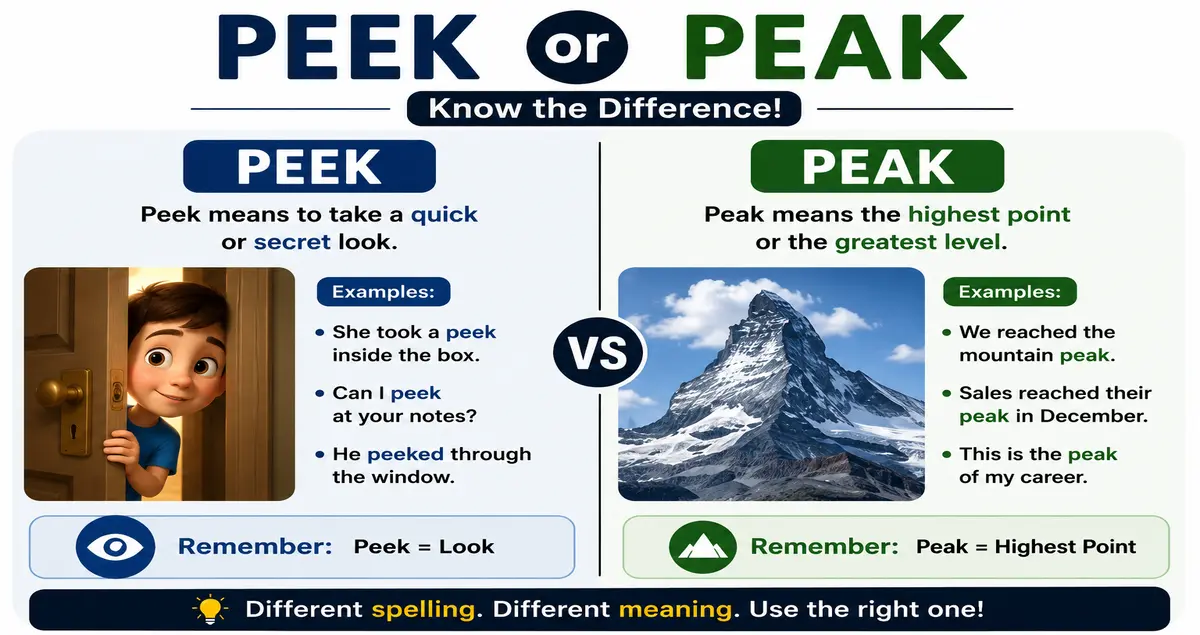
The quick answer is:
- Peek means to take a quick or secret look.
- Peak means the highest point or highest level of something.
Examples
Peek
- She took a peek inside the gift.
- Can I peek at your notes?
Peak
- We reached the mountain peak.
- Sales reached their peak in December.
Remember:
- Peek = Look
- Peak = Highest Point
Read more: Onsite or On Site: Differences, and Correct Usage
The Origin of Peek or Peak
Although they sound alike, peek and peak have different histories.
Peek
The word peek first appeared in the English language during the 17th century. It means to glance quickly or secretly.
Examples:
- Peek through the window.
- Peek behind the curtain.
Peak
The word peak comes from an older word meaning a pointed mountain top.
Over time, its meaning expanded to include:
- Highest point
- Greatest level
- Maximum performance
Examples:
- Peak performance
- Mountain peak
- Peak season
Because both words are pronounced the same, many writers confuse them.
Read more: In-Person or In Person: What’s the Correct Usage and Spelling?
British English vs American English Spelling
There is no spelling difference between British and American English.
Both countries use:
- Peek
- Peak
Comparison Table
| Feature | British English | American English |
| Peek | ✔ Correct | ✔ Correct |
| Peak | ✔ Correct | ✔ Correct |
| Pronunciation | Same | Same |
| Meaning | Same | Same |
The meanings remain identical worldwide.
Which Spelling Should You Use?
Choosing the correct word depends entirely on its meaning.
Use “Peek” When You Mean:
- A quick look
- A secret glance
- Looking briefly
Examples:
- Take a peek.
- Sneak peek.
- Peek through the door.
Use “Peak” When You Mean:
- Highest point
- Maximum level
- Top of a mountain
- Best performance
Examples:
- Peak season
- Peak performance
- Mountain peak
For Global Audiences
Since there is no regional difference, simply choose the word that matches your intended meaning.
Common Mistakes with Peek or Peak
Mistake 1: Writing “Sneak Peak”
❌ Here’s a sneak peak.
✅ Here’s a sneak peek.
Mistake 2: Confusing Mountain Peak
❌ We climbed to the mountain peek.
✅ We climbed to the mountain peak.
Mistake 3: Using Peek for Maximum Level
❌ Demand reached its peek.
✅ Demand reached its peak.
Common Corrections Table
| Incorrect | Correct |
| Sneak Peak | Sneak Peek |
| Mountain Peek | Mountain Peak |
| Peak Through Window | Peek Through Window |
| Sales Peeked | Sales Peaked |
Peek or Peak in Everyday Examples
Emails
- Here’s a sneak peek of our new website.
News
- Tourism reaches its peak during summer.
Social Media
- Take a peek at our latest collection!
Business Writing
- Demand peaked during the holiday season.
Travel
- We finally reached the mountain peak.
Education
- Students peeked at the answers before the quiz.
Peek or Peak – Google Trends & Usage Data
Search data shows that both words are searched frequently because they sound identical.
Peek
Most commonly used in:
- Marketing
- Entertainment
- Publishing
- Everyday conversations
Popular phrases:
- Sneak peek
- Peek inside
- Quick peek
Peak
Most commonly used in:
- Business
- Sports
- Geography
- Weather
- Economics
Popular phrases:
- Peak performance
- Peak season
- Mountain peak
Usage Comparison
| Word | Primary Meaning |
| Peek | Quick look |
| Peak | Highest point |
Many people search peek or peak to learn which word fits their sentence.
Peek vs Peak Comparison Table
| Feature | Peek | Peak |
| Part of Speech | Verb/Noun | Noun/Adjective/Verb |
| Meaning | Quick glance | Highest point |
| Example | Take a peek | Mountain peak |
| Used in Sneak Peek | ✔ Yes | ✘ No |
| Used in Peak Performance | ✘ No | ✔ Yes |
| Common Context | Looking | Height, success, maximum |
FAQs
1. What is the difference between peek and peak?
Peek means a quick look, while peak means the highest point or level.
2. Is it sneak peek or sneak peak?
The correct phrase is sneak peek because peek means a quick look.
3. Can peak be used as a verb?
Yes. It can mean to reach the highest level.
Example:
- Sales peaked in July.
4. Is peek always a verb?
No. It can also be a noun.
Example:
- Have a peek inside.
5. Is there a British spelling difference?
No. Both British and American English use peek and peak with the same meanings.
6. Why are peek and peak confusing?
They are homophones, meaning they sound the same but have different meanings and spellings.
7. How can I remember the difference?
Think:
- Peek = Look
- Peak = Point at the top
This simple trick makes it easy to choose the correct word.
Conclusion
When comparing peek or peak, the difference comes down to meaning rather than spelling rules. Peek refers to taking a quick or secret look, while peak refers to the highest point, greatest level, or top of something. Although the words sound exactly alike, they are not interchangeable.
A useful memory trick is to remember that peek is connected with looking, while peak is connected with the top of a mountain or the highest level of success. This simple association can help you avoid one of the most common English spelling mistakes.
Whether you’re writing emails, blog posts, business reports, or social media updates, choosing the correct word will make your writing clearer and more professional. The next time you hesitate between peek and peak, think about whether you’re talking about looking or reaching the top and you’ll always choose the right word.

My name is SwiftSphere, and I am a passionate English language author and the creator of Spellcompare.com. I specialize in word comparisons, grammar clarity, and simplifying confusing English terms for readers around the world.
As a professional writer, I focus on breaking down commonly misunderstood words, phrases, and language rules into clear, practical explanations. My goal is to make English easier, more accurate, and more accessible for students, professionals, and everyday learners.
Through Spellcompare.com, I provide well-researched, easy-to-understand content that helps readers confidently choose the right words in writing and speech. Whether it’s comparing similar spellings, explaining grammar rules, or clarifying tricky vocabulary, I am committed to delivering precise and reliable guidance.
I believe that strong language skills create strong communication — and strong communication creates opportunity. That belief drives my work every day.