Many English learners, writers, students, and professionals get confused about writing “in-person” or “in person.” At first, they look almost the same, but the hyphen changes how the phrase works in a sentence.
This small detail often creates doubt in emails, essays, job applications, and online content. People search for this keyword because they want to sound correct, natural, and professional in English writing.
The confusion usually comes from grammar rules about hyphens and adverbs. Sometimes “in-person” works like an adjective before a noun, while “in person” is used as an adverb after a verb. If you use the wrong form, your sentence may look slightly incorrect to native readers.
This article will clearly explain the difference in very simple language. You will learn when to use each form, why both are correct, and how native speakers use them in real life. By the end, you will never mix them up again in writing or speaking.
In-Person or In Person – Quick Answer
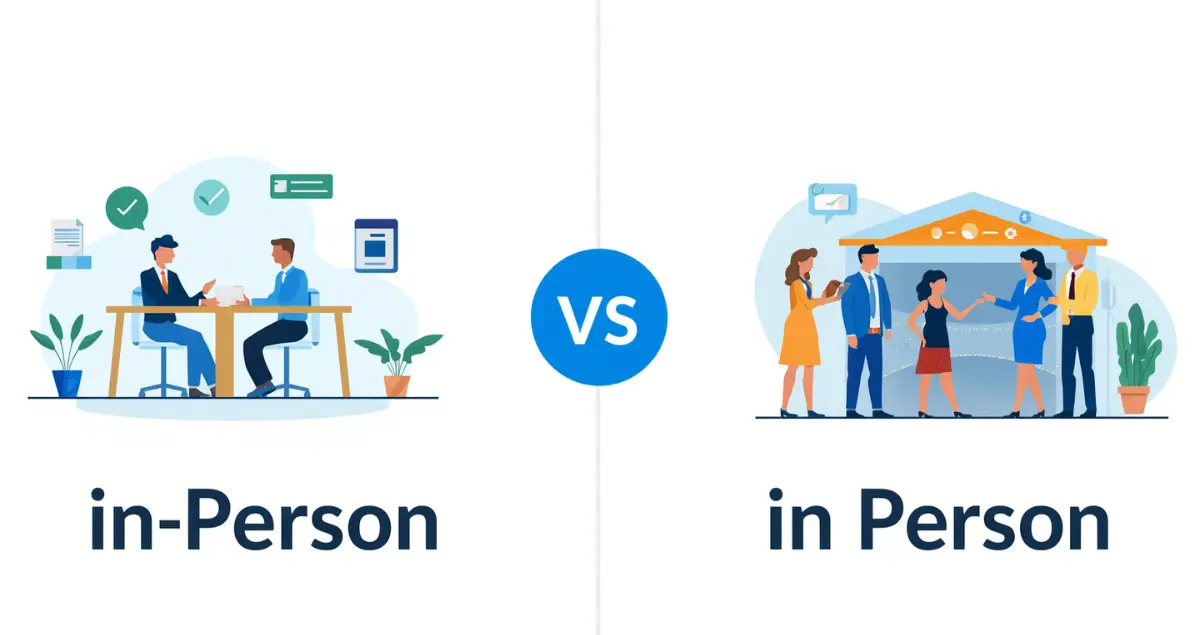
- In-person (with hyphen) → Used as an adjective before a noun
Example: We had an in-person meeting. - In person (without hyphen) → Used as an adverb after a verb
Example: We met in person.
Simple rule:
- Before a noun = in-person
- After a verb = in person
Read more: Other Than or Other Then: Which Spelling Is Correct ?
The Origin of In-Person / In Person
The phrase comes from Latin roots:
- “in persona” = “in the body of a person”
Over time, English adopted it to mean meeting someone physically instead of online or by phone.
The hyphen form “in-person” developed later to help readers understand it as a single describing word (adjective). English writers added hyphens to avoid confusion in sentences.
British English vs American English Spelling
Both British and American English use in-person and in person in the same way. There is no major spelling difference between UK and US usage for this phrase.
However, style preferences differ slightly:
- American English: more frequent use of hyphenated adjectives
- British English: sometimes more flexible with hyphens in informal writing
Read more: Deeply Seeded or Seated: What’s the Correct Word ?
Comparison Table
| Usage Type | Correct Form | Example |
| Adjective | in-person | in-person interview |
| Adverb | in person | meet in person |
| Formal writing | in-person / in person | Same in both UK & US |
| Informal writing | in-person / in person | Same in both |
Which Spelling Should You Use?
- USA writers: Use both forms correctly based on grammar rules
- UK/Commonwealth writers: Same rule applies
- Global English users: Follow grammar function, not country style
👉 Best advice:
Focus on sentence structure, not location.
Common Mistakes with In-Person or In Person
❌ We had a in person meeting (wrong article + wrong form)
✔ We had an in-person meeting
❌ I met him in-person yesterday
✔ I met him in person yesterday
❌ The in person class was good (missing hyphen)
✔ The in-person class was good
In-Person or In Person in Everyday Examples
Emails:
- We request an in-person interview next week.
News:
- The president met leaders in person.
Social Media:
- Finally meeting my favorite creator in person!
Formal Writing:
- The training will be conducted in-person at the headquarters.
In-Person or In Person – Google Trends & Usage Data
Search trends show:
- Higher searches in India, Pakistan, and ESL countries
- Strong usage in USA and UK for writing clarity
- Increased interest after remote work and online meetings became common
Why?
People often switch between online and offline communication, so they need correct grammar for both contexts.
Comparison Table: In-Person vs In Person
| Phrase | Type | Position in Sentence | Meaning |
| in-person | Adjective | Before noun | Physical meeting/activity |
| in person | Adverb | After verb | Physically present |
FAQs
1. Is “in-person” always correct?
Yes, when used before a noun as a description.
2. Is “in person” grammatically correct?
Yes, it is correct when used after a verb.
3. Can I use “in-person” in speaking?
Yes, but hyphens are mainly for writing.
4. Which is more common?
Both are equally common depending on sentence use.
5. Is “in person meeting” correct?
No, it should be “in-person meeting.”
6. Do British and American English differ here?
No, both follow the same rule.
7. Can I replace it with “physically”?
Sometimes, but it changes tone slightly.
Conclusion
The difference between “in-person” and “in person” is simple once you understand grammar rules. The hyphenated form is used when the phrase describes a noun, while the open form is used when it describes an action. Both are correct, and neither is more “English” than the other.
This confusion is common because English uses hyphens in flexible ways. Many learners mix them up, especially in professional writing. However, once you remember the rule before noun = in-person, after verb = in person you will avoid mistakes easily.
Using the correct form improves clarity, professionalism, and writing confidence. If you are writing emails, essays, or business documents, this small detail makes your English look more natural and polished.

My name is SwiftSphere, and I am a passionate English language author and the creator of Spellcompare.com. I specialize in word comparisons, grammar clarity, and simplifying confusing English terms for readers around the world.
As a professional writer, I focus on breaking down commonly misunderstood words, phrases, and language rules into clear, practical explanations. My goal is to make English easier, more accurate, and more accessible for students, professionals, and everyday learners.
Through Spellcompare.com, I provide well-researched, easy-to-understand content that helps readers confidently choose the right words in writing and speech. Whether it’s comparing similar spellings, explaining grammar rules, or clarifying tricky vocabulary, I am committed to delivering precise and reliable guidance.
I believe that strong language skills create strong communication — and strong communication creates opportunity. That belief drives my work every day.