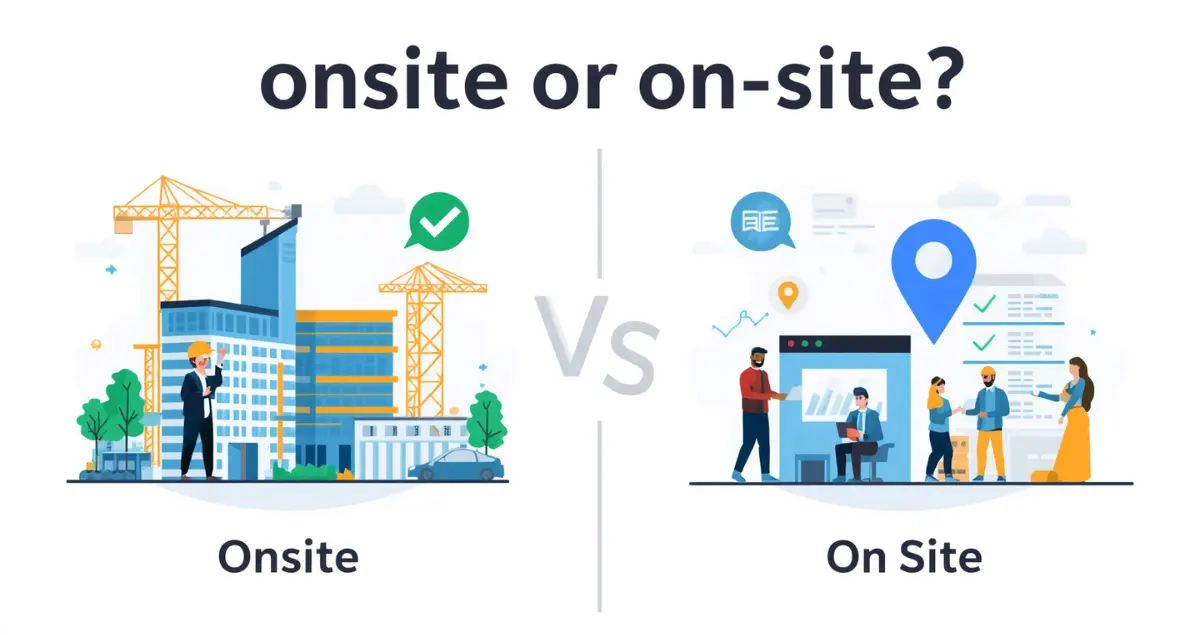
Many people get confused when writing the term “onsite” or “on site.” You may see both versions in job posts, business reports, construction updates, and IT services. This creates doubt: which one is correct? Are they different words, or just spelling variations?
This confusion is very common because English allows different spelling styles depending on region and usage. Some writers prefer the single-word form “onsite,” while others use the two-word form “on site.” Both are used in professional writing, but their meaning and style can slightly change depending on context.
People often search this keyword when writing resumes, business emails, job descriptions, or academic content. They want to avoid mistakes and sound professional. The real issue is not about grammar style, regional English (US vs UK), and how formal the writing is.
In this article, you will clearly understand the difference between “onsite” and “on site,” when to use each one, and how professionals use them in real communication. You will also see examples, mistakes to avoid, and a simple comparison so you never get confused again.
Onsite or On Site – Quick Answer → Short Direct Explanation
“On site” (two words) is the traditional and most widely accepted form, especially in formal British English. It means something located at a specific place.
Example:
- The technician is working on site today.
“Onsite” (one word) is a modern, simplified version commonly used in American English, business writing, and digital platforms.
Example:
- We offer onsite training for employees.
👉 Both are correct, but usage depends on style and region.
Read more: 5 Letter Word Ending in OR: Meaning and Usage Guide
The Origin of Onsite / On Site
The phrase originally comes from combining:
- “on” (preposition)
- “site” (location or place)
Earlier English writing always used two words: on site, meaning “at the location.”
Over time, especially in business and technical English, writers started merging words for faster communication. This is how onsite became common in modern usage.
This change is similar to other English evolutions like:
- “on line” → “online”
- “e-mail” → “email”
So, “onsite” is a linguistic evolution, while “on site” is the traditional grammatical form.
Read more: Whomever or Whomsoever: When to Use Each Correctly?
British English vs American English Spelling
| Feature | On Site | Onsite |
| Region | UK, Commonwealth | USA, business English |
| Style | Formal, traditional | Modern, simplified |
| Usage | Academic, official writing | Corporate, tech, HR |
| Example | The team is on site | Onsite support is available |
British English prefers clarity and traditional spacing.
American English prefers shorter, merged words.
Which Spelling Should You Use?
- UK / Commonwealth users → Use on site
- US users → Use onsite
- Global business writing → Either is fine, but stay consistent
- Academic writing → Prefer on site
- Tech / IT / HR content → Prefer onsite
👉 Golden rule: Consistency matters more than choice.
Common Mistakes with Onsite / On Site
❌ Wrong: The engineer is onsite the location
✔ Correct: The engineer is on site
❌ Wrong: We provide on-site training (mixed random hyphen use without style rule)
✔ Correct: We provide onsite training OR on-site training (choose one style)
❌ Wrong: He is working onsite at the factory
✔ Correct: He is working on site at the factory
👉 Main mistake: mixing styles in the same document.
Onsite in Everyday Examples
Emails:
- The manager will be on site tomorrow for inspection.
Job Descriptions:
- This role requires onsite presence five days a week.
Business Communication:
- Our team provides onsite technical support.
Social Media:
- Excited for onsite training with the new team!
Formal Reports:
- All maintenance work was completed on site.
Onsite or On Site – Google Trends & Usage Data
Search behavior shows:
- “onsite” is more popular in USA, India, and tech industries
- “on site” is more common in UK, academic writing, and government content
- Digital platforms (job boards, IT services) mostly prefer “onsite”
👉 Trend insight:
Modern business communication is shifting toward onsite, but formal English still prefers on site.
Comparison Table: Onsite vs On Site
| Category | On Site | Onsite |
| Form | Two words | One word |
| Formality | High | Medium |
| Usage | Traditional English | Modern business English |
| Writing style | Academic/legal | Corporate/tech |
| Meaning | At a physical place | At a physical place |
FAQs about Onsite or On Site
1. Is “onsite” grammatically correct?
Yes, it is correct in modern English, especially in business and tech writing.
2. Is “on site” more formal?
Yes, it is more traditional and preferred in formal British English.
3. Do both mean the same thing?
Yes, both mean “at a physical location.”
4. Which is better for resumes?
“Onsite” is more common in modern resumes and job descriptions.
5. Can I use both in one document?
No, always choose one style and stay consistent.
6. Is “on-site” with a hyphen correct?
Yes, “on-site” is also used as an adjective in some styles (e.g., on-site training).
7. What is most used globally?
“Onsite” is becoming more popular globally in digital industries.
Conclusion
The confusion between “onsite” and “on site” is very common, but the meaning is simple. Both terms refer to something located at a physical place. The difference is not in meaning but in writing style and regional preference.
“On site” is the traditional form used in British English, academic writing, and formal documents. It keeps the phrase separated and follows classic grammar rules. On the other hand, “onsite” is a modern, simplified version widely used in American English, business communication, IT, HR, and job postings.
The most important rule is consistency. Once you choose a style, stick with it throughout your writing. Mixing both forms in one document can look unprofessional.
For students and formal writers, “on site” is safer. For business, tech, and modern communication, “onsite” is widely accepted and often preferred.
Understanding this small difference helps you write more clearly, avoid mistakes, and appear more professional in emails, resumes, and reports. If you choose “onsite” or “on site,” both are correct as long as you use them correctly and consistently.

SwiftHarbor is a dedicated English professor, language researcher, and the founder of SpellCompare.com. With years of academic experience in English grammar, vocabulary development, and linguistic comparison, SwiftHarbor specializes in simplifying complex language rules into clear, practical explanations.
As an expert in word usage, spelling differences, and commonly confused terms, SwiftHarbor has helped thousands of learners improve their writing accuracy and communication skills. Through SpellCompare.com, he provides detailed comparisons, easy examples, and research-based insights that make English learning accessible for students, writers, and professionals worldwide.
Known for a clear teaching style and structured explanations, SwiftHarbor focuses on eliminating confusion between similar words, improving grammar confidence, and promoting precise communication. His mission is simple: to make English easier, clearer, and more powerful for everyone.