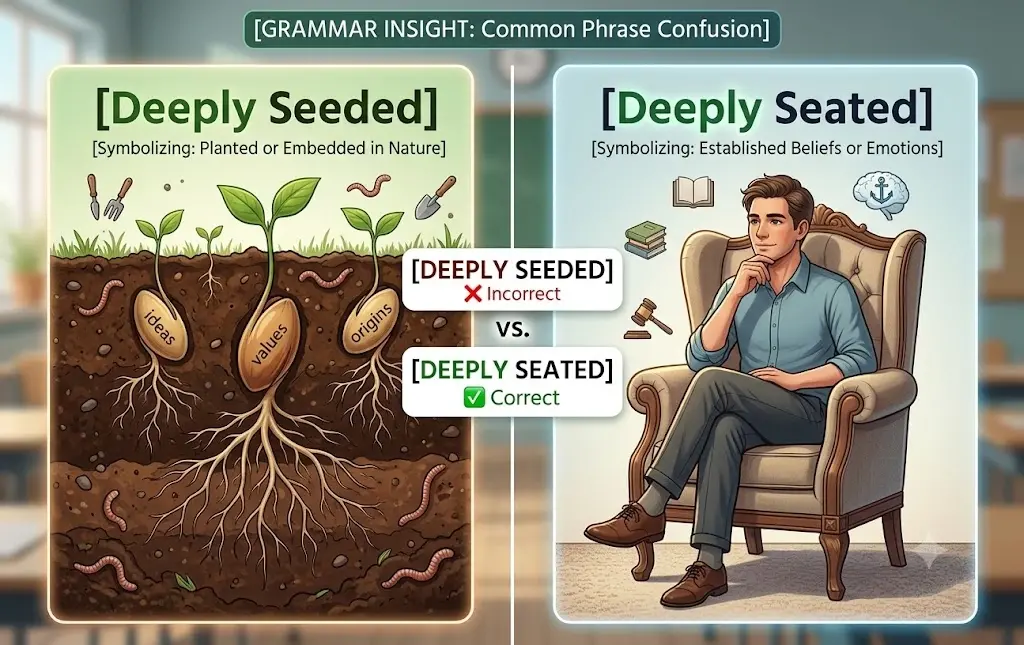
Many people get confused when they see or hear the phrase “deeply seeded” or “deeply seated.” It sounds similar, but only one form is correct in standard English. This confusion often appears in writing, emails, news articles, and even social media posts.
The main problem is that both “seeded” and “seated” are real English words. Because of this, people assume either version might be correct. However, the true idiom is not actually either of these common guesses. The correct phrase is “deep-seated.”
People search for this keyword because they want to avoid grammar mistakes and sound professional in writing. It is also commonly misunderstood in emotional or psychological contexts, such as “deep-seated fear” or “deep-seated belief.”
In this article, you will clearly learn the correct spelling, meaning, origin, and usage. You will also see why “deeply seeded” and “deeply seated” are wrong in most cases. By the end, you will know exactly how to use this phrase with confidence in both formal and informal writing.
Deeply Seeded or Seated – Quick Answer
The correct phrase is “deep-seated.”
It means something deeply fixed, strong, or long-lasting, especially emotions, beliefs, or problems.
Examples:
- He has a deep-seated fear of failure.
- There is a deep-seated belief in tradition.
- The issue is deep-seated and hard to change.
Important Note:
- ❌ Deeply seeded (incorrect in this meaning)
- ❌ Deeply seated (rare and incorrect in modern usage)
- ✅ Deep-seated (correct idiom)
Read more: Difference Between Parfum and Perfume: Which One Suits You ?
The Origin of Deep-Seated
The phrase “deep-seated” comes from the idea of something being “seated” or placed deeply inside.
- “Seated” here does not mean sitting in a chair.
- It means “firmly fixed” or “established.”
This usage comes from older English where “seat” meant a place where something is located or settled. Over time, it became a figurative expression.
So, “deep-seated” literally means:
Something placed deeply and firmly inside the mind, body, or system.
This is why it is used for emotions, beliefs, and problems that are not easy to remove.
British English vs American English Spelling
Good news: both British and American English use “deep-seated.”
There is no official spelling difference between UK and US English for this phrase.
However, confusion happens because:
Read more: Difference Between Supercharger and Procharger : Ultimate Guide
- Americans often mishear it as “deep seeded”
- British speakers sometimes simplify pronunciation, causing spelling errors
Key Point:
The correct form stays the same in all English varieties.
Comparison Table
| Incorrect Forms | Correct Form | Meaning |
| Deeply seeded | Deep-seated | Strong, fixed belief/emotion |
| Deeply seated | Deep-seated | Firmly established idea |
| Deep seeded fear | Deep-seated fear | Persistent fear |
Which Spelling Should You Use?
Here is simple guidance based on audience:
- US English: Use deep-seated only
- UK English: Use deep-seated only
- Canada / Australia / Global English: Use deep-seated only
Simple Rule:
If you are writing anything formal, academic, or professional, always use deep-seated.
Avoid “seeded” and “seated” unless you are talking about literal seating or planting seeds.
Common Mistakes with Deep-Seated
Many writers make these errors:
1. Writing “deep seeded”
- ❌ Wrong: deep seeded anger
- ✅ Correct: deep-seated anger
2. Thinking it relates to farming or seeds
People think “seeded” comes from agriculture. It does not.
3. Using “deeply seated” in modern writing
This is outdated and rarely accepted today.
4. Overthinking grammar rules
There is no plural or tense change needed:
- deep-seated fear (not deep-seated fears unless plural context)
Deep-Seated in Everyday Examples
1. Emails (Professional)
- “The team addressed a deep-seated issue in communication.”
2. News Articles
- “The conflict has deep-seated political causes.”
3. Social Media
- “I finally overcame my deep-seated anxiety.”
4. Academic Writing
- “Researchers studied deep-seated cultural beliefs.”
5. Workplace Use
- “There is a deep-seated resistance to change in the company.”
Deep-Seated – Google Trends & Usage Data
Search behavior shows:
- Highest searches: United States, India, UK
- Common queries:
- “deep seeded meaning”
- “deep seated vs seeded”
- “is deeply seated correct”
Usage Insight:
- “Deep-seated” dominates formal writing worldwide
- “Deep seeded” appears mostly in casual search errors
- Grammar websites consistently correct users toward “deep-seated”
Conclusion from usage:
The phrase is globally standardized with no variation, but confusion remains high in search engines.
Comparison Table: Keyword Variations
| Variation | Correct? | Usage Type | Notes |
| Deep-seated | ✅ Yes | Formal/Correct | Standard idiom |
| Deeply seated | ❌ No | Rare/Old usage | Not recommended |
| Deeply seeded | ❌ No | Incorrect meaning | Confused with agriculture |
| Deep seeded | ❌ No | Informal error | Common typo |
FAQs about Deeply Seeded or Seated
1. What is the correct phrase: deeply seeded or seated?
The correct phrase is deep-seated, not deeply seeded or seated.
2. What does deep-seated mean?
It means something firmly fixed, such as emotions, beliefs, or fears.
3. Is deeply seated ever correct?
It is considered outdated and not used in modern English writing.
4. Why do people say deeply seeded?
Because “seeded” sounds similar, but it is a misunderstanding of the real word “seated.”
5. Can I use deep-seated in formal writing?
Yes, it is widely accepted in academic, business, and professional writing.
6. Is there a difference between US and UK spelling?
No. Both use deep-seated.
7. What is an example sentence?
“She has a deep-seated belief in honesty.”
Conclusion
The confusion between “deeply seeded,” “deeply seated,” and the correct form “deep-seated” is very common in English writing. Many people assume it relates to seeds or physical seating, but the true meaning is completely different.
The correct phrase, deep-seated, describes something firmly fixed in the mind or system. It is used for emotions, beliefs, fears, or problems that are not easy to remove. This makes it very useful in both formal and informal communication.
Both British and American English use the same spelling, so there is no regional difference to worry about. The key is simply remembering that “seeded” is incorrect in this context and “seated” is only correct in its older, less common form.
By understanding its origin and usage, you can now confidently use “deep-seated” in writing, emails, academic work, and daily conversation. Avoiding the common mistakes will also make your English sound more professional and accurate.

Henry is a passionate English professor, language specialist, and the founder of SpellCompare.com. With years of academic experience and a deep understanding of grammar, vocabulary, and linguistic nuances, he has dedicated his career to helping students and writers master the English language with clarity and confidence.
As an expert in word comparisons, spelling differences, and grammar rules, Henry simplifies complex language concepts into easy-to-understand explanations. His mission is to eliminate confusion between commonly misused words and provide accurate, research-based guidance that improves writing skills for learners worldwide.
Through SpellCompare.com, Henry combines academic expertise with practical examples, creating content that is clear, reliable, and reader-friendly. His work focuses on precision, correctness, and helping others communicate effectively in both academic and professional settings.
When he’s not teaching or writing, Henry continues researching evolving language trends to ensure his content remains current, helpful, and authoritative.