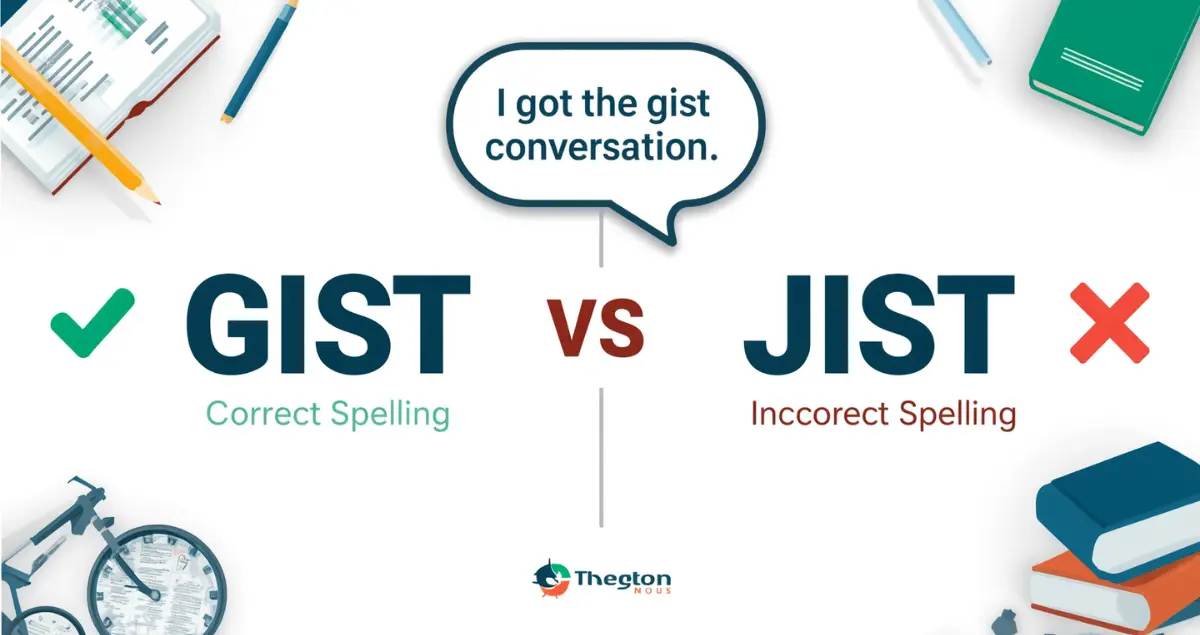
Have you ever written the phrase “I got the jist of it” and wondered if it was correct? You are not alone. Many English learners and native speakers search for “gist or jist” because both words sound the same when spoken.
The confusion comes from pronunciation. The word gist is pronounced with a soft “g” sound that sounds almost like the letter “j.” Because of this, many people mistakenly write jist instead of gist. Spell-check tools often catch the mistake, but it still appears in emails, social media posts, and even professional writing.
Understanding the difference is important because only one spelling is accepted in standard English. Using the correct spelling helps your writing look professional and clear.
In this guide, you’ll learn the quick answer, the history of the word, British and American English usage, common mistakes, real-life examples, and practical advice on which spelling to use.
Gist or Jist – Quick Answer
Gist is the correct spelling.
Jist is a misspelling of the word gist.
Examples
✅ Correct: Can you give me the gist of the article?
✅ Correct: I understand the gist of the meeting.
❌ Incorrect: Can you give me the jist of the article?
❌ Incorrect: I got the jist of what you said.
Meaning of Gist
The word gist means:
The main point or essential meaning of something.
Example:
“I didn’t read the full report, but I understood the gist.”
Read more: Acknowledgement or Acknowledgment: Which Is Correct?
The Origin of Gist or Jist
The word gist has an interesting history. It comes from an old French legal term “gésir,” meaning “to lie” or “to rest.”
In English law, the term referred to the essential part of a legal case. Over time, the meaning expanded to describe the central point or core idea of any subject.
Why Does Confusion Exist?
The confusion happens because gist is pronounced like “jist.”
For example:
- Gift → hard “g”
- Gist → soft “g” (sounds like j)
Many people hear the word before they see it written. As a result, they assume it starts with the letter “j.”
However, dictionaries recognize only gist as the standard spelling.
British English vs American English Spelling
Unlike many English words, gist has the same spelling in both British and American English.
There is no regional spelling difference.
Read more: And/Or: Meaning, Usage and When to Use It Correctly?
Comparison Table
| English Version | Correct Spelling | Example |
| American English | Gist | I got the gist of the discussion. |
| British English | Gist | She explained the gist of the report. |
| Canadian English | Gist | Tell me the gist of the message. |
| Australian English | Gist | I understand the gist now. |
| New Zealand English | Gist | What’s the gist of the article? |
Key Point
Whether you write for a US, UK, Canadian, Australian, or global audience, gist remains the correct spelling.
Which Spelling Should You Use?
The answer is simple.
For American Audiences
Use gist.
Example:
“Can you summarize the gist of the proposal?”
For British Audiences
Use gist.
Example:
“The gist of the report was positive.”
For Commonwealth Countries
Use gist.
Countries include:
- Canada
- Australia
- New Zealand
- South Africa
For Global Communication
Always use gist.
The spelling jist may appear in informal writing, but it is not considered correct standard English.
Common Mistakes with Gist or Jist
Many writers make mistakes because they spell the word based on how it sounds.
Mistake #1: Writing “Jist”
❌ I got the jist.
✅ I got the gist.
Mistake #2: Using It as a Verb
❌ Can you gist the article for me?
✅ Can you summarize the article for me?
Mistake #3: Confusing Meaning
Some people think gist means a detailed explanation.
Actually, it means the opposite.
❌ The gist contains every detail.
✅ The gist contains only the main idea.
Mistake #4: Capitalization Errors
❌ The Gist of the story.
✅ The gist of the story.
Unless it starts a sentence, keep it lowercase.
Gist or Jist in Everyday Examples
In Emails
“Can you send me the gist of yesterday’s meeting?”
“I understand the gist, but I need more details.”
In News Writing
“The gist of the report suggests economic growth.”
“Readers quickly understood the gist of the announcement.”
On Social Media
“Didn’t watch the whole video, but I got the gist.”
“Can someone explain the gist in one sentence?”
In Academic Writing
“The gist of the research findings is presented below.”
“Students should understand the gist before analyzing details.”
In Business Communication
“Please provide the gist of the proposal before the meeting.”
“The executive summary gives the gist of the report.”
Gist or Jist – Google Trends & Usage Data
Search behavior shows that many people look up “gist or jist” because they are unsure about the correct spelling.
Why People Search This Term
- The pronunciation sounds like “jist.”
- People hear the word more often than they read it.
- Spell-check tools flag “jist” as incorrect.
- Writers want to avoid mistakes in professional communication.
Popular Countries for Searches
The search is common in:
- United States
- United Kingdom
- Canada
- Australia
- India
Usage Contexts
People commonly use gist in:
- Business emails
- School assignments
- News articles
- Social media discussions
- Everyday conversations
The word remains popular because it provides a quick way to describe the main point of something.
Gist vs Jist Comparison Table
| Feature | Gist | Jist |
| Correct Spelling | Yes | No |
| Dictionary Word | Yes | No |
| Standard English | Yes | No |
| Used in Professional Writing | Yes | No |
| Accepted in Academic Writing | Yes | No |
| Means Main Idea | Yes | Intended Meaning Only |
| Recommended Usage | Always | Never |
FAQs About Gist or Jist
1. Is it gist or jist?
Gist is correct. Jist is a misspelling.
2. What does gist mean?
It means the main point, central idea, or essential meaning of something.
3. Why do people write jist?
Because gist is pronounced with a soft “g” sound that sounds like the letter “j.”
4. Is jist in the dictionary?
No. Standard English dictionaries recognize gist only.
5. Is gist used in British English?
Yes. British English and American English both use gist.
6. Can I use gist in formal writing?
Yes. It is commonly used in business, academic, and professional writing.
7. What is a synonym for gist?
Common synonyms include:
- Summary
- Main idea
- Essence
- Core message
- Key point
Conclusion
The debate between gist or jist has a very simple answer: gist is the correct spelling, and jist is a misspelling. The confusion happens because the word is pronounced with a soft “g” sound that closely resembles the letter “j.” As a result, many people spell it the way they hear it.
The word gist refers to the main point, central meaning, or essential idea of something. It has been part of English for centuries and is accepted in all major forms of English, including American, British, Canadian, and Australian English.
If you are writing an email, article, report, social media post, or academic paper, always choose gist. Using the correct spelling improves clarity and professionalism. Remember that there is no regional variation and no situation where jist is the preferred standard spelling.
A simple rule can help: if you mean “the main idea,” write gist every time.

SwiftHarbor is a dedicated English professor, language researcher, and the founder of SpellCompare.com. With years of academic experience in English grammar, vocabulary development, and linguistic comparison, SwiftHarbor specializes in simplifying complex language rules into clear, practical explanations.
As an expert in word usage, spelling differences, and commonly confused terms, SwiftHarbor has helped thousands of learners improve their writing accuracy and communication skills. Through SpellCompare.com, he provides detailed comparisons, easy examples, and research-based insights that make English learning accessible for students, writers, and professionals worldwide.
Known for a clear teaching style and structured explanations, SwiftHarbor focuses on eliminating confusion between similar words, improving grammar confidence, and promoting precise communication. His mission is simple: to make English easier, clearer, and more powerful for everyone.