Have you ever stopped while writing and wondered whether to use pickup or pick up? You are not alone. Many English learners, writers, and even native speakers get confused by these two forms because they look almost identical.
The confusion comes from the fact that both pickup and pick up are correct, but they serve different purposes in a sentence. One is usually a noun or adjective, while the other is a verb phrase. Using the wrong form can make your writing appear less polished and sometimes change the meaning of your sentence.
Whether you’re writing an email, posting on social media, creating business content, or working on school assignments, understanding the difference between pickup and pick up can improve your communication.
This guide provides a quick answer, explains the history of both forms, compares British and American English usage, highlights common mistakes, and offers real-world examples to help you use the correct spelling every time.
Pickup or Pick Up – Quick Answer
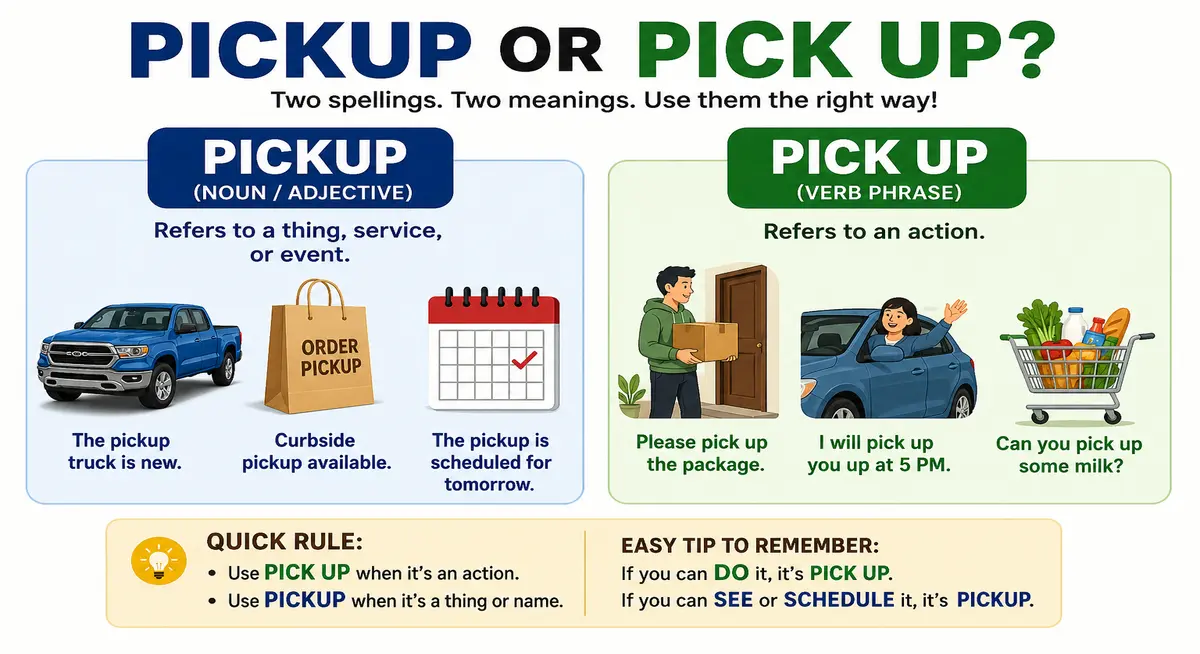
The difference is simple:
- Pick up = Verb phrase (an action)
- Pickup = Noun or adjective (a thing or description)
Examples
Pick up (verb):
- Please pick up the package.
- I will pick up the kids after school.
- Can you pick up some milk on your way home?
Pickup (noun):
- The pickup is scheduled for tomorrow.
- He drives a pickup truck.
- We arranged a curbside pickup.
Quick Rule
If someone is doing an action, use pick up.
If you are naming a thing, service, or event, use pickup.
Read more: More or Less Meaning: Definition, Usage and Examples
The Origin of Pickup or Pick Up
The phrase pick up originated in Middle English and has been used for centuries as a phrasal verb. It combines:
- Pick = to take or gather
- Up = indicating upward movement or collection
Originally, it referred to physically lifting something from the ground.
Over time, English speakers began turning many common verb phrases into compound nouns. This process created words such as:
- setup
- checkout
- breakthrough
- pickup
As a result, pickup emerged as a noun describing the act of collecting something or an item associated with collection.
Why the Difference Exists
English often separates verbs but combines nouns:
Read more: Council or Counsel: What’s the Difference?
| Verb Phrase | Noun |
| Pick up | Pickup |
| Check out | Checkout |
| Set up | Setup |
| Break through | Breakthrough |
This pattern explains why both forms exist today.
British English vs American English Spelling
Both British and American English generally follow the same rule regarding pickup and pick up.
American English
Americans commonly use:
- pickup truck
- pickup service
- store pickup
Examples:
- The store offers free pickup.
- He owns a red pickup truck.
British English
British English also uses:
- pick up (verb)
- pickup (noun)
However, the noun form may appear less frequently in everyday contexts because pickup trucks are less common in the UK.
Comparison Table
| Meaning | American English | British English |
| Collect an item | pick up | pick up |
| Collect a passenger | pick up | pick up |
| Collection service | pickup | pickup |
| Pickup truck | pickup truck | pickup truck |
| Scheduled collection | pickup | pickup |
The spelling rules are essentially identical on both sides of the Atlantic.
Which Spelling Should You Use?
Choosing the correct form depends on grammar rather than location.
Use “Pick Up” When:
- Describing an action
- Writing instructions
- Giving directions
- Talking about collecting something
Examples:
- Please pick up your order.
- I’ll pick up the documents later.
Use “Pickup” When:
- Naming a service
- Referring to a collection event
- Describing a pickup truck
- Using it as an adjective
Examples:
- Curbside pickup is available.
- The pickup truck needs repairs.
Audience-Based Advice
| Audience | Recommended Usage |
| United States | Follow noun vs verb rule |
| United Kingdom | Follow noun vs verb rule |
| Canada | Follow noun vs verb rule |
| Australia | Follow noun vs verb rule |
| Global audience | Follow noun vs verb rule |
The rule is universal.
Common Mistakes with Pickup or Pick Up
Many writers accidentally interchange these forms.
Mistake #1
❌ I will pickup the package.
✅ I will pick up the package.
Reason: This is an action, so use the verb phrase.
Mistake #2
❌ Your order is ready for pick up.
✅ Your order is ready for pickup.
Reason: Here it functions as a noun.
Mistake #3
❌ The pick up truck is parked outside.
✅ The pickup truck is parked outside.
Reason: The compound noun is correct.
Mistake #4
❌ We scheduled a pick up for Friday.
✅ We scheduled a pickup for Friday.
Reason: Pickup names the event.
Mistake #5
❌ Can you pickup my friend?
✅ Can you pick up my friend?
Reason: This is an action.
Pickup or Pick Up in Everyday Examples
Understanding real-world usage makes the difference easier to remember.
In Emails
- Please pick up your badge at reception.
- Your order is available for pickup.
In News Articles
- Residents can pick up supplies today.
- Waste pickup services will resume Monday.
On Social Media
- Don’t forget to pick up your tickets!
- Same-day pickup now available.
In Business Writing
- Customers may pick up orders between 9 AM and 5 PM.
- The company offers free curbside pickup.
In Academic Writing
- Participants could pick up information packets.
- Document pickup occurred at designated locations.
Pickup or Pick Up – Google Trends & Usage Data
Search data shows that people frequently look up pickup or pick up because both forms appear regularly in everyday writing.
Where Searches Are Common
- United States
- Canada
- United Kingdom
- Australia
- India
Common Search Intent
Users often want to know:
- Which spelling is correct?
- Is pickup one word or two?
- When should I use pick up?
- What is the difference between pickup and pick up?
Usage Contexts
| Context | More Common Form |
| Action | Pick up |
| Transportation | Pickup |
| Retail collection | Pickup |
| Delivery services | Pickup |
| Instructions | Pick up |
| Business notices | Pickup |
The distinction remains grammar-based rather than region-based.
Pickup vs Pick Up Comparison Table
| Feature | Pickup | Pick Up |
| Part of Speech | Noun/Adjective | Verb Phrase |
| Describes Action | No | Yes |
| Names a Service | Yes | No |
| Refers to a Truck | Yes | No |
| Used in Commands | No | Yes |
| Example | Order pickup | Pick up the order |
FAQs
Is pickup one word or two words?
Both forms are correct. Pickup is a noun or adjective, while pick up is a verb phrase.
Which is correct: pickup the package or pick up the package?
Pick up the package is correct because it describes an action.
Is curbside pickup one word?
Yes. Pickup is the correct noun in the phrase curbside pickup.
Why do people confuse pickup and pick up?
They sound identical and are closely related in meaning, but they serve different grammatical functions.
Is pickup truck one word?
Yes. The standard form is pickup truck.
Do British and American English use different spellings?
No. Both varieties generally follow the same noun-versus-verb rule.
How can I remember the difference?
If the phrase describes an action, use pick up. If it names a thing, event, or service, use pickup.
Conclusion
The difference between pickup and pick up is easier than it first appears. The key is understanding the role each form plays in a sentence. Use pick up whenever you’re describing an action, such as collecting a package, gathering supplies, or giving someone a ride. Use pickup when referring to a thing, service, event, or vehicle, such as a scheduled pickup or a pickup truck.
This distinction follows a common English pattern where verb phrases remain separate while related nouns become compound words. The rule applies in both American and British English, making it useful for writers around the world.
When proofreading your work, ask yourself a simple question: “Is this an action or a thing?” If it’s an action, choose pick up. If it’s a thing or service, choose pickup. Following this rule will help you write clearly, professionally, and confidently in every situation.

Henry is a passionate English professor, language specialist, and the founder of SpellCompare.com. With years of academic experience and a deep understanding of grammar, vocabulary, and linguistic nuances, he has dedicated his career to helping students and writers master the English language with clarity and confidence.
As an expert in word comparisons, spelling differences, and grammar rules, Henry simplifies complex language concepts into easy-to-understand explanations. His mission is to eliminate confusion between commonly misused words and provide accurate, research-based guidance that improves writing skills for learners worldwide.
Through SpellCompare.com, Henry combines academic expertise with practical examples, creating content that is clear, reliable, and reader-friendly. His work focuses on precision, correctness, and helping others communicate effectively in both academic and professional settings.
When he’s not teaching or writing, Henry continues researching evolving language trends to ensure his content remains current, helpful, and authoritative.