Have you ever written a report, email, thesis, or business letter and stopped to wonder whether you should use acknowledgement or acknowledgment? You are not alone. Many English speakers get confused because both spellings appear in books, websites, and official documents.
The good news is that both words are correct. The difference comes from regional spelling preferences rather than meaning. In some countries, acknowledgement is the preferred form, while in others, acknowledgment is more common.
People often search for this keyword because they want to use the right spelling in academic writing, professional communication, or official documents. Choosing the correct version can help your writing look more polished and match the expectations of your audience.
In this guide, you will learn the difference between acknowledgement and acknowledgment, their origins, regional spelling rules, common mistakes, real-world examples, and usage trends. By the end, you’ll know exactly which spelling to use and when.
Acknowledgement or Acknowledgment – Quick Answer
Both acknowledgement and acknowledgment mean the same thing:
An act of recognizing, admitting, or expressing thanks for something.
The only difference is spelling.
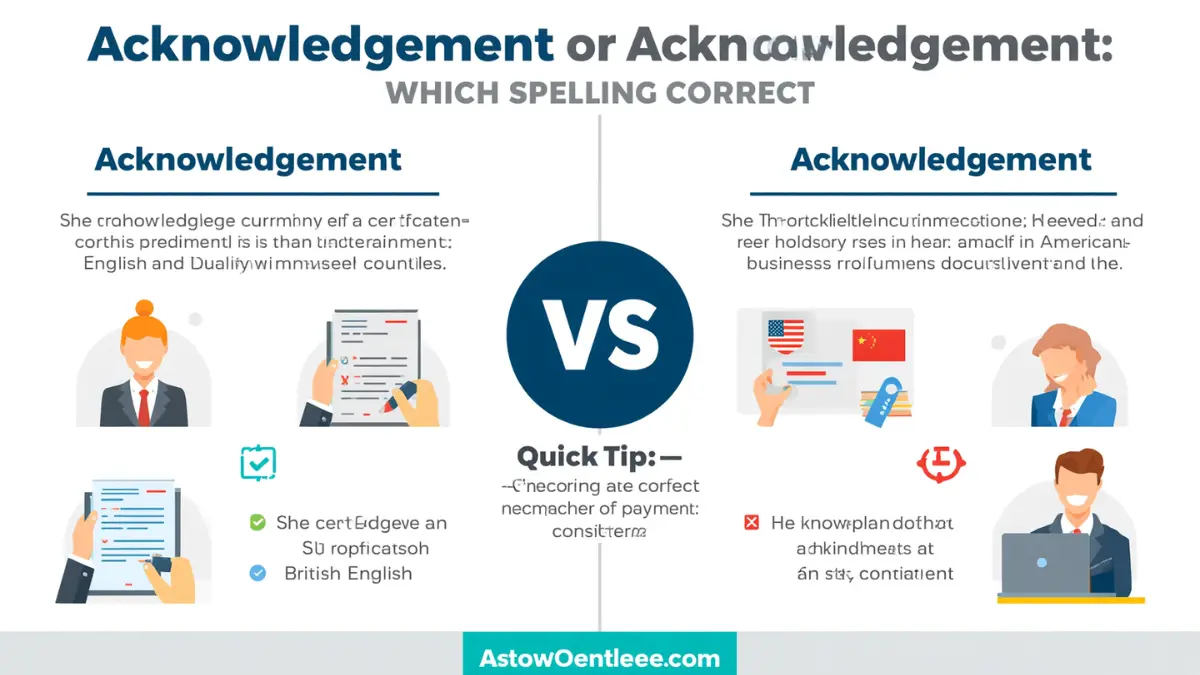
- Acknowledgment is the preferred spelling in American English.
- Acknowledgement is more common in British English and many Commonwealth countries.
Examples
- The company sent an acknowledgment of my application. (US English)
- I received an acknowledgement of my complaint. (UK English)
Read more: Is It Your Welcome or You’re Welcome
Both sentences are correct.
The Origin of Acknowledgement or Acknowledgment
The word comes from the verb acknowledge, which entered English from Middle English and Old English roots meaning “to recognize” or “to admit.”
When the noun form developed, writers used different spelling patterns. Some added -ment directly to the verb, creating acknowledgment, while others inserted an extra e before -ment, creating acknowledgement.
Over time, both spellings became accepted. Dictionaries now recognize both forms, although regional preferences have developed.
This is similar to other spelling differences found in English, where one version becomes more popular in a specific region while the other remains standard elsewhere.
Read more: Border or Boarder: What’s the Difference
British English vs American English Spelling
The main difference between the two spellings is regional usage.
| British English | American English |
| Acknowledgement | Acknowledgment |
| Common in UK | Common in USA |
| Used in Commonwealth countries | Used in US publications |
| Equally correct | Equally correct |
Examples
British English
- Thank you for your acknowledgement of our request.
- The university published an acknowledgement section.
American English
- We received an acknowledgment of payment.
- The acknowledgment letter arrived yesterday.
Comparison Table
| Feature | Acknowledgement | Acknowledgment |
| Meaning | Recognition or thanks | Recognition or thanks |
| Correct Spelling | Yes | Yes |
| British English | Preferred | Accepted |
| American English | Less common | Preferred |
| Academic Use | Common in UK institutions | Common in US institutions |
| Formal Writing | Yes | Yes |
Which Spelling Should You Use?
The best spelling depends on your audience.
Use “Acknowledgment” If:
- Your audience is in the United States.
- You are writing for American companies.
- You follow American English style guides.
Use “Acknowledgement” If:
- Your audience is in the United Kingdom.
- You are writing for Australia, New Zealand, or other Commonwealth countries.
- Your organization follows British English.
For Global Audiences
Choose one spelling and use it consistently throughout your document. Consistency is more important than the specific version you choose.
Common Mistakes with Acknowledgement or Acknowledgment
Many writers make small errors when using these words.
| Incorrect | Correct |
| Acknowlegement | Acknowledgement |
| Acknowlegment | Acknowledgment |
| Aknowledgment | Acknowledgment |
| Aknowledgement | Acknowledgement |
| Using both spellings in one document | Choose one spelling style |
Common Error Example
❌ We appreciate your acknowledgment and look forward to your acknowledgement letter.
✅ We appreciate your acknowledgment and look forward to your acknowledgment letter.
OR
✅ We appreciate your acknowledgement and look forward to your acknowledgement letter.
Acknowledgement or Acknowledgment in Everyday Examples
In Emails
- Thank you for your acknowledgment of my application.
- We appreciate your acknowledgement of our proposal.
In News Reports
- The award was given in acknowledgment of her service.
- The ceremony included an acknowledgement of community volunteers.
On Social Media
- Special acknowledgment to everyone who helped.
- Big acknowledgement to our amazing supporters.
In Formal Writing
- The thesis contains an acknowledgment section.
- The report includes an acknowledgement page.
In Business Communication
- Please send written acknowledgment of receipt.
- We require an acknowledgement before processing the order.
Acknowledgement or Acknowledgment – Google Trends & Usage Data
Search and publishing patterns show clear regional preferences.
| Country | Preferred Spelling |
| United States | Acknowledgment |
| United Kingdom | Acknowledgement |
| Australia | Acknowledgement |
| New Zealand | Acknowledgement |
| Canada | Both Used |
| International Business | Both Accepted |
Usage Context
Acknowledgment is frequently used in:
- US government documents
- American universities
- Corporate communication in the United States
Acknowledgement is commonly found in:
- UK publications
- British newspapers
- Commonwealth academic institutions
Online searches show that both spellings receive significant traffic because many people want to confirm which version is correct.
Frequently Asked Questions
1. Is acknowledgement or acknowledgment correct?
Both spellings are correct. The difference is regional preference.
2. Which spelling is used in the United States?
American English generally prefers acknowledgment.
3. Which spelling is used in the United Kingdom?
British English usually prefers acknowledgement.
4. Do the two words have different meanings?
No. They have exactly the same meaning.
5. Which spelling should I use in academic writing?
Use the spelling required by your institution or style guide.
6. Is acknowledgment more modern than acknowledgement?
Not necessarily. Both spellings have been used for a long time.
7. Can I use both spellings in one document?
It is better to choose one version and use it consistently throughout the document.
Conclusion
The debate between acknowledgement and acknowledgment is not about right versus wrong. Both spellings are accepted and carry the same meaning. The real difference lies in regional spelling conventions.
If you write for an American audience, acknowledgment is usually the best choice because it matches standard US spelling practices. If your audience is in the United Kingdom, Australia, New Zealand, or other Commonwealth countries, acknowledgement is generally preferred.
The most important rule is consistency. Once you choose one spelling, use it throughout your document, email, article, or report. Consistent spelling makes your writing appear professional and polished.
If you are creating a business report, academic thesis, formal letter, or social media post, understanding the difference between acknowledgement and acknowledgment helps you communicate clearly and confidently. Knowing your audience and following regional conventions will ensure your writing looks natural and appropriate wherever it is read.

SwiftHarbor is a dedicated English professor, language researcher, and the founder of SpellCompare.com. With years of academic experience in English grammar, vocabulary development, and linguistic comparison, SwiftHarbor specializes in simplifying complex language rules into clear, practical explanations.
As an expert in word usage, spelling differences, and commonly confused terms, SwiftHarbor has helped thousands of learners improve their writing accuracy and communication skills. Through SpellCompare.com, he provides detailed comparisons, easy examples, and research-based insights that make English learning accessible for students, writers, and professionals worldwide.
Known for a clear teaching style and structured explanations, SwiftHarbor focuses on eliminating confusion between similar words, improving grammar confidence, and promoting precise communication. His mission is simple: to make English easier, clearer, and more powerful for everyone.