Have you ever written border when you meant boarder, or vice versa? You’re not alone. These two words sound similar, but they have very different meanings. Because they are often confused, many people search for “border or boarder” to learn which spelling is correct.
The confusion happens because both words share the same pronunciation in many accents. However, one word relates to boundaries and edges, while the other refers to a person who rents a room or boards somewhere.
Understanding the difference is important for students, writers, business professionals, and English learners. Using the wrong word can change the meaning of a sentence and make your writing look less professional.
In this guide, you’ll learn the meaning of each word, their origins, spelling differences, common mistakes, real-life examples, and usage trends. By the end, you’ll know exactly when to use border and when to use boarder.
Border or Boarder – Quick Answer
The correct word depends on your meaning:
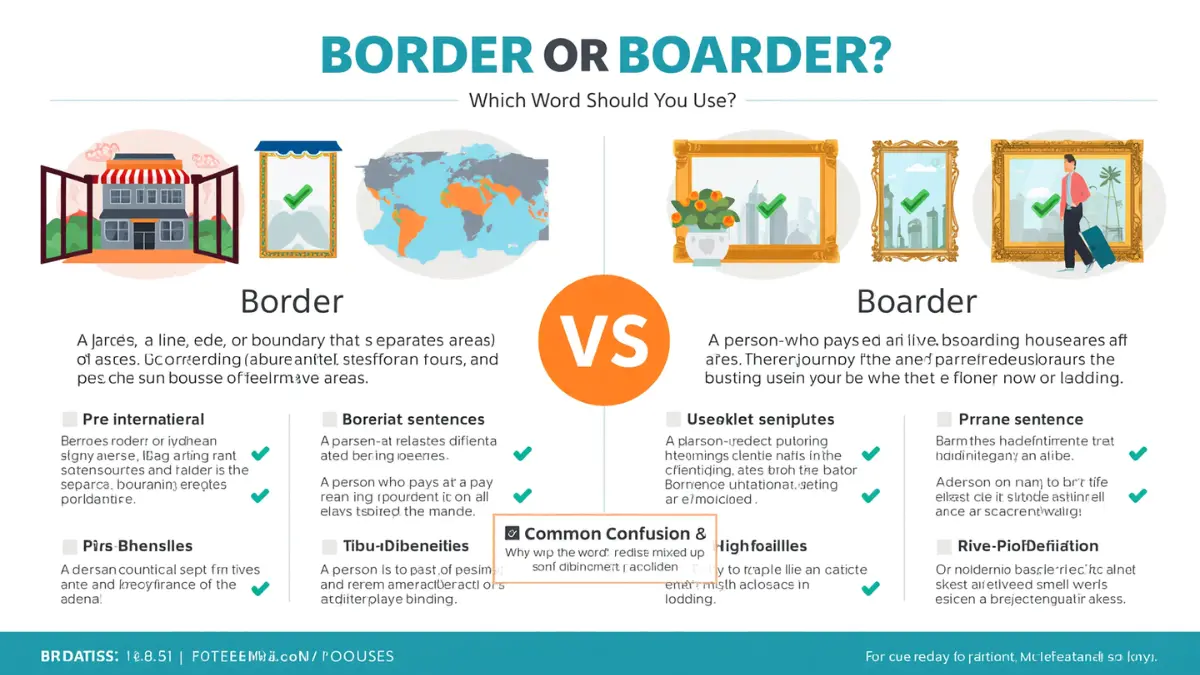
- Border = a boundary, edge, or line separating areas.
- Boarder = a person who pays to live and eat in someone else’s home.
Examples
✅ The border between Canada and the United States is very long.
✅ She added a decorative border around the photo.
✅ The boarder rented a room in the family’s house.
✅ The school boarder returned home for the holidays.
Quick Memory Tip
- Border contains “order”, which can help you remember boundaries and limits.
- Boarder contains “board”, which relates to lodging or boarding.
Read more: Other Than or Other Then: Which Spelling Is Correct ?
The Origin of Border or Boarder
Understanding the history of these words makes the difference easier to remember.
Origin of Border
The word border comes from the Old French word bordure, meaning edge or boundary. It entered English during the Middle Ages and has long been used to describe the limits between countries, regions, or objects.
Examples:
- National border
- Garden border
- Decorative border
Origin of Boarder
The word boarder comes from the word board, which once referred to the table where meals were served. People who paid for meals and lodging were said to receive “room and board.”
Over time, a boarder became someone who lives in another person’s home and pays for accommodation and meals.
Examples:
- College boarder
- School boarder
- House boarder
Because the words developed from different roots, their meanings remain completely separate.
Read more: Whomever or Whomsoever: When to Use Each Correctly?
British English vs American English Spelling
Unlike many English words, border and boarder have the same spelling in both British and American English.
There is no regional spelling difference.
Comparison Table
| Meaning | British English | American English |
| Boundary or edge | Border | Border |
| Person renting lodging | Boarder | Boarder |
Examples
| Sentence | Correct Word |
| The border crossing was busy today. | Border |
| A boarder moved into the spare room. | Boarder |
| The artist drew a border around the page. | Border |
| The boarder pays rent monthly. | Boarder |
Since both countries use the same spellings, the challenge is choosing the correct word based on meaning.
Which Spelling Should You Use?
Choose the spelling according to the context.
Use “Border” When:
- Talking about country boundaries.
- Describing edges or outlines.
- Referring to decorative designs around objects.
Examples:
- The border checkpoint opened early.
- The blanket has a blue border.
Use “Boarder” When:
- Talking about someone who pays for lodging.
- Referring to students living at boarding schools.
- Describing a renter receiving room and board.
Examples:
- The boarder stayed with the family for six months.
- Every boarder must follow school rules.
Audience-Based Advice
| Audience | Recommended Usage |
| United States | Border or Boarder based on meaning |
| United Kingdom | Border or Boarder based on meaning |
| Australia | Border or Boarder based on meaning |
| Canada | Border or Boarder based on meaning |
| Global Audience | Use the word that matches the context |
Common Mistakes with Border or Boarder
Many writers accidentally swap these words.
Mistake 1
❌ The boarder between the two countries is closed.
✅ The border between the two countries is closed.
Mistake 2
❌ A new border moved into our guest room.
✅ A new boarder moved into our guest room.
Mistake 3
❌ The invitation had a beautiful boarder.
✅ The invitation had a beautiful border.
Mistake 4
❌ The border pays rent every month.
✅ The boarder pays rent every month.
Easy Rule
If you’re discussing a boundary, use border.
If you’re discussing a person living somewhere, use boarder.
Border or Boarder in Everyday Examples
In Emails
Border
Please check the border requirements before traveling internationally.
Boarder
Our new boarder will arrive on Friday.
In News Articles
Border
Officials increased security along the border.
Boarder
The boarder reported maintenance issues to the landlord.
On Social Media
Border
Just crossed the border today!
Boarder
We welcomed a new boarder into our home.
In Formal Writing
Border
The treaty established a new border between the regions.
Boarder
Each boarder is responsible for maintaining their room.
Border or Boarder – Google Trends & Usage Data
Search behavior shows that border is vastly more common than boarder.
Why Border Is More Popular
The word appears frequently in discussions about:
- International travel
- Immigration
- Geography
- Politics
- Design and art
Why Boarder Is Less Common
The word is used in more specific situations:
- Boarding schools
- Rental housing
- Lodging arrangements
Usage by Context
| Word | Common Contexts |
| Border | Geography, politics, travel, design |
| Boarder | Housing, schools, accommodation |
Popular Countries for Searches
The keyword border is commonly searched in:
- United States
- United Kingdom
- Canada
- Australia
- India
The keyword boarder receives fewer searches because it serves a narrower purpose.
Border vs Boarder Comparison Table
| Feature | Border | Boarder |
| Part of Speech | Noun | Noun |
| Meaning | Boundary or edge | Person receiving lodging |
| Common Usage | Geography, design | Housing, schools |
| Frequency | Very common | Less common |
| Example | Border crossing | School boarder |
| Refers to a Person? | No | Yes |
FAQs About Border or Boarder
1. Is it a border or boarder between countries?
Border is correct because it refers to a boundary between places.
2. What does boarder mean?
A boarder is someone who pays to live and often eats in another person’s home or institution.
3. Are border and boarder pronounced the same?
In many English accents, yes. They are often pronounced similarly, which causes confusion.
4. Is a student at a boarding school called a boarder?
Yes. Students who live at the school are known as boarders.
5. What is a border in design?
A border is a decorative edge around text, images, or objects.
6. Which word is more common?
Border is much more common because it appears in geography, travel, politics, and design.
7. Can border ever mean a person?
No. Border refers to a boundary or edge. A person is a boarder.
Conclusion
The difference between border and boarder is simple once you understand their meanings. A border is a boundary, edge, or dividing line. It can describe the line between countries, the edge of a garden, or a decorative frame around a document. A boarder, on the other hand, is a person who pays for lodging, often including meals, in a private home, school, or other residence.
Although these words sound alike, they are not interchangeable. Using the wrong spelling can confuse readers and change the meaning of your sentence. A useful memory trick is that boarder contains the word board, reminding you of room and board. Meanwhile, border relates to boundaries and edges.
Whether you write for school, work, travel, or everyday communication, choosing the correct word helps your writing stay clear and professional. When discussing limits or edges, use border. When referring to a resident paying for accommodation, use boarder. Keeping this distinction in mind will help you avoid one of English’s most common spelling mix-ups.

Henry is a passionate English professor, language specialist, and the founder of SpellCompare.com. With years of academic experience and a deep understanding of grammar, vocabulary, and linguistic nuances, he has dedicated his career to helping students and writers master the English language with clarity and confidence.
As an expert in word comparisons, spelling differences, and grammar rules, Henry simplifies complex language concepts into easy-to-understand explanations. His mission is to eliminate confusion between commonly misused words and provide accurate, research-based guidance that improves writing skills for learners worldwide.
Through SpellCompare.com, Henry combines academic expertise with practical examples, creating content that is clear, reliable, and reader-friendly. His work focuses on precision, correctness, and helping others communicate effectively in both academic and professional settings.
When he’s not teaching or writing, Henry continues researching evolving language trends to ensure his content remains current, helpful, and authoritative.