Have you ever typed “your welcome” in a text, email, or social media comment and wondered if it was correct? Many people make this mistake because “your” and “you’re” sound exactly the same when spoken. However, only one version is grammatically correct when responding to someone who says “thank you.”
This confusion is one of the most common English grammar mistakes. Whether you’re writing a professional email, posting online, or chatting with friends, using the correct phrase helps you communicate clearly and confidently.
In this guide, you’ll learn the difference between your welcome and you’re welcome, where the expression came from, how it is used in British and American English, common mistakes to avoid, and real-life examples. By the end, you’ll know exactly which phrase to use and why.
Is It Your Welcome or You’re Welcome? – Quick Answer
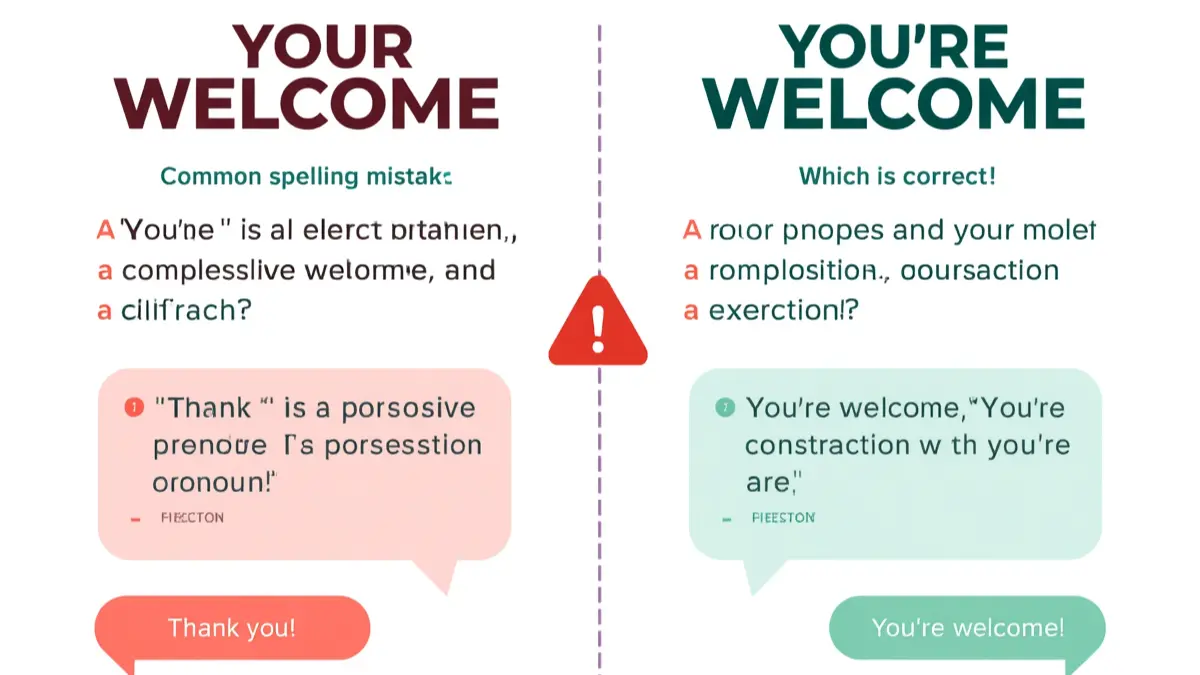
The correct phrase is “you’re welcome.”
You’re is a contraction of you are.
When someone thanks you, “you’re welcome” means “you are welcome.”
Correct Examples
- Thank you for your help.
- You’re welcome.
- Thanks for explaining.
- You’re welcome.
Incorrect Examples
- Thank you.
- ❌ Your welcome.
- Thanks for the gift.
- ❌ Your welcome.
Read more: Aswell or As Well: Which One Is Correct?
A simple trick is to replace you’re with you are. If the sentence still makes sense, you’re is correct.
The Origin of Is It Your Welcome or You’re Welcome?
The phrase “you’re welcome” comes from the adjective welcome, which has been part of English for centuries.
The word welcome originated from Old English words meaning “a pleasing guest” or “one whose arrival is desired.”
Over time, the expression evolved into a polite response after receiving thanks. Saying “you’re welcome” communicates that the help, favor, or gift was gladly given.
The confusion between your and you’re is not historical. It comes from modern English pronunciation because both words sound identical.
Read more: Aswell or As Well: Which One Is Correct?
Understanding the Difference
| Word | Meaning | Example |
| Your | Shows ownership | Your book is on the table. |
| You’re | Short for “you are” | You’re welcome. |
Since welcome describes a person, the phrase requires you are welcome, making you’re welcome the only correct option.
British English vs American English Spelling
Unlike many words that have different spellings in British and American English, “you’re welcome” is spelled the same in both versions.
There is no regional spelling difference.
Examples
| British English | American English |
| You’re welcome. | You’re welcome. |
| You’re very welcome. | You’re very welcome. |
| You’re most welcome. | You’re most welcome. |
Comparison Table
| Feature | British English | American English |
| Correct phrase | You’re welcome | You’re welcome |
| Incorrect phrase | Your welcome | Your welcome |
| Pronunciation | Similar | Similar |
| Meaning | You are welcome | You are welcome |
The grammar rule remains identical worldwide.
Which Spelling Should You Use?
Always use “you’re welcome” when responding to thanks.
For US Audiences
Use you’re welcome in emails, articles, customer service messages, and conversations.
For UK Audiences
Use you’re welcome in both formal and informal communication.
For Commonwealth Countries
Countries such as Canada, Australia, New Zealand, India, and South Africa also use you’re welcome.
For Global Communication
If you’re writing for an international audience, you’re welcome is universally understood and accepted.
Common Mistakes with Is It Your Welcome or You’re Welcome?
Many writers accidentally use your instead of you’re.
Mistake #1: Using Ownership Instead of a Contraction
❌ Your welcome.
✅ You’re welcome.
Mistake #2: Relying on Pronunciation
Because both words sound the same, people often choose the wrong spelling while typing.
❌ Your welcome for the information.
✅ You’re welcome for the information.
Mistake #3: Skipping the Apostrophe
❌ Youre welcome.
✅ You’re welcome.
Mistake #4: Mixing Up Grammar Rules
Remember:
- Your = belonging to you
- You’re = you are
Is It Your Welcome or You’re Welcome? in Everyday Examples
Here are examples from daily life.
Emails
Correct:
“Thank you for your quick response.”
“You’re welcome. Let me know if you need anything else.”
News Interviews
Reporter: “Thank you for joining us today.”
Guest: “You’re welcome.”
Social Media
User: “Thanks for sharing this guide!”
Creator: “You’re welcome!”
Workplace Communication
Employee: “Thanks for helping with the project.”
Manager: “You’re welcome.”
Formal Writing
“You’re welcome to contact us with additional questions.”
Is It Your Welcome or You’re Welcome? – Google Trends & Usage Data
Search data consistently shows that many users search for:
- your welcome or you’re welcome
- is your welcome correct
- how to spell you’re welcome
- your vs you’re
The reason is simple: the words are homophones. They sound identical but have different meanings and spellings.
Popular Regions
The search query appears frequently in:
- United States
- United Kingdom
- Canada
- Australia
- India
Students, professionals, and English learners commonly search for this grammar question.
Usage Contexts
| Context | Preferred Form |
| You’re welcome | |
| Text Message | You’re welcome |
| Social Media | You’re welcome |
| Business Writing | You’re welcome |
| Academic Writing | You’re welcome |
Comparison Table: Your Welcome vs You’re Welcome
| Feature | Your Welcome | You’re Welcome |
| Grammatically Correct? | No | Yes |
| Meaning | Indicates possession | Means “you are welcome” |
| Common Usage | Mistake | Standard expression |
| Suitable for Formal Writing | No | Yes |
| Suitable for Casual Writing | No | Yes |
| Accepted Worldwide | No | Yes |
Frequently Asked Questions
1. Is “your welcome” ever correct?
Not as a response to “thank you.” The correct phrase is you’re welcome.
2. Why do people write “your welcome”?
Because your and you’re sound the same when spoken.
3. What does “you’re welcome” mean?
It means “you are welcome” and is a polite response to gratitude.
4. Is “you’re welcome” formal or informal?
It works in both formal and informal situations.
5. Can I say “you are welcome” instead?
Yes. You are welcome is grammatically correct, though you’re welcome is more common.
6. Is “you’re welcome” used in British English?
Yes. British English and American English both use you’re welcome.
7. What is the easiest way to remember the difference?
If you can replace the word with “you are,” use you’re.
Conclusion
The debate between your welcome and you’re welcome is actually quite simple once you understand the grammar. The correct phrase is always “you’re welcome” when responding to someone’s thanks. This is because you’re is a contraction of you are, making the phrase mean “you are welcome.”
The spelling “your welcome” is a common mistake caused by pronunciation. Since both words sound identical, many people accidentally choose the wrong version while typing. However, your shows ownership, while you’re means you are, so only one fits the sentence correctly.
The good news is that the rule is the same in British English, American English, and other English-speaking countries. Whether you’re writing an email, posting on social media, or communicating professionally, using you’re welcome will always be the correct choice.
When in doubt, replace you’re with you are. If the sentence still makes sense, you’ve chosen the right spelling.

My name is SwiftSphere, and I am a passionate English language author and the creator of Spellcompare.com. I specialize in word comparisons, grammar clarity, and simplifying confusing English terms for readers around the world.
As a professional writer, I focus on breaking down commonly misunderstood words, phrases, and language rules into clear, practical explanations. My goal is to make English easier, more accurate, and more accessible for students, professionals, and everyday learners.
Through Spellcompare.com, I provide well-researched, easy-to-understand content that helps readers confidently choose the right words in writing and speech. Whether it’s comparing similar spellings, explaining grammar rules, or clarifying tricky vocabulary, I am committed to delivering precise and reliable guidance.
I believe that strong language skills create strong communication — and strong communication creates opportunity. That belief drives my work every day.