Have you ever written a sentence and stopped to wonder whether it should be flushed out or fleshed out? Many people mix up these two phrases because they sound similar. Yet they have very different meanings.
This confusion appears in emails, business plans, articles, social media posts, and even professional documents. Some writers use flushed out when they actually mean fleshed out, while others are unsure which phrase is correct.
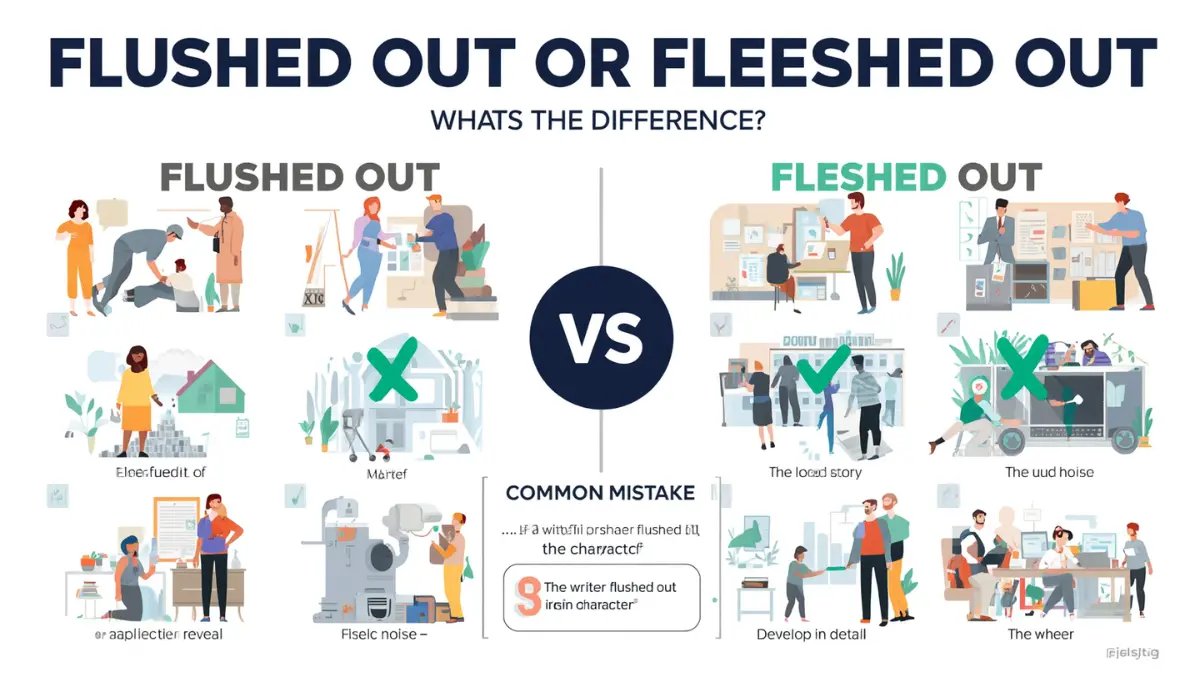
The good news is that the difference is simple once you understand it. Fleshed out means adding details and developing an idea. Flushed out means forcing something or someone to leave a hiding place. Because the phrases sound alike, they are often confused.
In this guide, you’ll learn the correct meaning of each phrase, where they came from, how they are used in British and American English, common mistakes to avoid, and which one you should use in different situations.
Flushed Out or Fleshed Out – Quick Answer
The correct phrase depends on what you mean.
| Phrase | Meaning | Example |
| Fleshed Out | Developed with more details | “The team fleshed out the project proposal.” |
| Flushed Out | Forced out of hiding | “The police flushed out the suspect.” |
Quick Rule
- Use fleshed out when talking about expanding or developing an idea.
- Use flushed out when talking about driving someone or something from hiding.
Read more: Difference Between Twin and Full: Which Bed Size Is Right ?
Examples
✅ The author fleshed out the characters before publishing the novel.
✅ We need to flesh out the marketing plan
The Origin of Flushed Out or Fleshed Out
Understanding the history of these phrases helps explain why they are often confused.
Origin of Fleshed Out
The phrase flesh out comes from the idea of adding flesh to a skeleton. A skeleton has the basic structure, but flesh gives it shape and detail.
Over time, writers began using the phrase to describe adding information, details, or substance to ideas, plans, and stories.
Example:
- A rough outline becomes a complete report after it is fleshed out.
Origin of Flushed Out
The phrase flush out comes from hunting. Hunters would force birds or animals out of bushes so they could be seen.
Later, the phrase expanded to mean revealing hidden information or forcing someone out of concealment.
Read more: Difference Between Hypertonic and Hypotonic: in (2026)
Example:
- Journalists flushed out evidence of corruption.
Why the Confusion Exists
The phrases sound very similar when spoken. Because both can appear in professional writing, many people accidentally replace one with the other.
British English vs American English Spelling
Unlike many spelling differences between British and American English, these phrases are not regional spelling variants. They are separate expressions with separate meanings.
Both British and American English use:
- Fleshed out
- Flushed out
The difference is meaning, not spelling.
Comparison Table
| Expression | British English | American English | Meaning |
| Fleshed Out | ✔ | ✔ | Developed with more detail |
| Flushed Out | ✔ | ✔ | Forced from hiding |
| Flesh Out | ✔ | ✔ | Expand an idea |
| Flush Out | ✔ | ✔ | Reveal or force out |
Key Point
This is not like “colour” versus “color.”
Both countries use both phrases exactly the same way.
Which Spelling Should You Use?
Your choice depends on meaning rather than location.
For US Audiences
Use:
- Fleshed out for developed ideas
- Flushed out for revealing hidden things
For UK Audiences
The same rule applies.
- Fleshed out = add details
- Flushed out = force out
For Global Audiences
Choose the phrase that matches your intended meaning.
Ask yourself:
Am I adding detail?
→ Use fleshed out
Am I revealing or forcing something out?
→ Use flushed out
Common Mistakes with Flushed Out or Fleshed Out
Many writers accidentally use the wrong phrase.
Mistake 1
❌ We need to flush out the proposal.
✅ We need to flesh out the proposal.
Reason: A proposal needs more detail, not removal from hiding.
Mistake 2
❌ The police fleshed out the suspect.
✅ The police flushed out the suspect.
Reason: The suspect was forced out of hiding.
Mistake 3
❌ The editor flushed out the story.
✅ The editor fleshed out the story.
Reason: The story was expanded with more details.
Mistake 4
❌ The investigators fleshed out the criminals.
✅ The investigators flushed out the criminals.
Reason: Criminals were discovered or revealed.
Flushed Out or Fleshed Out in Everyday Examples
In Emails
Fleshed Out
“Please flesh out the proposal before tomorrow’s meeting.”
In News Reports
Flushed Out
“The operation flushed out several suspects.”
On Social Media
Fleshed Out
“I love how the writer fleshed out every character.”
In Business Writing
Fleshed Out
“The strategy has been fully fleshed out.”
In Government Reports
Flushed Out
“The audit flushed out several accounting errors.”
In Academic Writing
Fleshed Out
“The theory was fleshed out through further research.”
Flushed Out or Fleshed Out – Google Trends & Usage Data
Search behavior shows that many users look for flushed out or fleshed out because they are unsure which phrase is correct.
Fleshed Out Usage
Most commonly appears in:
- Business plans
- Writing projects
- Books
- Marketing documents
- Academic papers
Flushed Out Usage
Most commonly appears in:
- News reports
- Law enforcement stories
- Investigations
- Hunting discussions
- Security reports
Countries Where Confusion Is Common
- United States
- United Kingdom
- Canada
- Australia
- New Zealand
Because English speakers worldwide use both expressions, searches comparing the two phrases remain common.
Comparison Table: Flushed Out vs Fleshed Out
| Feature | Fleshed Out | Flushed Out |
| Meaning | Developed with detail | Forced from hiding |
| Common Context | Writing, planning, business | Investigations, hunting, law enforcement |
| Verb Form | Flesh out | Flush out |
| Related Idea | Expand | Reveal |
| Professional Use | Very common | Common |
| Often Confused With | Flushed out | Fleshed out |
FAQs
Is fleshed out the correct phrase?
Yes. Use fleshed out when adding details or developing an idea.
Is flushed out ever correct?
Yes. Use flushed out when something hidden is forced into view.
Why do people confuse fleshed out and flushed out?
The phrases sound similar when spoken, which leads to frequent mistakes.
Can I say “flesh out a plan”?
Yes. This is one of the most common uses of the phrase.
Can I say “flush out a plan”?
Usually no. Plans are developed, not forced from hiding.
Is fleshed out used in business writing?
Yes. Business professionals often use it when discussing proposals, strategies, and projects.
Do British and American English use these phrases differently?
No. Both varieties use the same phrases with the same meanings.
Conclusion
The difference between flushed out and fleshed out is easier than it first appears. While the phrases sound alike, they serve completely different purposes.
Use fleshed out when you want to describe adding details, expanding ideas, or developing plans. Think of giving a skeleton more substance and shape. This phrase is common in business writing, creative writing, education, and project planning.
Use flushed out when you mean forcing something hidden into the open. It is often used in hunting, journalism, law enforcement, investigations, and security contexts. The phrase focuses on revealing or exposing something that was concealed.
A simple memory trick can help. If you are adding information, choose fleshed out. If you are revealing something hidden, choose flushed out.
Knowing the difference will make your writing clearer, more professional, and easier for readers to understand. When in doubt, focus on the meaning you want to express rather than the sound of the phrase.

Henry is a passionate English professor, language specialist, and the founder of SpellCompare.com. With years of academic experience and a deep understanding of grammar, vocabulary, and linguistic nuances, he has dedicated his career to helping students and writers master the English language with clarity and confidence.
As an expert in word comparisons, spelling differences, and grammar rules, Henry simplifies complex language concepts into easy-to-understand explanations. His mission is to eliminate confusion between commonly misused words and provide accurate, research-based guidance that improves writing skills for learners worldwide.
Through SpellCompare.com, Henry combines academic expertise with practical examples, creating content that is clear, reliable, and reader-friendly. His work focuses on precision, correctness, and helping others communicate effectively in both academic and professional settings.
When he’s not teaching or writing, Henry continues researching evolving language trends to ensure his content remains current, helpful, and authoritative.