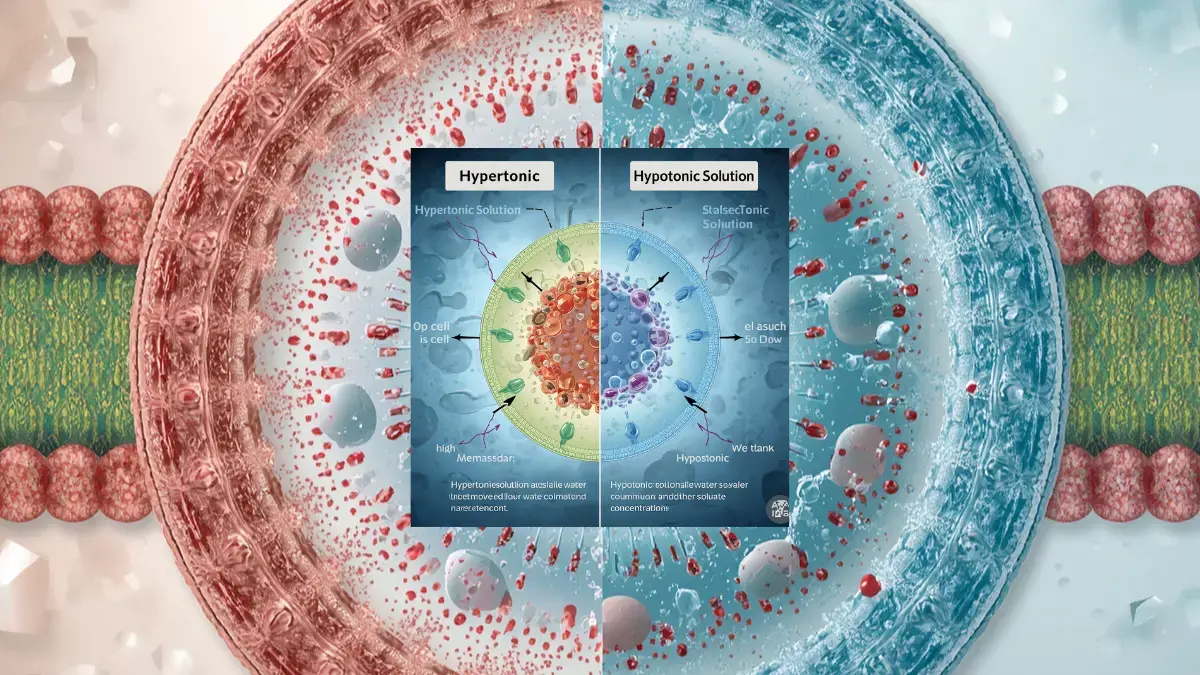
In biology, the terms difference between hypertonic and hypotonic describe how water moves between cells and their surroundings. Imagine you are soaking raisins in water or sprinkling salt on a cucumber. Both processes show how cells react to different solutions.
The difference between hypertonic and hypotonic solutions becomes clear when we observe whether a cell shrinks or swells. In everyday science, the difference between hypertonic and hypotonic environments helps explain how our body maintains balance. Without understanding the difference between hypertonic and hypotonic, it becomes difficult to grasp concepts like dehydration, swelling, and cell survival.
Pronunciation
- Hypertonic: /ˌhaɪpərˈtɒnɪk/ (UK), /ˌhaɪpərˈtɑːnɪk/ (US)
- Hypotonic: /ˌhaɪpəˈtɒnɪk/ (UK), /ˌhaɪpəˈtɑːnɪk/ (US)
Now, let’s move deeper into how these two biological terms actually behave in real life.
Key Difference Between Hypertonic and Hypotonic
The main difference lies in water movement:
- A hypertonic solution has more solutes (like salt or sugar) outside the cell, causing water to leave the cell.
- A hypotonic solution has fewer solutes outside, causing water to enter the cell.
Difference Between Motrin and Tylenol: in (2026)
Why Understanding Their Difference Is Important
Knowing the difference between hypertonic and hypotonic is essential in medicine, agriculture, and biology education. In hospitals, IV fluids must be carefully balanced to avoid damaging red blood cells. In agriculture, plant health depends on soil water concentration. Even in daily life, understanding cell behavior helps explain hydration and food preservation. Without this knowledge, students and professionals may misunderstand how living cells respond to their environment, leading to errors in science and healthcare practices.
H2: Difference Between Hypertonic and Hypotonic
1. Solute Concentration
- Hypertonic: High solute concentration
- Example 1: Saltwater solution
- Example 2: Sugar syrup
- Hypotonic: Low solute concentration
- Example 1: Distilled water
- Example 2: Fresh rainwater
- Difference Between Less and Fewer: in (2026)
2. Water Movement
- Hypertonic: Water moves out of the cell
- Example 1: Red blood cells shrink in saltwater
- Example 2: Plant cells lose firmness
- Hypotonic: Water moves into the cell
- Example 1: Red blood cells swell in pure water
- Example 2: Plant cells become turgid
3. Effect on Animal Cells
- Hypertonic: Cells shrink (crenation)
- Example 1: Dehydrated red blood cells
- Example 2: Shrinking muscle cells in salty environment
- Hypotonic: Cells swell or burst (lysis)
- Example 1: Red blood cell bursting in water
- Example 2: Overhydrated tissues
4. Effect on Plant Cells
- Hypertonic: Causes plasmolysis
- Example 1: Wilting leaf cells
- Example 2: Shrinking onion cells
- Hypotonic: Causes turgidity
- Example 1: Fresh lettuce leaves
- Example 2: Firm garden plants
5. Direction of Osmosis
- Hypertonic: Outward movement of water
- Example 1: Salt curing meat
- Example 2: Cell dehydration in saline
- Hypotonic: Inward movement of water
- Example 1: Soaking beans in water
- Example 2: Plant watering absorption
6. Cell Shape Change
- Hypertonic: Cells shrink
- Example 1: Raisins drying further in salt
- Example 2: Shrunk blood cells
- Hypotonic: Cells expand
- Example 1: Grapes swelling in water
- Example 2: Swollen plant roots
7. External Environment
- Hypertonic: More concentrated than cell
- Example 1: Ocean water
- Example 2: Strong saline solution
- Hypotonic: Less concentrated than cell
- Example 1: River water
- Example 2: Pure laboratory water
8. Biological Effect
- Hypertonic: Leads to dehydration
- Example 1: Drying cells
- Example 2: Shrinking tissues
- Hypotonic: Leads to hydration
- Example 1: Cell swelling
- Example 2: Improved plant freshness
9. Medical Use
- Hypertonic: Used to reduce swelling
- Example 1: Hypertonic saline in medicine
- Example 2: Eye drops for swelling
- Hypotonic: Used for rehydration
- Example 1: IV fluids in dehydration
- Example 2: Cell hydration therapy
10. Natural Occurrence
- Hypertonic: Found in salty environments
- Example 1: Sea water exposure
- Example 2: Salt-preserved foods
- Hypotonic: Found in fresh environments
- Example 1: Rainwater exposure
- Example 2: Freshwater lakes
Nature and Behaviour of Both
A hypertonic solution behaves like a drying agent, pulling water out of cells and shrinking them. It creates a dehydrating environment that stresses living cells. On the other hand, a hypotonic solution behaves like a hydrating agent, pushing water into cells and making them swell. This balance is crucial for life, as both extremes can affect survival.
Why People Are Confused About Their Use
People often confuse hypertonic and hypotonic because both involve water movement and similar biological terms like osmosis. The words also sound similar, which adds to the confusion. Without visual examples or experiments, learners struggle to remember which causes swelling and which causes shrinking.
Table: Difference and Similarity Between Hypertonic and Hypotonic
| Feature | Hypertonic | Hypotonic |
| Solute level | High | Low |
| Water movement | Out of cell | Into cell |
| Cell effect | Shrinks | Swells |
| Plant effect | Wilting | Turgid |
| Similarity | Both involve osmosis and water balance |
Which Is Better in What Situation?
A hypertonic solution is better when the goal is to reduce swelling or remove excess water from tissues. For example, doctors use it to treat brain swelling or eye pressure because it pulls water out of cells.
A hypotonic solution, however, is better when the body needs hydration. It helps cells absorb water, making it useful in treating dehydration or restoring fluid balance. In agriculture, hypotonic conditions help plants stay fresh and healthy. Both are useful depending on whether water needs to be removed or added.
How They Are Used in Metaphors and Similes
- Hypertonic: “Her emotions were like a hypertonic solution, draining every bit of energy from her.”
- Hypotonic: “The atmosphere was hypotonic, filling everyone with calm and freshness.”
These comparisons show how science terms can describe emotional or environmental states.
Connotative Meaning
- Hypertonic: Often negative (stress, dehydration, shrinkage)
- Example: “A hypertonic environment of pressure drained his confidence.”
- Hypotonic: Often positive (hydration, growth, freshness)
- Example: “A hypotonic sense of peace filled the garden with life.”
Idioms or Proverbs
- “Like a sponge in hypotonic water” – meaning something that absorbs everything easily
- “Shrinking like a hypertonic cell” – used metaphorically for stress or loss
Works in Literature (Scientific References)
- “Cell Biology: Structure and Function” – Bruce Alberts, 2015 (Biology textbook, science genre)
- “Molecular Biology of the Cell” – Alberts et al., 1983 (Educational science reference)
- “Essentials of Cell Biology” – 2006, USA (Academic biology literature)
Movie References
There are no mainstream movies directly named after hypertonic or hypotonic, but these concepts are often featured in:
- “Osmosis Jones” (2001, USA) – Animated/medical comedy exploring body systems
- “Fantastic Voyage” (1966, USA) – Science fiction involving human body environments
Frequently Asked Questions (FAQs)
1. What is a hypertonic solution?
A solution with higher solute concentration that causes cells to lose water.
2. What is a hypotonic solution?
A solution with lower solute concentration that causes cells to gain water.
3. What happens to cells in hypertonic solution?
They shrink due to water loss.
4. What happens to cells in hypotonic solution?
They swell due to water gain.
5. Why are these terms important?
They explain water balance in biology, medicine, and agriculture.
How Both Are Useful for Surroundings
Both hypertonic and hypotonic conditions are essential for life. Hypertonic environments help in food preservation and medical treatments. Hypotonic environments support hydration and plant growth. Together, they maintain balance in ecosystems, agriculture, and human health.
Final Words for Both
Hypertonic and hypotonic solutions are two sides of the same biological process. One removes water, the other adds it. Understanding both helps us appreciate how living cells survive and adapt to changing environments.
Conclusion
The difference between hypertonic and hypotonic is a fundamental concept in biology that explains how water moves in and out of cells. A hypertonic environment causes cells to lose water and shrink, while a hypotonic environment makes them absorb water and swell.
This simple yet powerful principle helps scientists, doctors, and students understand processes like dehydration, swelling, and plant health. By learning the difference between hypertonic and hypotonic, we gain insight into how life maintains balance at the cellular level. From medicine to agriculture, these concepts play a crucial role in real-world applications. Mastering them makes biology easier to understand and more meaningful in everyday life.

SwiftHarbor is a dedicated English professor, language researcher, and the founder of SpellCompare.com. With years of academic experience in English grammar, vocabulary development, and linguistic comparison, SwiftHarbor specializes in simplifying complex language rules into clear, practical explanations.
As an expert in word usage, spelling differences, and commonly confused terms, SwiftHarbor has helped thousands of learners improve their writing accuracy and communication skills. Through SpellCompare.com, he provides detailed comparisons, easy examples, and research-based insights that make English learning accessible for students, writers, and professionals worldwide.
Known for a clear teaching style and structured explanations, SwiftHarbor focuses on eliminating confusion between similar words, improving grammar confidence, and promoting precise communication. His mission is simple: to make English easier, clearer, and more powerful for everyone.