Have you ever wondered whether to write set up or setup? Many people use these terms every day, especially when talking about computers, businesses, events, or equipment. Yet they often get confused because both forms look similar and sound exactly the same.
The confusion comes from the fact that set up and setup are both correct, but they serve different purposes in a sentence. One acts as a verb, while the other works as a noun or adjective. Using the wrong form can make your writing appear less professional, especially in emails, reports, websites, and business documents.
In this guide, you’ll learn the difference between set up and setup, where each form came from, how British and American English use them, common mistakes to avoid, and practical examples you can copy. By the end, you’ll know exactly which spelling to use in every situation.
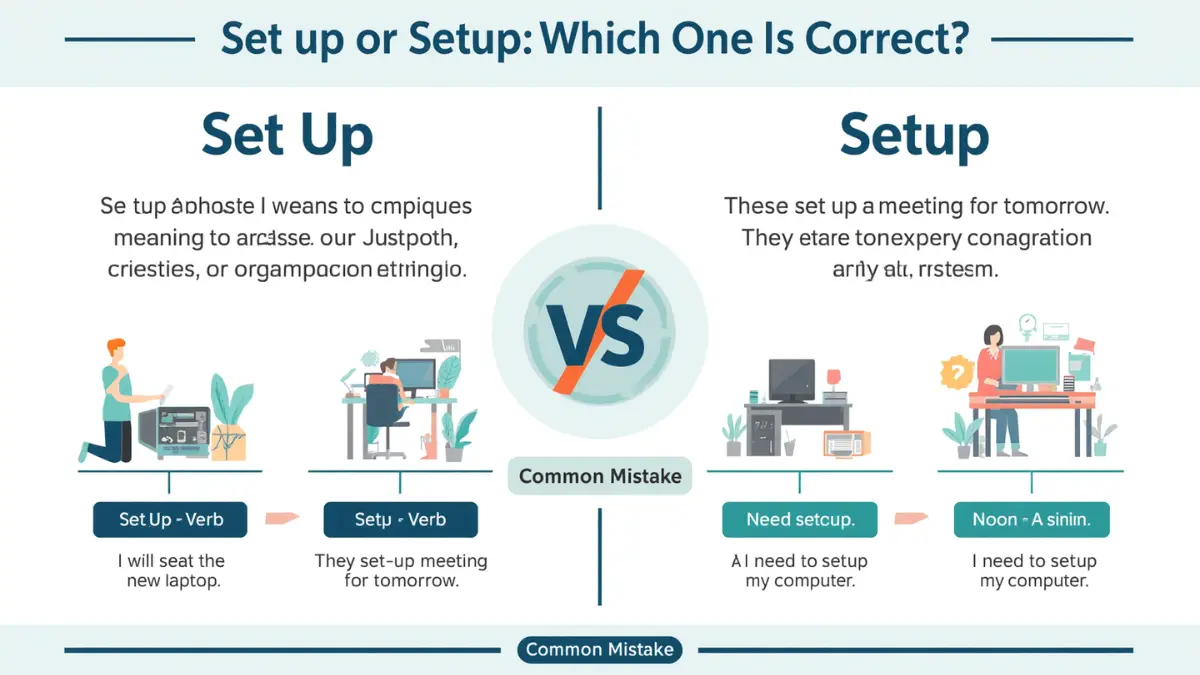
Set Up or Setup – Quick Answer
The quick answer is simple:
- Set up = Verb (an action)
- Setup = Noun or adjective (a thing or description)
Examples
✅ I need to set up my new laptop.
✅ They will set up the meeting tomorrow.
✅ The computer setup took only ten minutes.
✅ We have a simple office setup.
Easy Rule
If you can replace it with an action, use set up.
If you are naming a thing, system, arrangement, or configuration, use setup.
Read more: Is It Your Welcome or You’re Welcome
The Origin of Set Up or Setup
The phrase set up comes from the verb set, which has existed in English for centuries. People originally used it to mean placing something upright or arranging something in position.
Over time, English speakers began combining the words set and up to describe many actions, such as:
- Set up a tent
- Set up a business
- Set up a meeting
- Set up equipment
Later, the combined form setup appeared as a noun. English often turns common verb phrases into single-word nouns.
Read more: Border or Boarder: What’s the Difference
Examples include:
| Verb Phrase | Noun Form |
| set up | setup |
| check in | check-in |
| log in | login |
| backup | backup |
This natural language development explains why both spellings exist today.
British English vs American English Spelling
Unlike many spelling differences between British and American English, set up and setup are generally the same in both regions.
Both British and American style guides follow the same rule:
- Set up = verb
- Setup = noun/adjective
Comparison Table
| Usage | British English | American English |
| Verb | set up | set up |
| Noun | setup | setup |
| Adjective | setup process | setup process |
| Computer installation | setup | setup |
| Event arrangement | setup | setup |
Examples
British English
- We need to set up the conference room.
- The room setup looks professional.
American English
- Please set up the software.
- The software setup is easy.
There is virtually no regional spelling disagreement for these words.
Which Spelling Should You Use?
The correct choice depends on how the word functions in your sentence.
Use “Set Up” When
You are describing an action.
Examples:
- Set up a website.
- Set up an account.
- Set up a meeting.
- Set up a camera.
Use “Setup” When
You are naming a system, arrangement, configuration, or process.
Examples:
- Office setup
- Computer setup
- Home theater setup
- Network setup
Audience-Based Advice
| Audience | Recommended Usage |
| United States | Follow verb/noun rule |
| United Kingdom | Follow verb/noun rule |
| Canada | Follow verb/noun rule |
| Australia | Follow verb/noun rule |
| Global Audience | Follow verb/noun rule |
The rule remains the same worldwide.
Common Mistakes with Set Up or Setup
Many writers accidentally switch the two forms.
Mistake #1
❌ I will setup the printer.
✅ I will set up the printer.
Why? The phrase describes an action.
Mistake #2
❌ My computer set up is complete.
✅ My computer setup is complete.
Why? Here it is a noun.
Mistake #3
❌ We need a better set-up process.
✅ We need a better setup process.
Modern style guides generally prefer setup as one word.
Mistake #4
❌ The technician completed the set up.
✅ The technician completed the setup.
The completed arrangement is a noun.
Quick Correction Guide
| Incorrect | Correct |
| setup the account | set up the account |
| setup a meeting | set up a meeting |
| computer set up | computer setup |
| office set up | office setup |
Set Up or Setup in Everyday Examples
In Emails
- Please set up a meeting for next week.
- The new office setup looks great.
In News Articles
- The company plans to set up a new branch.
- The security setup passed inspection.
On Social Media
- I just finished setting up my gaming room!
- Check out my new gaming setup.
In Formal Writing
- The team will set up the equipment before the event.
- The laboratory setup meets industry standards.
In Technology
- Follow the instructions to set up your device.
- The setup wizard will guide you through installation.
Set Up or Setup – Google Trends & Usage Data
Search data shows that both terms are widely used because they serve different purposes.
Where “Set Up” Is Popular
People often search for:
- How to set up Wi-Fi
- How to set up email
- How to set up a business
- How to set up a website
These searches involve actions.
Where “Setup” Is Popular
People often search for:
- Gaming setup
- Office setup
- PC setup
- Home setup
These searches involve systems or arrangements.
Usage by Country
| Country | More Common Search Intent |
| United States | Both forms frequently used |
| United Kingdom | Both forms frequently used |
| Canada | Both forms frequently used |
| Australia | Both forms frequently used |
| India | Strong usage of both forms |
| Pakistan | Strong usage of both forms |
The popularity depends more on context than location.
Set Up vs Setup Comparison Table
| Feature | Set Up | Setup |
| Part of Speech | Verb | Noun |
| Function | Action | Thing or arrangement |
| One Word? | No | Yes |
| Example | Set up the printer | Printer setup |
| Example | Set up the meeting | Meeting setup |
| Example | Set up the account | Account setup |
| Formal Usage | Yes | Yes |
| British English | Same | Same |
| American English | Same | Same |
FAQs
Is setup one word or two?
Both forms are correct. Use setup as a noun and set up as a verb.
Which is correct: set up a meeting or set up a meeting?
Set up a meeting is correct because it describes an action.
Is computer setup correct?
Yes. Computer setup is correct because setup is a noun.
Is the set up always two words?
When used as a verb, yes. It remains two separate words.
Do British and American English use different spellings?
No. Both follow the same grammar rule.
Is setup formal English?
Yes. It is commonly used in professional, academic, and technical writing.
How can I remember the difference?
Think of set up as something you do and setup as something you have.
Conclusion
The difference between set up and setup is easier than many people think. The key is understanding how the word functions in a sentence. If you’re talking about an action, use set up. If you’re referring to a system, arrangement, configuration, or completed result, use setup.
This rule applies in both British and American English, making it one of the simpler grammar distinctions to learn. Whether you’re writing emails, creating technical documents, publishing website content, or posting on social media, choosing the correct form helps your writing appear clear and professional.
A simple memory trick can help: set up is something you do, while setup is something you have. Once you remember this distinction, you’ll avoid one of the most common writing mistakes related to these words. Following this rule ensures your communication remains accurate, polished, and easy for readers to understand in every situation.

Henry is a passionate English professor, language specialist, and the founder of SpellCompare.com. With years of academic experience and a deep understanding of grammar, vocabulary, and linguistic nuances, he has dedicated his career to helping students and writers master the English language with clarity and confidence.
As an expert in word comparisons, spelling differences, and grammar rules, Henry simplifies complex language concepts into easy-to-understand explanations. His mission is to eliminate confusion between commonly misused words and provide accurate, research-based guidance that improves writing skills for learners worldwide.
Through SpellCompare.com, Henry combines academic expertise with practical examples, creating content that is clear, reliable, and reader-friendly. His work focuses on precision, correctness, and helping others communicate effectively in both academic and professional settings.
When he’s not teaching or writing, Henry continues researching evolving language trends to ensure his content remains current, helpful, and authoritative.