Imagine you want to build a fence around your garden and also plant grass inside it. The length of the fence tells you how much boundary you need, while the grass tells you how much space is inside the garden.
This simple real-life example explains the difference between area and perimeter. Many students, teachers, builders, and even designers often confuse these two mathematical terms because both are related to shapes and measurements.
The difference between area and perimeter is important in daily life, from construction and farming to architecture and sports field design. Understanding the difference between area and perimeter helps learners solve math problems correctly and helps professionals make better calculations.
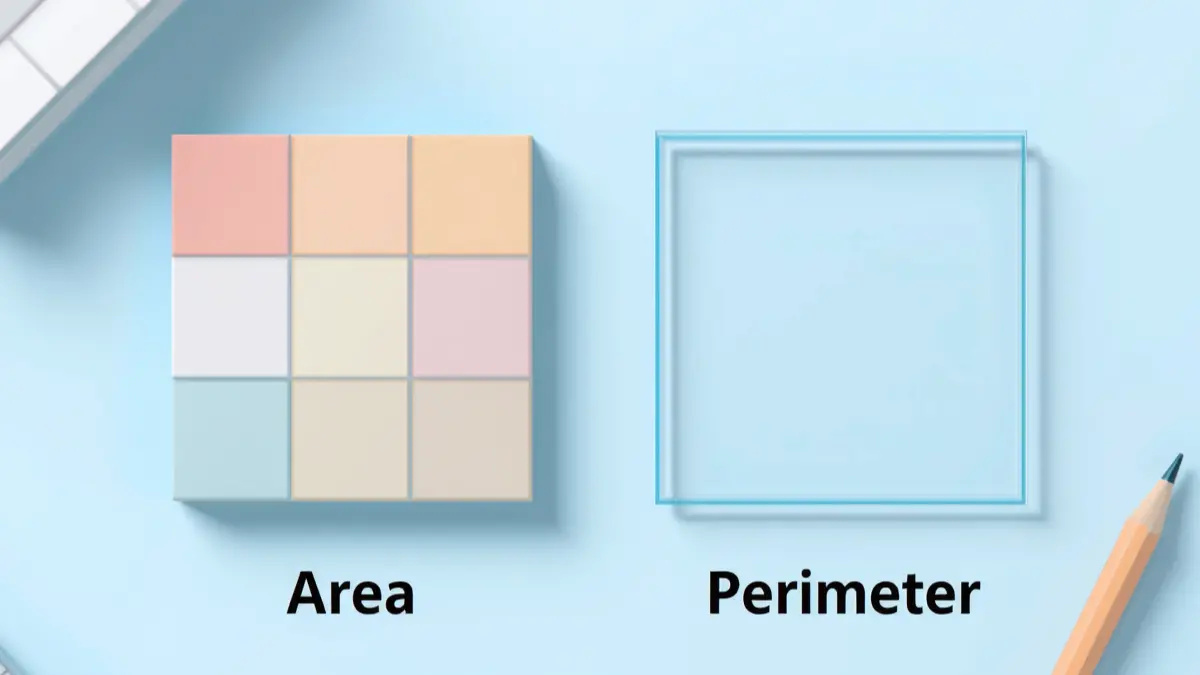
In simple words, area measures the inside space of a shape, while perimeter measures the outer boundary. Learning the difference between area and perimeter can make geometry easier and more practical for everyone.
Pronunciation of Both Words
Area
- US Pronunciation: /ˈer.i.ə/
- UK Pronunciation: /ˈeə.ri.ə/
Perimeter
- US Pronunciation: /pəˈrɪm.ə.t̬ɚ/
- UK Pronunciation: /pəˈrɪm.ɪ.tə/
Understanding these pronunciations makes learning geometry more engaging and accurate. Now, let us explore the main differences between these two important mathematical concepts.
Difference Between Exothermic and Endothermic: A Guide?
Difference Between Area and Perimeter
Key Difference Between Both
The main difference between area and perimeter is that area measures the amount of space inside a shape, while perimeter measures the total distance around the outside of a shape.
For example:
- A carpet covers the area of a room.
- A wall border measures the perimeter of a room.
Area is measured in square units such as square meters or square centimeters, whereas perimeter is measured in simple linear units such as meters or centimeters.
Difference Between Adderall and Meth: A Complete Easy Guide?
Why Is Their Difference Necessary to Know?
Understanding the difference between area and perimeter is important for both learners and experts because these concepts are used in everyday life and many professions.
Importance in Society
- Builders calculate perimeter for fencing and area for flooring.
- Farmers measure land area for crops and perimeter for boundaries.
- Architects use both while designing homes and parks.
- Teachers use these concepts to improve logical thinking in students.
- Sports field designers calculate the perimeter and area for proper layouts.
Without understanding their difference, measurements can become incorrect and costly.
H2 Difference Between Area and Perimeter
| Point of Difference | Area | Perimeter |
| Meaning | Measures inside space | Measures outside boundary |
| Units | Square units | Linear units |
| Formula | Length × Width | Sum of all sides |
| Purpose | Space calculation | Boundary calculation |
| Used For | Flooring, painting | Fencing, borders |
| Dimension | Two-dimensional | One-dimensional |
| Symbol | sq units | units |
| Focus | Interior region | Exterior line |
| Shape Coverage | Entire surface | Edge only |
| Example | Carpet area | Fence length |
1. Difference in Meaning
Area
Area measures the total space inside a shape.
Examples
- The area of a classroom floor tells how much tile is needed.
- The area of a field shows how much land is available for farming.
Perimeter
The perimeter measures the total length around a shape.
Examples
- The perimeter of a park tells how much fencing is required.
- The perimeter of a playground shows the running boundary.
2. Difference in Units
Area
The area uses square units because it covers surface space.
Examples
- A room may have an area of 100 square feet.
- A book cover may have an area of 50 square centimeters.
Perimeter
Perimeter uses ordinary length units.
Examples
- A garden perimeter may be 40 meters.
- A table perimeter may be 12 feet.
3. Difference in Formula
Area
Different shapes have different formulas for area.
A = l \times w
Examples
- Rectangle area = length × width.
- Triangle area = ½ × base × height.
Perimeter
The perimeter is found by adding all side lengths.
P = 2(l+w)
Examples
- Rectangle perimeter = 2(length + width).
- Square perimeter = 4 × side.
4. Difference in Purpose
Area
Area helps calculate coverage.
Examples
- Painters use area to estimate paint.
- Farmers use the area to measure crops.
Perimeter
The perimeter helps calculate boundaries.
Examples
- Builders use perimeter for walls.
- Gardeners use perimeter for fences.
5. Difference in Dimension
Area
Area is two-dimensional because it has length and width.
Examples
- A painting canvas has area.
- A football field has an area.
Perimeter
The perimeter is one-dimensional because it only measures length.
Examples
- A track boundary has a perimeter.
- A picture frame edge has a perimeter.
6. Difference in Shape Coverage
Area
Area covers the whole surface.
Examples
- Water covering a pond represents the area.
- A blanket covering a bed represents the area.
Perimeter
The perimeter only traces the edges.
Examples
- Ribbon around a gift box shows perimeter.
- Border tape around a chart paper shows perimeter.
7. Difference in Real-Life Use
Area
The area is useful for filling spaces.
Examples
- Carpet installation depends on the area.
- Floor tiling depends on the area.
Perimeter
The perimeter is useful for enclosing spaces.
Examples
- Boundary walls depend on the perimeter.
- Wire fencing depends on the perimeter.
8. Difference in Mathematical Representation
Area
Area is written with square notation.
Examples
- 25 cm²
- 100 m²
Perimeter
Perimeter is written in normal units.
Examples
- 40 cm
- 200 m
9. Difference in Visual Appearance
Area
The area looks like a filled region.
Examples
- Colored map regions show the area.
- Painted walls show the area.
Perimeter
The perimeter appears as an outline.
Examples
- Chalk outline on a board.
- Boundary line of a stadium.
10. Difference in Calculation Method
Area
Area often requires multiplication.
Examples
- Length × width for rectangles.
- πr² for circles.
Perimeter
The perimeter mainly requires addition.
Examples
- Adding all four sides of a square.
- Adding all polygon edges.
Why Are People Confused About Their Use?
People confuse area and perimeter because both deal with measurements of shapes. Students often think larger perimeter means larger area, but this is not always true. Two shapes can have the same perimeter but different areas. The formulas also appear similar, which creates misunderstanding. Another reason is that both concepts are taught together in geometry classes.
Difference and Similarity Between Area and Perimeter
| Feature | Area | Perimeter | Similarity |
| Definition | Inside space | Outer boundary | Both measure shapes |
| Units | Square units | Linear units | Both use measurement |
| Purpose | Coverage | Boundary | Both useful in geometry |
| Formula Type | Multiplication | Addition | Both need dimensions |
| Application | Flooring | Fencing | Both used in construction |
Which Is Better in What Situation?
When Area Is Better
Area is better when you need to know how much space is covered or occupied. It is useful for painting walls, buying carpets, planting crops, laying tiles, and designing rooms. Architects and engineers often focus on area because it helps estimate materials and costs accurately. Students also use areas in geometry to understand surfaces and dimensions. In daily life, area helps determine the usable space inside homes, parks, and buildings.
When Perimeter Is Better
Perimeter is better when the boundary or outer edge matters more than the inside space. It is useful for fencing gardens, building walls, creating borders, and designing tracks or pathways. Security planners and landowners often calculate perimeter to protect property. Sports fields also use perimeter measurements for boundary lines. In everyday life, perimeter helps measure the length required to surround or enclose something effectively.
How the Keywords Are Used in Metaphors and Similes
Area in Metaphors and Similes
- “Her knowledge covered a vast area.”
- “The city spread like an endless area of lights.”
Perimeter in Metaphors and Similes
- “He built a perimeter around his emotions.”
- “The guards stood like a human perimeter.”
Connotative Meaning of Both Keywords
Area
Positive Meaning
- Growth and opportunity
- Example: “The company entered a new area of success.”
Neutral Meaning
- Region or space
- Example: “This area is reserved for parking.”
Negative Meaning
- Restricted zone
- Example: “The danger area was blocked.”
Perimeter
Positive Meaning
- Protection and safety
- Example: “The security perimeter kept everyone safe.”
Neutral Meaning
- Boundary line
- Example: “The school perimeter was measured.”
Negative Meaning
- Limitation or restriction
- Example: “He could not step beyond the perimeter.”
Idioms or Proverbs Related to the Words
Related to Area
“Gray Area”
Meaning: Something unclear or uncertain.
Example
“The rules about online content remain a gray area.”
Related to Perimeter
“Perimeter Defense”
Meaning: Protecting the outer boundary first.
Example
“The army strengthened its perimeter defense before the storm.”
Works in Literature Using the Keywords
Area
- “Area 7” — Thriller novel by Matthew Reilly (2001)
- “The Forbidden Area” — Fiction by Pat Murphy (1989)
Perimeter
- “Perimeter” — Science fiction novel by Michael Atamanov (2020)
- “The Perimeter” — Historical nonfiction by Erika Fatland (2017)
Movies Related to the Keywords
Area
- “Area 51” — 2015, USA
- “The Area” — 2016, USA
Perimeter
- “Outside the Perimeter” — 2022, Canada
- “Perimeter Road” — 2019, USA
Frequently Asked Questions
1. What is the main difference between area and perimeter?
Area measures inside space, while perimeter measures the boundary around a shape.
2. Can two shapes have the same perimeter but different areas?
Yes. Different shapes can share the same perimeter but have different areas.
3. Why is the area measured in square units?
Because the area covers a two-dimensional surface.
4. Why is perimeter important in daily life?
Perimeter helps measure fences, borders, walls, and boundaries.
5. Which formula is used for the perimeter of a rectangle?
P = 2(l+w)
How Both Are Useful for Surroundings
Area and perimeter are useful in maintaining organized surroundings. The area helps in planning parks, farms, buildings, and playgrounds efficiently. The perimeter helps secure places through walls and fences. Together, they improve city planning, farming, construction, and environmental management. Without these concepts, designing safe and functional spaces would become difficult.
Final Words for Both
Area and perimeter are essential mathematical concepts that simplify real-world measurements. Area focuses on space and coverage, while perimeter focuses on boundaries and protection. Understanding both improves problem-solving skills and practical decision-making.
Conclusion
The difference between area and perimeter is simple yet highly important in mathematics and everyday life. Area measures the space inside a shape, while perimeter measures the distance around it. These concepts are used in construction, farming, architecture, sports, and education. Although people often confuse them, understanding their formulas, units, and purposes makes geometry easier and more meaningful.
Whether you are measuring a garden, painting a room, or building a fence, knowing the difference between area and perimeter helps you make accurate calculations. Both concepts work together to create organized and functional surroundings, proving their importance in society and practical life.

SwiftHarbor is a dedicated English professor, language researcher, and the founder of SpellCompare.com. With years of academic experience in English grammar, vocabulary development, and linguistic comparison, SwiftHarbor specializes in simplifying complex language rules into clear, practical explanations.
As an expert in word usage, spelling differences, and commonly confused terms, SwiftHarbor has helped thousands of learners improve their writing accuracy and communication skills. Through SpellCompare.com, he provides detailed comparisons, easy examples, and research-based insights that make English learning accessible for students, writers, and professionals worldwide.
Known for a clear teaching style and structured explanations, SwiftHarbor focuses on eliminating confusion between similar words, improving grammar confidence, and promoting precise communication. His mission is simple: to make English easier, clearer, and more powerful for everyone.