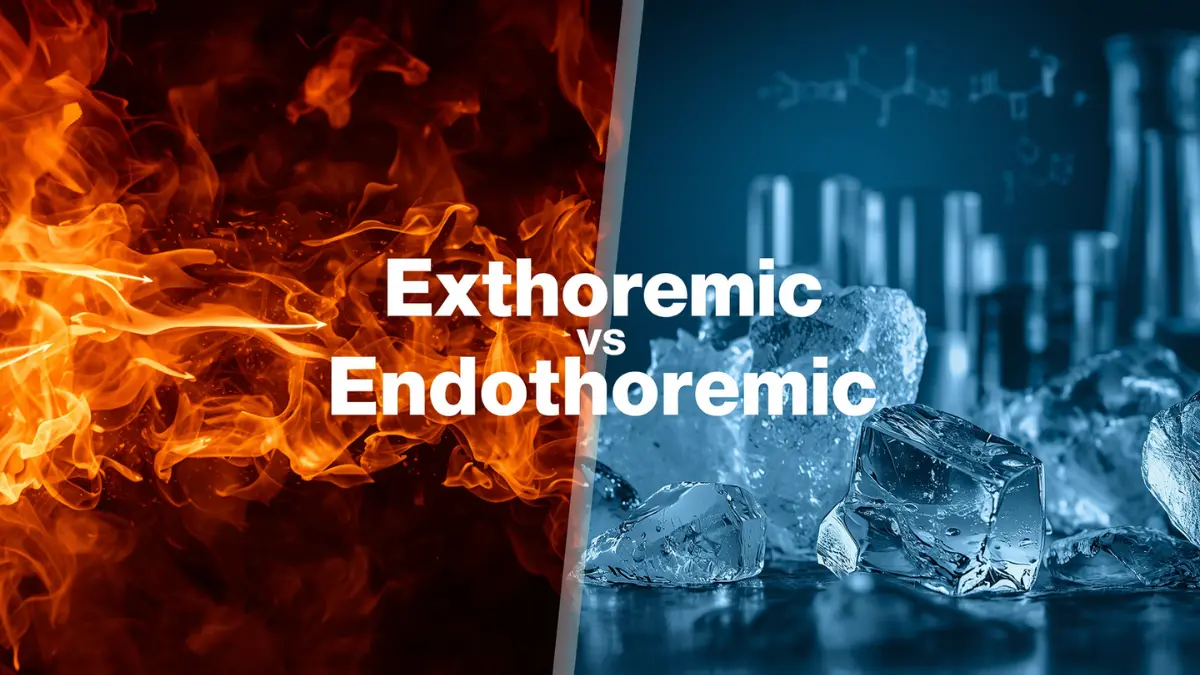
In chemistry, energy is everything and reactions are constantly either releasing or absorbing it. This is where the difference between exothermic and endothermic reactions becomes important. Imagine holding a hot pack in winter; it warms your hands because of an exothermic reaction releasing heat. Now think of an ice pack used for injuries.
It feels cold because of an endothermic reaction absorbing heat. These real-life experiences clearly show the difference between exothermic and endothermic, making chemistry easier to understand.
The difference between exothermic and endothermic reactions is not just a textbook idea but something we experience daily in cooking, weather changes, and even biological processes. Understanding the difference between exothermic and endothermic helps students, scientists, and engineers make sense of energy flow in nature and industry.
Pronunciation:
- Exothermic: /ˌek.soʊˈθɜːr.mɪk/ (US), /ˌek.səʊˈθɜː.mɪk/ (UK)
- Endothermic: /ˌen.doʊˈθɜːr.mɪk/ (US), /ˌen.dəʊˈθɜː.mɪk/ (UK)
Now that we understand the basics, let’s connect these energy changes more deeply and explore how they behave in real chemistry.
Difference Between Exothermic and Endothermic
1. Energy Flow
- Exothermic: Releases energy to surroundings
- Example: Burning wood releases heat
- Example: Respiration in humans releases energy
- Endothermic: Absorbs energy from surroundings
- Example: Melting ice absorbs heat
- Example: Photosynthesis absorbs sunlight
- Difference Between Album and EP: in (2026)
2. Temperature Change
- Exothermic: Surroundings become warmer
- Example: Fire heating a room
- Example: Concrete setting process
- Endothermic: Surroundings become cooler
- Example: Instant cold packs
- Example: Evaporation of sweat
3. Energy of Products and Reactants
- Exothermic: Products have lower energy than reactants
- Example: Combustion of fuel
- Example: Acid-base neutralization
- Endothermic: Products have higher energy than reactants
- Example: Thermal decomposition of limestone
- Example: Dissolving ammonium nitrate
- Difference Between Americano and Coffee: A Complete Guide?
4. Heat Absorption or Release
- Exothermic: Heat is released
- Example: Explosions
- Example: Freezing water
- Endothermic: Heat is absorbed
- Example: Boiling water
- Example: Cooking an egg
5. Bond Formation and Breaking
- Exothermic: Bond formation releases energy
- Example: Formation of water
- Example: Condensation process
- Endothermic: Bond breaking requires energy
- Example: Splitting hydrogen gas
- Example: Evaporation process
6. Enthalpy Change
- Exothermic: Negative enthalpy (ΔH < 0)
- Example: Rust formation
- Example: Combustion of methane
- Endothermic: Positive enthalpy (ΔH > 0)
- Example: Photosynthesis
- Example: Melting solids
7. Spontaneity
- Exothermic: Often spontaneous
- Example: Burning paper
- Example: Iron rusting
- Endothermic: Usually needs continuous energy input
- Example: Electrolysis of water
- Example: Ice melting in freezer off
8. Energy Storage
- Exothermic: Energy is released from stored chemical bonds
- Example: Batteries discharging
- Example: Digestion of food
- Endothermic: Energy is stored in bonds
- Example: Plant growth
- Example: Fuel formation
9. Reaction Environment
- Exothermic: Requires no external heating
- Example: Fireworks
- Example: Neutralization reactions
- Endothermic: Requires external energy
- Example: Cooking rice
- Example: Melting wax
10. Effect on Surroundings
- Exothermic: Increases surrounding temperature
- Example: Lava flow
- Example: Hand warmers
- Endothermic: Decreases surrounding temperature
- Example: Ice packs
- Example: Sweat evaporation
Nature and Behaviour of Both
Exothermic reactions naturally release energy and tend to stabilize systems by lowering internal energy. They are often fast, powerful, and noticeable, such as explosions or burning fuels.
Endothermic reactions behave oppositely; they absorb energy and create cooling effects. They are often slower and require continuous energy input, like plant photosynthesis or evaporation processes. Both are essential for maintaining energy balance in nature.
Why People Get Confused
People often confuse these terms because both involve energy changes and heat flow. The direction of energy transfer is not always visually obvious. For example, boiling water (endothermic) feels like heat is being produced, but it actually absorbs energy. Similarly, freezing water (exothermic) releases heat even though it feels cold externally.
Table: Difference and Similarities
| Feature | Exothermic | Endothermic |
| Energy flow | Releases energy | Absorbs energy |
| Temperature effect | Increases surroundings | Decreases surroundings |
| Enthalpy | Negative | Positive |
| Reaction need | No external energy | Needs external energy |
| Example | Burning fuel | Photosynthesis |
Similarity: Both involve energy changes and occur in chemical reactions.
Which Is Better in What Situation?
Exothermic reactions are more useful when energy output is needed. For example, heating systems, engines, and combustion processes rely on exothermic reactions because they produce heat and power. They are ideal for generating energy quickly and efficiently.
Endothermic reactions are better when cooling or energy absorption is required. For example, cold packs for injuries, refrigeration, and photosynthesis depend on endothermic processes. Without them, natural cooling systems and biological energy storage would not function properly. Both are equally important depending on the situation.
Metaphors and Similes
- Exothermic reactions are like “a burning fire in winter”they give warmth and energy.
- Endothermic reactions are like “a sponge soaking up water”they absorb energy from surroundings.
Connotative Meaning
- Exothermic: Positive connotation (energy, warmth, power, activity)
- Example: “Her enthusiasm was exothermic, spreading energy in the room.”
- Endothermic: Neutral to slightly negative (cooling, energy loss, absorption)
- Example: “The project felt endothermic, draining all his motivation.”
Idioms or Proverbs
There are no common idioms directly using these terms, but they can be used creatively:
- “His anger turned exothermic” → meaning sudden emotional release
- “The room went endothermic after the bad news” → meaning energy dropped suddenly
In Literature
These scientific terms are rarely used as direct themes in literature, but energy concepts appear in:
- Genre: Science fiction
- Authors like Isaac Asimov (1950s–1980s) explore energy systems
- Genre: Educational science writing
- Writers like Bill Bryson (2003, A Short History of Nearly Everything) explain energy reactions
In Movies
Direct titles on these terms do not exist, but energy concepts appear in:
- Interstellar (2014, USA) – explores energy and physics concepts
- The Martian (2015, USA) – survival energy use in science conditions
- Chain Reaction (1996, USA) – deals with energy and chemical reactions
Frequently Asked Questions
1. What is the main difference between exothermic and endothermic?
Exothermic releases heat, while endothermic absorbs heat.
2. Which reaction feels hot or cold?
Exothermic feels hot; endothermic feels cold.
3. Is photosynthesis exothermic or endothermic?
It is endothermic because it absorbs sunlight.
4. Why do we study these reactions?
To understand energy changes in nature and industry.
5. Can both occur in the same system?
Yes, many biological systems use both types.
How Both Are Useful for Surroundings
Exothermic reactions provide energy for heating, cooking, transportation, and natural processes like respiration. Endothermic reactions help in cooling systems, plant growth, and environmental balance. Together, they maintain Earth’s energy cycle and support life processes in a balanced ecosystem.
Final Words
Both exothermic and endothermic reactions are essential parts of chemistry and daily life. One releases energy while the other absorbs it, creating a perfect balance in nature. Without exothermic reactions, we would lack heat and power. Without endothermic reactions, cooling systems and life processes like photosynthesis would not exist. Understanding the difference between exothermic and endothermic helps us better interpret natural phenomena and industrial processes. These reactions are not just scientific concepts but the hidden forces shaping everything around us.
Conclusion
The difference between exothermic and endothermic reactions is a fundamental concept in chemistry that explains how energy moves in chemical processes. Exothermic reactions release energy into the surroundings, making them warmer and often more energetic, while endothermic reactions absorb energy, creating cooling effects.
Both play vital roles in nature, technology, and daily life. From burning fuels and respiration to photosynthesis and evaporation, these reactions maintain the Earth’s energy balance.
Understanding them helps students, scientists, and engineers design better systems for energy use, industrial processes, and environmental control. In simple terms, one gives out energy and the other takes it in but together, they keep the world functioning smoothly and sustainably.

Henry is a passionate English professor, language specialist, and the founder of SpellCompare.com. With years of academic experience and a deep understanding of grammar, vocabulary, and linguistic nuances, he has dedicated his career to helping students and writers master the English language with clarity and confidence.
As an expert in word comparisons, spelling differences, and grammar rules, Henry simplifies complex language concepts into easy-to-understand explanations. His mission is to eliminate confusion between commonly misused words and provide accurate, research-based guidance that improves writing skills for learners worldwide.
Through SpellCompare.com, Henry combines academic expertise with practical examples, creating content that is clear, reliable, and reader-friendly. His work focuses on precision, correctness, and helping others communicate effectively in both academic and professional settings.
When he’s not teaching or writing, Henry continues researching evolving language trends to ensure his content remains current, helpful, and authoritative.