Have you ever written a sentence and stopped to wonder whether you should use choose or chose? This is one of the most common grammar questions in English. Since the two words look very similar and come from the same verb, many people accidentally use the wrong one.
Imagine you’re sending an important email and write, “Yesterday, I choose the best option.” Something feels wrong, but you’re not sure why. That’s exactly why people search for choose or chose. They want a quick answer and a simple explanation.
The confusion comes from verb tenses. Both words relate to making a decision, selecting an option, or picking something. However, one refers to the present or future, while the other refers to the past. Understanding choose or chose helps students, professionals, writers, and English learners communicate more accurately.
In this guide, you’ll learn the difference between choose or chose, their origins, usage rules, common mistakes, examples, and practical advice for everyday writing.
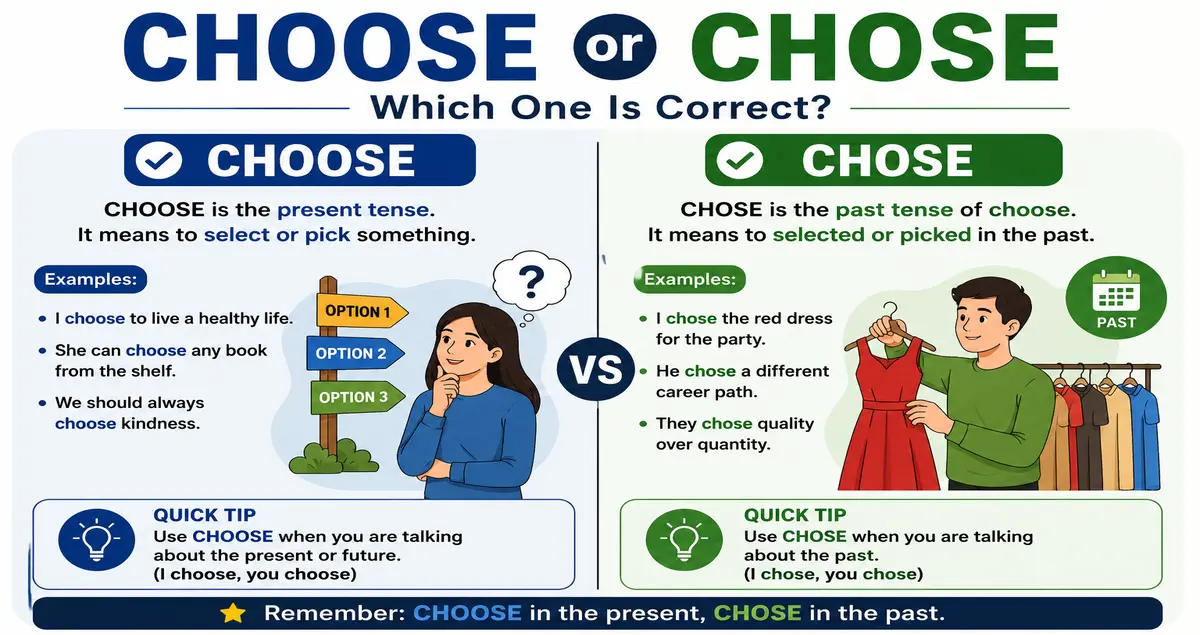
Choose or Chose – Quick Answer
✅ Choose = Present tense verb
✅ Chose = Past tense verb
Examples
- I choose healthy food every day.
- Yesterday, I chose healthy food.
Quick Rule
If the action is happening now or in the future, use choose.
If the action already happened, use chose.
Read more: Council or Counsel: What’s the Difference?
| Word | Tense | Example |
| Choose | Present | I choose this option. |
| Chose | Past | I chose this option yesterday. |
The Origin of Choose or Chose
The words choose and chose come from the Old English verb ceosan, meaning “to select” or “to decide.”
Over centuries, English evolved and created different verb forms:
- Choose (present tense)
- Chose (past tense)
- Chosen (past participle)
Why the Difference Exists
English contains many irregular verbs.
Examples:
- Speak → Spoke
- Break → Broke
- Choose → Chose
Instead of adding “-ed,” the vowel changes.
That is why we write:
✅ choose → chose
❌ choose → choosed
Read more: Onsite or On Site: Differences, and Correct Usage
British English vs American English Spelling
Unlike many English words, there is no spelling difference between British and American English.
Both countries use:
- Choose
- Chose
Examples
| British English | American English |
| I choose tea. | I choose coffee. |
| She chose wisely. | She chose wisely. |
Comparison Table
| Feature | British English | American English |
| Choose | Yes | Yes |
| Chose | Yes | Yes |
| Spelling Difference | No | No |
| Meaning Difference | No | No |
Which Spelling Should You Use?
The answer depends on the time of the action.
Use Choose When
The action is happening now or will happen later.
Examples:
- I choose honesty.
- We will choose the winner tomorrow.
Use Chose When
The action already happened.
Examples:
- I chose honesty.
- We chose the winner yesterday.
Audience-Based Advice
| Audience | Recommended Usage |
| US Readers | Choose or Chose based on tense |
| UK Readers | Choose or Chose based on tense |
| Australia | Choose or Chose based on tense |
| Canada | Choose or Chose based on tense |
| Global Audience | Choose or Chose based on tense |
Common Mistakes with Choose or Chose
Mistake 1
❌ Yesterday I choose the blue shirt.
✅ Yesterday I chose the blue shirt.
Mistake 2
❌ I chose this option every day.
✅ I choose this option every day.
Mistake 3
❌ She choose the winner last week.
✅ She chose the winner last week.
Mistake 4
❌ Tomorrow I chose a college.
✅ Tomorrow I choose a college.
Easy Rule
Think:
Today = Choose
Yesterday = Chose
Choose or Chose in Everyday Examples
Emails
✅ I choose to proceed with your proposal.
✅ We chose your company for the project.
News Writing
✅ Voters chose a new leader.
Social Media
✅ I chose this outfit for tonight.
Formal Writing
✅ Participants chose from several options.
Business Communication
✅ The committee chose the final candidate.
Choose or Chose – Google Trends & Usage Data
Searches for choose or chose remain popular because learners often struggle with irregular verbs.
Common Search Queries
- Choose or chose
- Difference between choose and chose
- Choose vs chose
- When to use choose
- When to use chose
Search Interest by Country
| Country | Search Interest |
| United States | High |
| United Kingdom | High |
| India | High |
| Canada | Moderate |
| Australia | Moderate |
Usage Context
Choose appears frequently in motivational writing, advertising, and instructions.
Chose appears more often in storytelling, news reports, and historical writing.
Choose vs Chose Comparison Table
| Feature | Choose | Chose |
| Part of Speech | Verb | Verb |
| Tense | Present | Past |
| Meaning | Select something | Selected something |
| Formal Writing | Yes | Yes |
| Informal Writing | Yes | Yes |
| Dictionary Word | Yes | Yes |
| Modern Usage | Very Common | Very Common |
FAQs
Is choose present tense?
Yes. Choose is the present tense form.
Is chose past tense?
Yes. Chose is the simple past tense form.
What is the past participle of choose?
The past participle is chosen.
Example:
- I have chosen the winner.
Is choosed a word?
No. English uses chose, not choosed.
Do British and American English use the same spelling?
Yes. Both use choose and chose.
How can I remember the difference?
Remember:
- Choose = now
- Chose = before
Can I use chose for future actions?
No. Future actions require choose.
Example:
✅ I will choose tomorrow.
❌ I will chose tomorrow.
Conclusion
Understanding the difference between choose or chose is simple once you know the role of verb tense. Both words come from the same verb, but they are used at different times. Choose is the present tense form used for actions happening now or in the future. Chose is the past tense form used for actions that already happened.
There is no spelling difference between British English and American English, making the rule easy to apply worldwide. The most common mistake is using choose for past events or chose for present actions. By remembering the simple rule “today equals choose, yesterday equals chose,” you can avoid confusion and improve your writing.
Whether you’re writing emails, reports, essays, social media posts, or business documents, using the correct form will make your communication clearer and more professional.

SwiftHarbor is a dedicated English professor, language researcher, and the founder of SpellCompare.com. With years of academic experience in English grammar, vocabulary development, and linguistic comparison, SwiftHarbor specializes in simplifying complex language rules into clear, practical explanations.
As an expert in word usage, spelling differences, and commonly confused terms, SwiftHarbor has helped thousands of learners improve their writing accuracy and communication skills. Through SpellCompare.com, he provides detailed comparisons, easy examples, and research-based insights that make English learning accessible for students, writers, and professionals worldwide.
Known for a clear teaching style and structured explanations, SwiftHarbor focuses on eliminating confusion between similar words, improving grammar confidence, and promoting precise communication. His mission is simple: to make English easier, clearer, and more powerful for everyone.