Many English learners and even native speakers get confused between “anyway” and “any way.” At first glance, they look almost the same. But they are not. One is a single adverb. The other is a phrase made of two words with a very different meaning.
People often search for this keyword when writing emails, essays, social media posts, or professional messages. They want to know: Am I using the correct form? Is it one word or two? Does it change the meaning? This confusion is common because both forms are correct but only in the right context.
Using the wrong version can make your writing look unprofessional or unclear. For example, “anyway” is used to continue or change a topic, while “any way” refers to “in any manner or method.”
In this article, you will learn the clear difference between anyway vs any way, their origin, spelling rules, usage examples, and common mistakes. You will also see simple comparisons and real-life examples so you never confuse them again.
Anyway or Any Way – Quick Answer
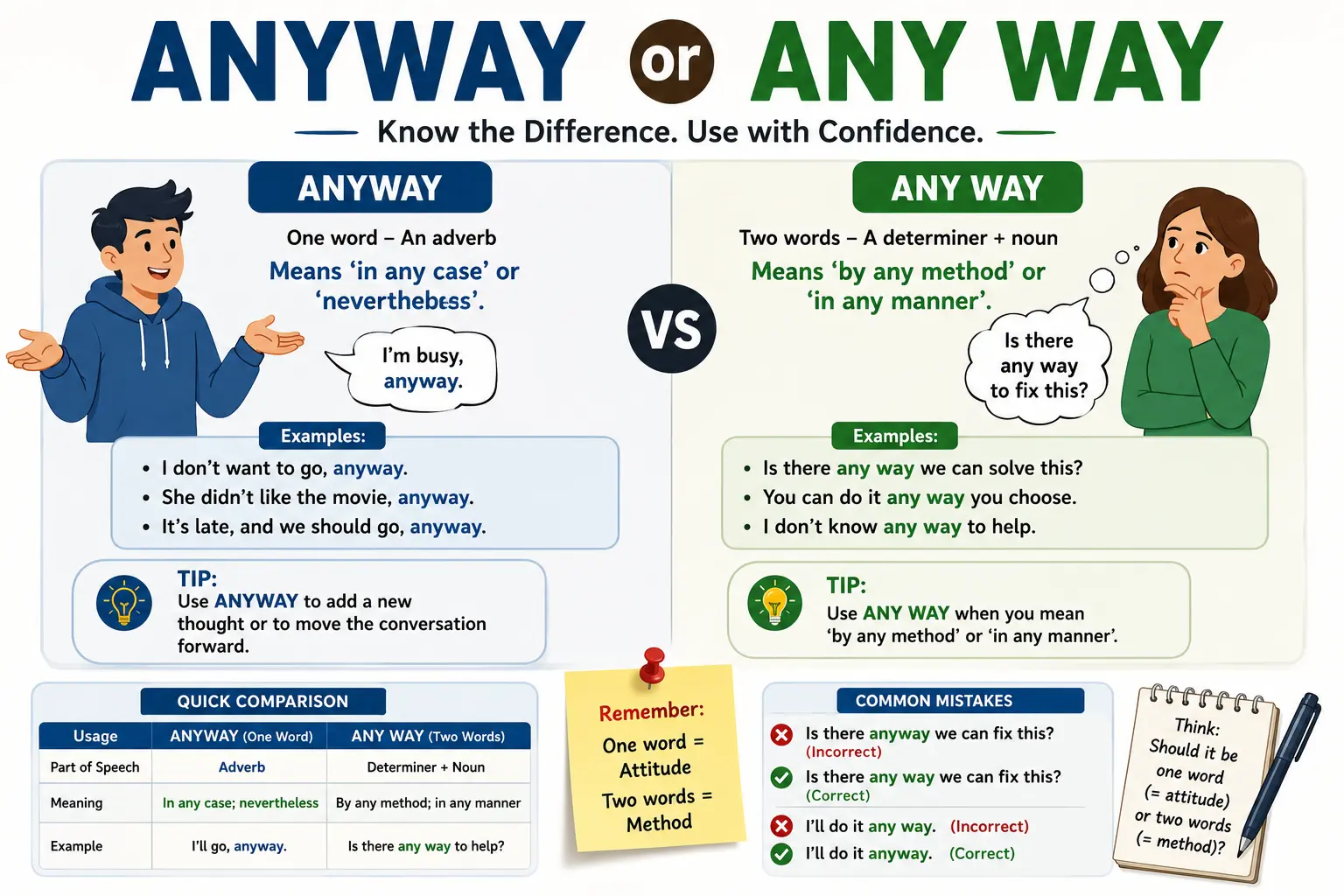
“Anyway” (one word) is an adverb meaning “in any case” or “regardless.”
“Any way” (two words) means “any method or manner.”
Examples:
- Anyway: I was tired, but I went to work anyway.
- Any way: Is there any way to fix this problem?
👉 Simple rule:
- Use anyway = transition or change of topic
- Use any way = method or possibility
Read more: Repass or Repast: Difference, and Correct Usage?
The Origin of Anyway / Any Way
The word “anyway” comes from Middle English expressions like “any wey” meaning “in any manner.” Over time, it merged into a single word as language became more streamlined.
The phrase “any way” stayed separate because it kept its literal meaning:
- Any = any
- Way = method or path
So:
- “Anyway” evolved into a grammar adverb
- “Any way” remained a literal phrase
This separation happened naturally as English simplified spelling rules over centuries.
British English vs American English Spelling
Good news: both British and American English use “anyway” and “any way” the same way.
There is no major spelling difference between regions for this pair.
However, usage style can slightly differ:
Read more: Due to or Do to: Correct Usage and Meaning
| Expression | Meaning | US Usage | UK Usage |
| anyway | in any case / however | very common | very common |
| any way | any method | common | common |
👉 Unlike “colour/color,” this is not a regional spelling issue. It is a grammar meaning issue.
Which Spelling Should You Use?
- Use “anyway” if you are:
- Continuing a story
- Changing a topic
- Ending a point
- Speaking casually or formally
- Use “any way” if you are:
- Talking about methods
- Asking for solutions
- Describing possibilities
Simple trick:
If you can replace it with “in any case,” use it anyway.
If you mean “method,” use any way.
Common Mistakes with Anyway / Any Way
- ❌ I will do it anyway possible
✔ I will do it any way possible - ❌ Is anyway to solve this?
✔ Is there any way to solve this? - ❌ I was late, any way I joined the meeting
✔ I was late, anyway I joined the meeting - ❌ She can finish it anyway she likes
✔ She can finish it any way she likes
👉 Main mistake: mixing adverb vs noun phrase
Anyway / Any Way in Everyday Examples
Emails:
- Anyway: I am not sure about the schedule. Anyway, let’s confirm tomorrow.
- Any way: Please let me know if there is any way to reschedule the meeting.
Social Media:
- Anyway: It was a long day, but I enjoyed it anyway.
- Any way: Is there any way to make this app faster?
News / Formal Writing:
- Anyway: The project failed; anyway, lessons were learned.
- Any way: There is no any way to ignore these results.
Anyway vs Any Way – Google Trends & Usage Data
- “Anyway” is far more common in everyday writing and speech.
- “Any way” appears less often because it is more specific.
- Search interest is highest in:
- India
- Pakistan
- United States
- United Kingdom
👉 Most confusion comes from students and ESL learners searching grammar rules online.
Comparison Table: Anyway vs Any Way
| Feature | Anyway | Any Way |
| Word type | Adverb | Phrase |
| Meaning | In any case / however | Any method |
| Usage | Transition in speech/writing | Talking about method |
| Example | I was late, anyway I came | Is there any way out? |
| Formality | Common in all styles | Common in instructions |
FAQs about Anyway vs Any Way
1. Is “anyway” one word or two?
It is one word when used as an adverb.
2. What does “any way” mean?
It means any method or manner of doing something.
3. Can I use “anyway” in formal writing?
Yes, but use it carefully as a transition word.
4. Is “anyway” correct English?
Yes, it is completely correct and widely used.
5. What is the easiest way to remember the difference?
If it means “in any case,” use anyway. If it means “method,” use any way.
6. Are both used in British and American English?
Yes, both forms are used the same way in both variants.
7. Why do people confuse them?
Because they sound similar but have different grammatical roles.
Conclusion
Understanding the difference between anyway and any way is simple once you know the rule. One is a single adverb used to continue or change a conversation. The other is a two-word phrase that refers to a method or possibility. Although they look similar, their meanings are very different.
Many learners confuse them because spoken English does not clearly separate the words. However, in writing, the difference becomes important. Using the wrong form can change your meaning or make your sentence unclear. For example, “Is there any way to fix this?” asks for a solution, while “Anyway, let’s move on” changes the topic.
There is no major difference between British and American English for this pair, which makes it easier to learn. The key is to focus on meaning, not spelling rules.
If you remember just one thing, keep this in mind: “anyway” = in any case, “any way” = any method.” With this simple rule, you can avoid mistakes and write with confidence in emails, essays, and everyday communication.

Henry is a passionate English professor, language specialist, and the founder of SpellCompare.com. With years of academic experience and a deep understanding of grammar, vocabulary, and linguistic nuances, he has dedicated his career to helping students and writers master the English language with clarity and confidence.
As an expert in word comparisons, spelling differences, and grammar rules, Henry simplifies complex language concepts into easy-to-understand explanations. His mission is to eliminate confusion between commonly misused words and provide accurate, research-based guidance that improves writing skills for learners worldwide.
Through SpellCompare.com, Henry combines academic expertise with practical examples, creating content that is clear, reliable, and reader-friendly. His work focuses on precision, correctness, and helping others communicate effectively in both academic and professional settings.
When he’s not teaching or writing, Henry continues researching evolving language trends to ensure his content remains current, helpful, and authoritative.