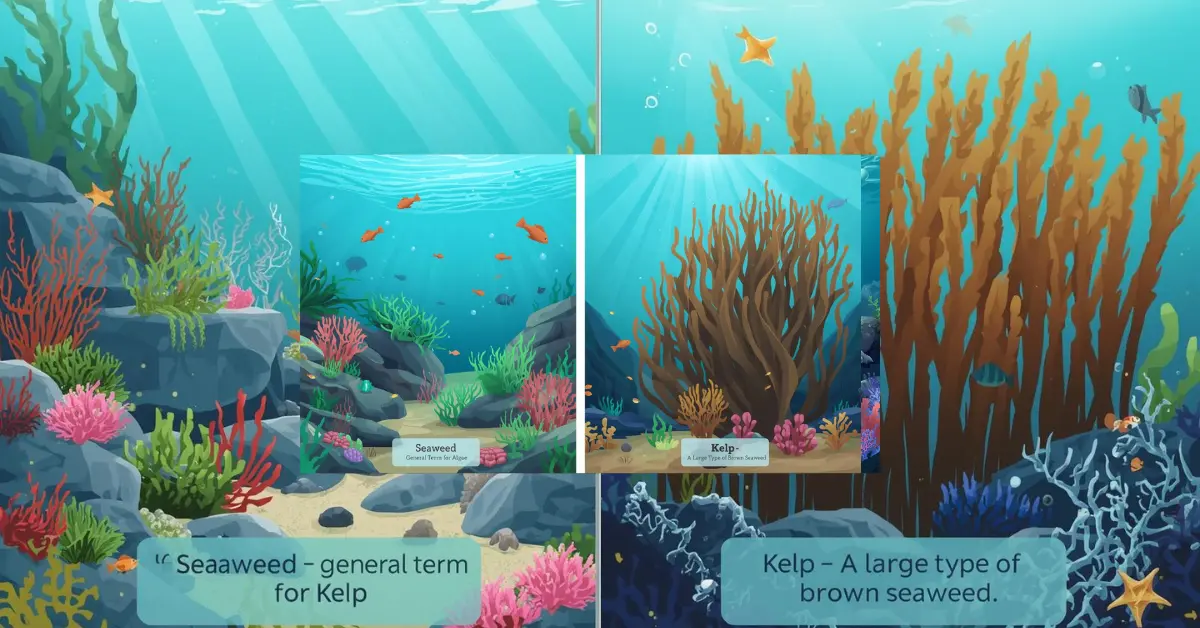
Imagine walking along the shoreline during a quiet morning, feeling the gentle splash of waves and noticing the dark green plants floating in the water. These are seaweed, a common sight in oceans worldwide. But sometimes, you may notice long, brownish strands swaying like underwater forests. This is kelp.
While many people use the terms interchangeably, understanding the difference between seaweed and kelp is important, especially for chefs, marine biologists, and environmentalists. Seaweed and kelp differ in their structure, growth, and even their use in daily life.
Knowing these distinctions helps us appreciate the underwater world more deeply and ensures accurate knowledge when we discuss ocean plants in education, science, or cuisine.
Pronunciation:
- Seaweed – US: /ˈsiː.wiːd/, UK: /ˈsiː.wiːd/
- Kelp – US: /kɛlp/, UK: /kɛlp/
Let’s dive deeper to explore the main differences between seaweed and kelp, their behavior, uses, and significance.
Difference Between Seaweed and Kelp
1. Type of Organism
- Seaweed: General term for all macroscopic marine algae.
- Example 1: Nori used in sushi is a type of red seaweed.
- Example 2: Green seaweed grows near tidal pools.
- Kelp: A type of large brown seaweed belonging to the order Laminariales.
- Example 1: Giant kelp forests in California are habitats for fish.
- Example 2: Kelp is used in fertilizers and animal feed.
2. Size
- Seaweed: Can range from tiny filamentous forms to medium size.
- Example: Sea lettuce is small and soft.
- Kelp: Usually large, can grow over 45 meters.
- Example: Giant kelp forms underwater forests.
3. Color
- Seaweed: Varies – green, red, or brown.
- Example: Red dulse, green sea lettuce, brown rockweed.
- Kelp: Mostly brown due to high fucoxanthin content.
- Example: Bull kelp and giant kelp are brown.
4. Habitat
- Seaweed: Found in both shallow and deep waters.
- Example: Seaweed on beaches, tidal pools.
- Kelp: Prefers cold, nutrient-rich waters near the coast.
- Example: Kelp forests off the Pacific coast of the US.
5. Structure
- Seaweed: Simple structure – blade, stipe, holdfast.
- Example: Ulva has a thin blade-like structure.
- Kelp: Complex – includes holdfast, stipe, blade, and gas-filled pneumatocysts.
- Example: Giant kelp uses pneumatocysts to float.
6. Growth Rate
- Seaweed: Slow to moderate growth.
- Example: Red algae grows 2–5 cm per month.
- Kelp: Extremely fast-growing, up to 60 cm per day in ideal conditions.
- Example: Giant kelp can grow 30–60 meters per year.
7. Economic Importance
- Seaweed: Used in food, cosmetics, and medicine.
- Example: Agar from red seaweed.
- Kelp: Primarily used for alginate, fertilizers, and animal feed.
- Example: Kelp extract in skincare products.
8. Ecological Role
- Seaweed: Provides oxygen and habitat for small marine animals.
- Example: Seaweed mats for small crabs.
- Kelp: Forms underwater forests supporting marine biodiversity.
- Example: Fish, sea otters, and invertebrates live in kelp forests.
9. Reproduction
- Seaweed: Can reproduce sexually or asexually.
- Example: Ulva releases spores for reproduction.
- Kelp: Alternates between large sporophyte and microscopic gametophyte stages.
- Example: Giant kelp produces spores in sori.
10. Human Confusion
- People often confuse them because all kelp is seaweed, but not all seaweed is kelp.
- Example: Sushi nori (seaweed) is not kelp.
- Example: Bull kelp is a specific type of seaweed.
Nature and Behavior
- Seaweed: Flexible, grows in various coastal environments, withstands tides and waves.
- Kelp: Forms dense underwater forests, floats using gas bladders, highly sensitive to water temperature and nutrient levels.
Why People Are Confused
Many people call any floating ocean plant “seaweed,” overlooking the scientific distinctions. Culinary use and local names add to the confusion.
Seaweed vs Kelp Table
| Feature | Seaweed | Kelp | Similarity |
| Type | General marine algae | Large brown seaweed | Both are marine algae |
| Color | Green, red, brown | Mostly brown | Both can be found in oceans |
| Size | Small to medium | Very large (up to 45m) | Both vary in size |
| Habitat | Shallow & deep waters | Cold, nutrient-rich coastal waters | Both need water to grow |
| Growth Rate | Slow to moderate | Very fast | Both are photosynthetic |
| Economic Use | Food, medicine, cosmetics | Alginates, fertilizers, feed | Both have economic importance |
| Structure | Simple (blade, stipe, holdfast) | Complex (blade, stipe, holdfast, pneumatocysts) | Both have holdfasts |
Which Is Better in What Situation?
- Seaweed: Better for culinary uses like sushi, soups, and salads due to its flavor and edible variety. It’s also effective for home gardening fertilizers.
- Kelp: Ideal for industrial and ecological purposes. Kelp extracts are used in cosmetics, biofertilizers, and its forests support marine ecosystems.
Metaphors, Similes, and Connotative Meaning
- Seaweed: Neutral; can symbolize flexibility or adaptability. Example: “She moved like seaweed in the current of life.”
- Kelp: Positive; represents strength, shelter, and growth. Example: “His support was like a kelp forest for the struggling team.”
Idioms/Proverbs:
- “Castaway like seaweed” – meaning to drift without direction.
- “Stand firm like kelp in the tide” – meaning resilience.
Works in Literature
- Seaweed Girl – Children’s fiction, Jeanne Willis, 2006
- Kelp Forest – Nature literature, Douglas J. Emlen, 2012
Movies
- Finding Nemo – 2003, USA (features kelp forest scenes)
- Moana – 2016, USA (includes seaweed imagery)
Frequently Asked Questions
- Is kelp a type of seaweed?
- Yes, all kelp is seaweed, but not all seaweed is kelp.
- Can we eat all seaweeds and kelp?
- No, only edible species are safe for consumption.
- Which grows faster, seaweed or kelp?
- Kelp grows faster, sometimes up to 60 cm per day.
- Are seaweed and kelp used in medicine?
- Yes, both are used in supplements and skin care.
- Do seaweed and kelp help the environment?
- Absolutely, they provide oxygen, habitat, and improve water quality.
Usefulness for Surroundings
- Seaweed: Helps prevent coastal erosion, provides food and shelter for marine animals.
- Kelp: Creates dense underwater forests supporting marine biodiversity, reduces carbon dioxide in oceans.
Final Words
Understanding the difference between seaweed and kelp enhances our appreciation for marine life, supports environmental conservation, and improves practical use in cooking and industry. Both are vital for ocean health and human use.
Conclusion
The difference between seaweed and kelp lies in type, size, color, structure, habitat, and growth rate. While seaweed is a broad category including many edible and industrial varieties, kelp is a specific large brown seaweed with unique ecological and economic significance.
Recognizing these differences helps scientists, chefs, environmentalists, and learners accurately communicate and utilize these ocean plants. Both seaweed and kelp are essential for ecosystems, human nutrition, and industry, making them more than just floating plants in the ocean—they are vital components of life and culture.