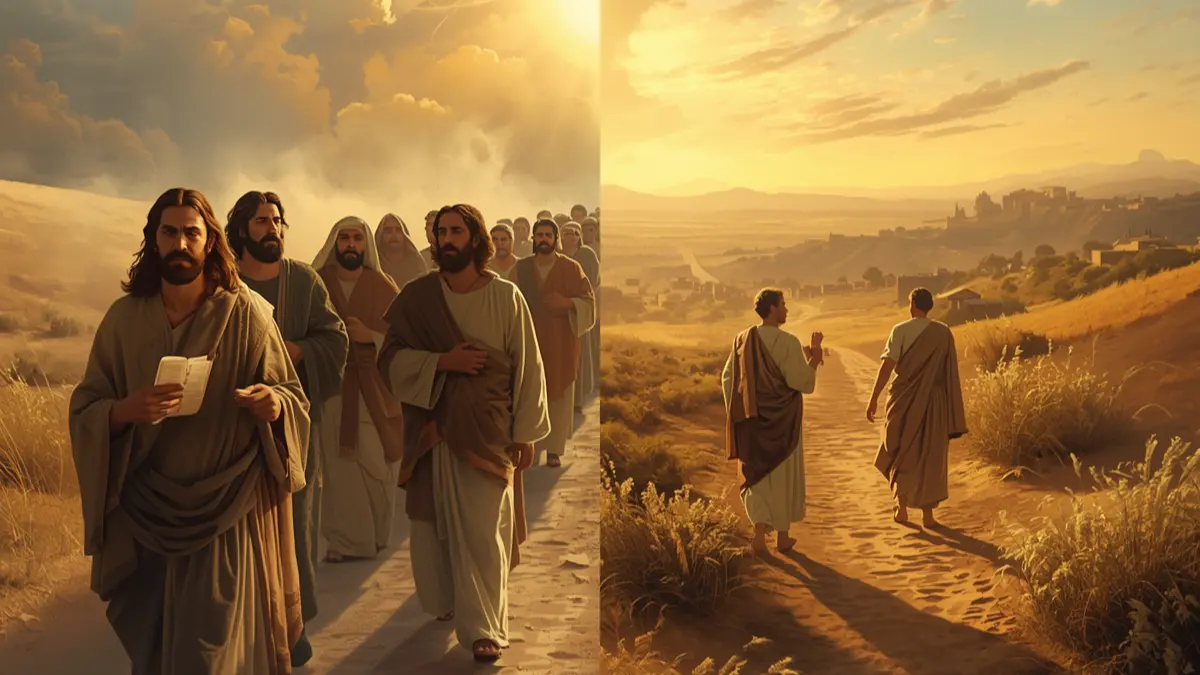
Imagine a student sitting quietly beside a wise teacher, learning every lesson carefully and following each instruction with dedication. Now imagine another person traveling from city to city, spreading the teacher’s message to the world.
These two images perfectly explain the difference between disciple and apostle. Although both words are closely connected in Christianity and religious studies, they have different meanings and purposes.
The difference between disciple and apostle is important for students, religious learners, writers, and even everyday readers who study the Bible or historical texts. A disciple is mainly a learner or follower, while an apostle is someone sent out with authority to teach and spread a message.
Many people confuse these words because the apostles of Jesus were first His disciples. Understanding the difference between disciple and apostle helps readers understand religious teachings more clearly. In this article, we will explore the difference between disciple and apostle in simple and easy language with examples, comparisons, and practical explanations.
Key Difference Between Disciple and Apostle
A disciple is a learner, student, or follower who receives knowledge from a teacher. An apostle is a messenger or representative sent to spread teachings or perform a mission with authority.
A disciple focuses on learning, while an apostle focuses on teaching and spreading the message.
Difference Between Area and Perimeter.
Why Their Difference Is Necessary to Know
Understanding the roles of disciples and apostles is important because these words shape religious education, history, leadership, and communication.
Importance in Society
- Helps readers understand Biblical and historical texts correctly.
- Teaches the value of learning before leading others.
- Explains how knowledge spreads from teachers to communities.
- Encourages discipline, faith, leadership, and responsibility.
- Helps scholars and students avoid confusion in religious discussions.
Both roles are valuable in society because disciples preserve knowledge, while apostles spread and influence communities with that knowledge.
Pronunciation of Disciple and Apostle
| Word | US Pronunciation | UK Pronunciation |
| Disciple | /dɪˈsaɪ.pəl/ | /dɪˈsaɪ.pəl/ |
| Apostle | /əˈpɑː.səl/ | /əˈpɒs.əl/ |
Linking Hook
Now that we understand the basic meanings, let us explore the detailed difference between disciple and apostle through examples, behaviors, responsibilities, and real-life comparisons.
Difference Between Software and Hardware: in (2026)
Difference Between Disciple and Apostle
1. Meaning
Disciple
A disciple is a learner or follower of a teacher.
Examples:
- The disciples followed Jesus to learn His teachings.
- A martial arts student can be called a disciple of the master.
Apostle
An apostle is someone sent with authority to spread a message.
Examples:
- Paul became an apostle who spread Christianity.
- The apostles traveled to different lands to preach.
2. Main Role
Disciple
The role of a disciple is to learn and grow.
Examples:
- The disciple listened carefully to every lesson.
- She became a disciple to gain spiritual wisdom.
Apostle
The role of an apostle is to teach and guide others.
Examples:
- The apostle established churches in new cities.
- He traveled widely as an apostle of faith.
3. Authority
Disciple
A disciple usually learns under authority.
Examples:
- The disciple obeyed the teacher’s instructions.
- Students act like disciples in classrooms.
Apostle
An apostle often carries authority from a higher source.
Examples:
- The apostle spoke with confidence and leadership.
- The king sent apostles to announce the news.
4. Relationship with Teacher
Disciple
A disciple stays close to the teacher.
Examples:
- The disciple spent years learning from the master.
- The disciples traveled with Jesus daily.
Apostle
An apostle may leave the teacher to spread teachings.
Examples:
- The apostles moved to distant regions.
- The apostle preached after leaving Jerusalem.
5. Focus
Disciple
Focuses on personal learning.
Examples:
- The disciple practiced meditation every morning.
- He learned discipline from his teacher.
Apostle
Focuses on public mission and communication.
Examples:
- The apostle addressed large crowds.
- She worked as a messenger of hope.
6. Stage of Growth
Disciple
Usually represents the learning stage.
Examples:
- Beginners often become disciples first.
- The disciple studied scriptures daily.
Apostle
Represents leadership after gaining knowledge.
Examples:
- The apostle guided new believers.
- Experienced leaders acted as apostles.
7. Number in Christianity
Disciple
There were many disciples of Jesus.
Examples:
- Hundreds followed Jesus as disciples.
Apostle
Traditionally, Jesus selected twelve apostles.
Examples:
- Peter was one of the twelve apostles.
- Judas was also counted among the apostles.
8. Mission
Disciple
The mission is self-improvement and understanding.
Examples:
- The disciple aimed to improve spiritually.
- Learning was the disciple’s first duty.
Apostle
The mission is spreading teachings.
Examples:
- Apostles carried the gospel worldwide.
- The apostle encouraged communities.
9. Symbolism
Disciple
Symbolizes loyalty and learning.
Examples:
- A disciple symbolizes dedication.
- The artist became a disciple of tradition.
Apostle
Symbolizes leadership and influence.
Examples:
- The apostle symbolized courage.
- Reformers are sometimes called apostles of change.
10. Modern Usage
Disciple
Used for followers of ideas, teachers, or movements.
Examples:
- He is a disciple of classical music.
- She became a disciple of mindfulness.
Apostle
Used for passionate promoters of ideas.
Examples:
- He became an apostle of peace.
- The scientist was called an apostle of innovation.
Nature and Behaviour of Both
Nature and Behaviour of a Disciple
- Humble and willing to learn.
- Patient and disciplined.
- Obedient toward guidance.
- Curious and thoughtful.
- Focused on self-growth.
Nature and Behaviour of an Apostle
- Confident and inspiring.
- Courageous in spreading ideas.
- Leadership-oriented.
- Communicative and active.
- Mission-driven and influential.
Why People Are Confused About Their Use
People often confuse disciple and apostle because the apostles of Jesus were first His disciples. Both words are connected with religion, followers, and teachings. In many texts, the same people are called disciples in one situation and apostles in another. The confusion also happens because both terms involve faith, learning, and spreading knowledge.
Difference and Similarity Table
| Feature | Disciple | Apostle | Similarity |
| Meaning | Learner or follower | Messenger or representative | Both relate to teachings |
| Main Focus | Learning | Spreading message | Both serve a purpose |
| Authority | Receives guidance | Carries authority | Both follow a mission |
| Role | Student | Leader/Messenger | Both influence people |
| Relationship | Close to teacher | Sent away to preach | Both connected to teacher |
| Stage | Early learning | Advanced leadership | Both require faith |
| Communication | Mainly receives | Mainly teaches | Both share knowledge |
| Symbolism | Discipline | Leadership | Both inspire others |
Which Is Better in What Situation?
Disciple
A disciple is better in situations where learning, training, and personal development are needed. Students, apprentices, and spiritual learners benefit from the mindset of a disciple. A disciple listens carefully, develops wisdom, and grows step by step. In modern life, becoming a disciple of a skill or profession helps people gain experience before leading others.
Apostle
An apostle is better in situations that require leadership, communication, and spreading ideas. Teachers, motivational speakers, reformers, and missionaries often act like apostles because they influence large groups of people. An apostle is important when knowledge needs to be shared with society for growth and guidance.
How the Keywords Are Used in Metaphors and Similes
Disciple in Metaphors and Similes
- “He was a disciple of truth.”
- “Like a disciple before a master, she listened silently.”
- “The young artist became a disciple of creativity.”
Apostle in Metaphors and Similes
- “She became an apostle of peace.”
- “Like an apostle carrying light, he inspired the village.”
- “The scientist acted as an apostle of innovation.”
Connotative Meaning of Both Keywords
| Word | Connotation | Examples |
| Disciple | Mostly Positive | “She is a disciplined disciple of knowledge.” |
| Apostle | Positive and Powerful | “He became an apostle of justice.” |
Negative Usage
Sometimes apostles may be used negatively for someone spreading harmful ideas.
Example:
“He became an apostle of violence.”
Idioms or Proverbs Related to the Words
Although direct idioms are rare, related expressions exist.
Related Expressions for Disciple
“Follow in someone’s footsteps”
Meaning: To copy someone’s actions or path.
Example:
The young musician followed in his teacher’s footsteps like a true disciple.
Related Expressions for Apostle
“Spread the word”
Meaning: To share information widely.
Example:
The volunteers spread the word about the campaign like apostles.
Works in Literature
Disciple
- “The Disciple” — Novel by Stephen Coonts (Thriller, 1987)
- “A Disciple of Plato” — Work by I. M. Crombie (Philosophy, 1962)
Apostle
- “The Apostle” — Novel by Sholem Asch (Religious Fiction, 1943)
- “The Acts of the Apostles” — Biblical text (Religious Literature, 1st Century)
Movie Names Based on the Keywords
Disciple
- “The Disciple” — India, 2020
- “The Disciple Maker” — USA, 1988
Apostle
- “Apostle” — United Kingdom/USA, 2018
- “Paul, Apostle of Christ” — USA, 2018
Frequently Asked Questions
1. What is the main difference between disciple and apostle?
A disciple learns from a teacher, while an apostle is sent to spread teachings.
2. Were all apostles disciples first?
Yes, in Christianity, the apostles were first disciples of Jesus.
3. Can a disciple become an apostle?
Yes, after learning and gaining authority, a disciple may become an apostle.
4. Is an apostle higher than a disciple?
An apostle usually has more responsibility and leadership than a disciple.
5. Are these words only used in religion?
No, both words are also used metaphorically in education, leadership, and social movements.
How Both Are Useful for Surroundings
Disciples help preserve knowledge, traditions, and discipline within communities. Apostles help spread awareness, ideas, and guidance to larger groups. Together, they create a balance between learning and teaching, which supports cultural, educational, and spiritual growth in society.
Final Words for Both
A disciple represents dedication to learning, while an apostle represents dedication to sharing truth and guidance. Both are essential for the growth of individuals and communities. Without disciples, knowledge cannot survive. Without apostles, knowledge cannot spread.
Conclusion
The difference between disciple and apostle is simple yet deeply meaningful. A disciple learns, follows, and grows under guidance, while an apostle teaches, leads, and spreads a mission with authority.
Both roles are connected, and one often leads to the other. Understanding this distinction helps readers appreciate religious teachings, historical texts, and even modern leadership concepts more clearly.
In everyday life, we all become disciples when we learn something new and apostles when we share useful knowledge with others. Therefore, both words symbolize growth, responsibility, and the power of influence in society.

Henry is a passionate English professor, language specialist, and the founder of SpellCompare.com. With years of academic experience and a deep understanding of grammar, vocabulary, and linguistic nuances, he has dedicated his career to helping students and writers master the English language with clarity and confidence.
As an expert in word comparisons, spelling differences, and grammar rules, Henry simplifies complex language concepts into easy-to-understand explanations. His mission is to eliminate confusion between commonly misused words and provide accurate, research-based guidance that improves writing skills for learners worldwide.
Through SpellCompare.com, Henry combines academic expertise with practical examples, creating content that is clear, reliable, and reader-friendly. His work focuses on precision, correctness, and helping others communicate effectively in both academic and professional settings.
When he’s not teaching or writing, Henry continues researching evolving language trends to ensure his content remains current, helpful, and authoritative.