A teacher once asked her students to solve a simple problem: “How can we reduce plastic waste in our city?” Some students suggested many creative ideas recycling drives, reusable bags, and community awareness campaigns.
Others focused on choosing the single most practical solution and planning how to implement it. This classroom moment perfectly explains the difference between divergent and convergent thinking.
Understanding the difference between divergent and convergent approaches helps us see how ideas are generated and how decisions are made. In daily life, creativity and decision-making often depend on balancing these two processes.
The difference between divergent and convergent methods becomes important in education, business, and innovation. By learning the difference between divergent and convergent, people can improve problem-solving skills and make better choices in complex situations.
Pronunciation
Divergent
- US: /daɪˈvɝː.dʒənt/
- UK: /daɪˈvɜː.dʒənt/
Convergent
- US: /kənˈvɝː.dʒənt/
- UK: /kənˈvɜː.dʒənt/
Before exploring their deeper meanings, let’s understand the difference between divergent and convergent thinking in detail.
Key Difference Between Divergent and Convergent
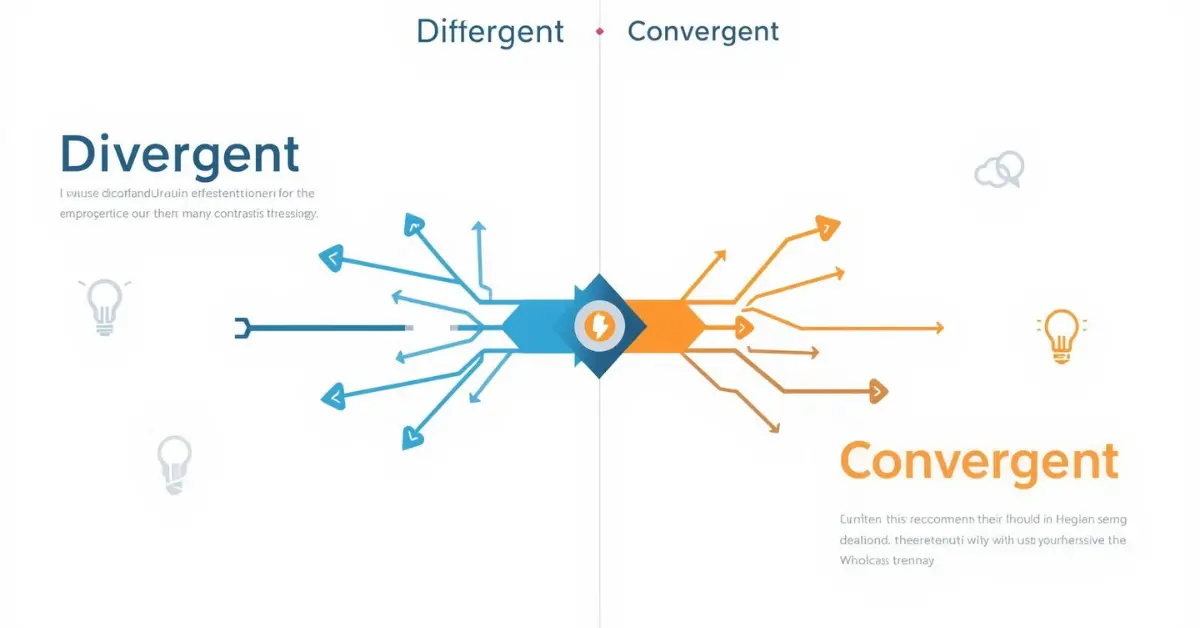
Divergent thinking focuses on generating many different ideas or possibilities, while convergent thinking focuses on selecting the best solution from those ideas.
Why Their Difference Is Important for Learners and Experts
Understanding the difference between divergent and convergent is important for both beginners and professionals.
- For learners: It improves creativity and problem-solving abilities.
- For experts: It helps in research, decision-making, and innovation.
- For society: These approaches encourage creative solutions while ensuring practical implementation.
Both processes together help individuals design inventions, solve social issues, and develop effective strategies in business and education.
Difference Between Divergent and Convergent
1. Purpose
Divergent: Generates many ideas.
Examples:
- Brainstorming business ideas
- Students suggesting multiple answers to a question
Convergent: Selects the best idea.
Examples:
- Choosing the most profitable business idea
- Selecting the correct answer in a test
2. Thinking Style
Divergent: Creative and open-ended.
Examples:
- Writing poetry with imaginative thoughts
- Designing different logo concepts
Convergent: Logical and analytical.
Examples:
- Solving mathematical equations
- Choosing the most effective design
3. Number of Solutions
Divergent: Many possible solutions.
Examples:
- Different ways to advertise a product
- Multiple solutions to reduce pollution
Convergent: One best solution.
Examples:
- Choosing one marketing strategy
- Selecting a final plan to reduce pollution
4. Direction of Thought
Divergent: Expands ideas outward.
Examples:
- Mind mapping
- Creative writing exercises
Convergent: Narrows ideas inward.
Examples:
- Finalizing a research conclusion
- Selecting a winner in a competition
5. Use in Education
Divergent: Encourages exploration.
Examples:
- Open-ended classroom discussions
- Creative art projects
Convergent: Focuses on correct answers.
Examples:
- Multiple-choice exams
- Standardized testing
6. Level of Creativity
Divergent: Highly creative.
Examples:
- Inventing a new product
- Writing a science fiction story
Convergent: Practical and realistic.
Examples:
- Evaluating product feasibility
- Editing a story for accuracy
7. Risk Level
Divergent: Encourages risk and experimentation.
Examples:
- Trying unusual marketing ideas
- Exploring new art styles
Convergent: Reduces risk by careful selection.
Examples:
- Choosing a proven strategy
- Approving a safe design plan
8. Process Type
Divergent: Free and spontaneous.
Examples:
- Brainstorming sessions
- Idea-generation workshops
Convergent: Structured and systematic.
Examples:
- Data analysis
- Decision-making meetings
9. Focus
Divergent: Idea creation.
Examples:
- Generating startup ideas
- Writing story plots
Convergent: Idea evaluation.
Examples:
- Choosing one startup idea
- Finalizing a plot for a novel
10. Outcome
Divergent: Produces possibilities.
Examples:
- List of creative projects
- Various design options
Convergent: Produces a final decision.
Examples:
- Selecting one project
- Approving a final design
Nature and Behaviour
Divergent Nature:
Divergent thinking is exploratory, imaginative, and flexible. People using this approach enjoy experimentation and innovation.
Convergent Nature:
Convergent thinking is focused, logical, and disciplined. It prioritizes efficiency and accuracy.
Why People Are Confused About Their Use
People often confuse these terms because both are part of the same problem-solving process. Divergent thinking generates ideas, while convergent thinking evaluates them. Since they are used together, many assume they mean the same thing, even though their purposes are different.
Table: Difference and Similarity
| Aspect | Divergent | Convergent | Similarity |
| Thinking style | Creative | Logical | Both solve problems |
| Number of ideas | Many | One best | Both analyze ideas |
| Direction | Expanding | Narrowing | Both part of decision process |
| Focus | Idea generation | Idea selection | Both used in innovation |
| Use | Brainstorming | Decision making | Both useful in learning |
Which Is Better in What Situation?
Divergent Thinking
Divergent thinking is better in situations that require creativity and innovation. It is useful when brainstorming new business ideas, writing stories, designing products, or solving complex problems with many possibilities. This approach encourages imagination and allows people to explore unusual solutions.
Convergent Thinking
Convergent thinking is better when a clear and practical decision is needed. It helps in selecting the best solution, analyzing data, and making logical conclusions. Fields such as engineering, mathematics, and management rely heavily on convergent thinking to ensure accuracy and efficiency.
Use in Metaphors and Similes
- “Ideas spread like divergent rivers flowing in many directions.”
- “Her decision was as convergent as a laser beam, focusing on one clear goal.”
Connotative Meanings
Divergent
- Positive: creativity, innovation
- Negative: confusion or lack of focus
- Neutral: variety of ideas
Example:
“His divergent thinking produced several creative solutions.”
Convergent
- Positive: clarity, precision
- Negative: narrow thinking
- Neutral: focused decision
Example:
“Her convergent thinking helped finalize the project plan.”
Idioms or Proverbs Related to the Concepts
“Think outside the box.”
Example: Divergent thinking helps people think outside the box.
“Cut to the chase.”
Example: Convergent thinking helps teams cut to the chase and select the best solution.
Works in Literature Related to the Keywords
- Divergent — Science fiction novel, Veronica Roth, 2011
- Convergent Evolution in Literature — Academic essays discussing idea convergence in storytelling
Movies Related to the Keywords
- Divergent — 2014, USA
- The Divergent Series: Insurgent — 2015, USA
- The Divergent Series: Allegiant — 2016, USA
Frequently Asked Questions
1. What is the main difference between divergent and convergent thinking?
Divergent thinking creates many ideas, while convergent thinking selects the best one.
2. Are both thinking styles necessary?
Yes, creativity requires divergent thinking and decision-making requires convergent thinking.
3. Where is divergent thinking commonly used?
It is used in brainstorming, art, innovation, and creative problem solving.
4. Where is convergent thinking used most?
It is common in mathematics, science, and analytical decision-making.
5. Can a person use both types of thinking?
Yes, effective problem solving often requires both processes.
How Both Are Useful for Surroundings
Divergent thinking helps communities generate new ideas for development, sustainability, and innovation. Convergent thinking helps choose the most practical solutions to implement those ideas effectively.
Final Words for Both
Divergent thinking inspires creativity and possibilities, while convergent thinking brings clarity and direction. Together they create balanced decision-making.
Conclusion
Understanding the difference between divergent and convergent thinking helps individuals improve creativity, reasoning, and decision-making. Divergent thinking encourages exploration and innovation by producing many ideas, while convergent thinking focuses on selecting the best and most practical solution.
In education, business, science, and everyday life, both approaches play an essential role. When used together, they allow people to generate creative possibilities and transform them into effective actions. Mastering the balance between divergent and convergent thinking ultimately leads to better problem-solving and smarter decisions in both personal and professional environments.

SwiftHarbor is a dedicated English professor, language researcher, and the founder of SpellCompare.com. With years of academic experience in English grammar, vocabulary development, and linguistic comparison, SwiftHarbor specializes in simplifying complex language rules into clear, practical explanations.
As an expert in word usage, spelling differences, and commonly confused terms, SwiftHarbor has helped thousands of learners improve their writing accuracy and communication skills. Through SpellCompare.com, he provides detailed comparisons, easy examples, and research-based insights that make English learning accessible for students, writers, and professionals worldwide.
Known for a clear teaching style and structured explanations, SwiftHarbor focuses on eliminating confusion between similar words, improving grammar confidence, and promoting precise communication. His mission is simple: to make English easier, clearer, and more powerful for everyone.