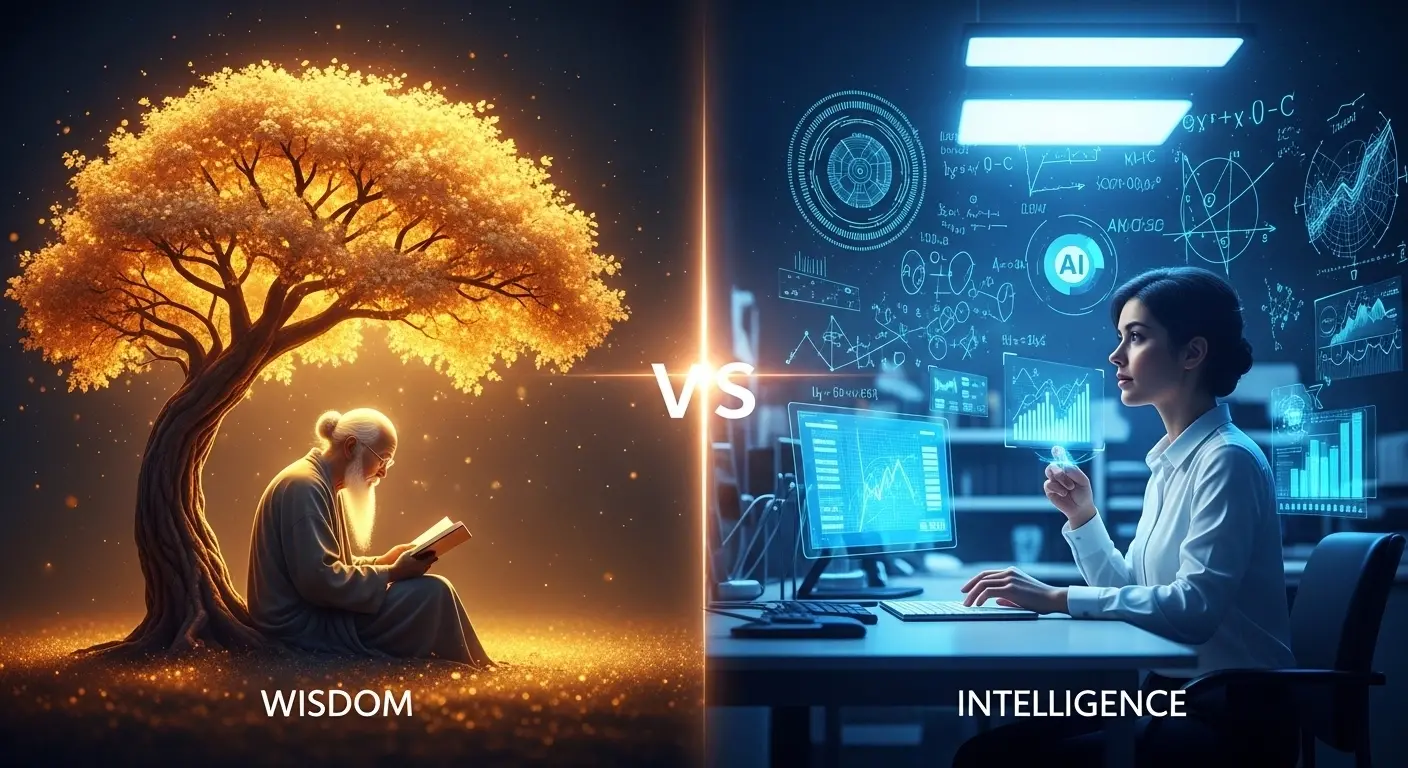
The difference between wisdom and intelligence is often misunderstood, even though both shape how humans think, decide, and behave in life. Many people assume that being smart automatically means being wise, but real-life experiences prove otherwise.
The difference between wisdom and intelligence becomes clearer when we observe how some highly intelligent people still make poor life choices, while others with average intelligence make deeply thoughtful and successful decisions.
In simple terms, intelligence is about how fast and accurately a person can learn, understand, and solve problems. Wisdom, on the other hand, is about applying knowledge, experience, and judgment in real-life situations. A school topper solving complex math problems may show intelligence, but an elderly farmer making the right decision about crops based on years of experience reflects wisdom.
The difference between wisdom and intelligence matters in education, leadership, relationships, and personal growth. Understanding this distinction helps people develop not just smarter thinking but also better decision-making in life.
Pronunciation
- Wisdom
- US: /ˈwɪz.dəm/
- UK: /ˈwɪz.dəm/
- Intelligence
- US: /ɪnˈtel.ɪ.dʒəns/
- UK: /ɪnˈtel.ɪ.dʒəns/
Before diving deeper, it is important to explore how these two concepts differ in real life and why both are essential for a balanced personality.
Difference Between Epoxy and Resin: in (2026)
Difference Between Wisdom and Intelligence
1. Definition
- Wisdom: Ability to make sound judgments based on experience and insight.
- Example 1: A doctor choosing not to operate on a risky patient case immediately.
- Example 2: A parent advising patience instead of reacting emotionally.
- Intelligence: Ability to learn, understand, and solve problems quickly.
- Example 1: A student solving a complex physics equation.
- Example 2: A programmer writing efficient code.
2. Source
- Wisdom: Comes from experience and reflection.
- Example 1: Learning from past business failures.
- Example 2: Gaining insight after years of travel.
- Intelligence: Comes from education and cognitive ability.
- Example 1: Scoring high on IQ tests.
- Example 2: Quickly understanding a new concept in class.
- Difference Between Budget and Forecast: in Current Situation
3. Nature
- Wisdom: Practical and emotional.
- Example 1: Choosing peace over argument.
- Example 2: Handling criticism calmly.
- Intelligence: Logical and analytical.
- Example 1: Solving math puzzles.
- Example 2: Analyzing data patterns.
4. Focus
- Wisdom: Focuses on long-term outcomes.
- Example 1: Saving money for future security.
- Example 2: Avoiding harmful habits.
- Intelligence: Focuses on immediate problem-solving.
- Example 1: Completing a test quickly.
- Example 2: Fixing a technical issue.
5. Decision Making
- Wisdom: Considers emotions, ethics, and consequences.
- Example 1: Forgiving someone instead of taking revenge.
- Example 2: Choosing honesty over profit.
- Intelligence: Based on facts and logic.
- Example 1: Calculating investment returns.
- Example 2: Solving a puzzle efficiently.
6. Dependency
- Wisdom: Depends on life experience.
- Example 1: Elderly people giving advice.
- Example 2: Learning from mistakes over time.
- Intelligence: Depends on brain capacity and education.
- Example 1: Genius-level problem solving.
- Example 2: Fast learners in academics.
7. Application
- Wisdom: Applied in real-life situations.
- Example 1: Managing family disputes calmly.
- Example 2: Making ethical business decisions.
- Intelligence: Applied in academic and technical fields.
- Example 1: Engineering calculations.
- Example 2: Scientific research.
8. Emotional Role
- Wisdom: Strong emotional understanding.
- Example 1: Comforting a grieving friend.
- Example 2: Understanding human behavior.
- Intelligence: Less emotional, more cognitive.
- Example 1: Logical debate participation.
- Example 2: Analytical reasoning tasks.
9. Stability Over Time
- Wisdom: Grows with age and experience.
- Example 1: Learning patience over years.
- Example 2: Better judgment in adulthood.
- Intelligence: Can be measured early and remains relatively stable.
- Example 1: Childhood IQ scores.
- Example 2: Early academic performance.
10. Outcome
- Wisdom: Leads to balanced and meaningful life decisions.
- Example 1: Strong relationships.
- Example 2: Peaceful lifestyle choices.
- Intelligence: Leads to success in tasks and academics.
- Example 1: High grades.
- Example 2: Career achievements.
Nature and Behaviour
Wisdom is calm, reflective, and deeply connected with emotional understanding. It does not rush decisions and often prioritizes long-term harmony over short-term gain.
Intelligence, however, is quick, sharp, and problem-focused. It reacts fast to information and is excellent in structured environments like exams, coding, or analysis.
Why People Are Confused About Wisdom and Intelligence
People often confuse these two because they can appear together in the same person. A highly intelligent person may also give wise advice, but not always. Media, education systems, and society often reward intelligence (grades, IQ, skills), while wisdom is harder to measure. This creates the illusion that both are the same, although they function differently.
Table: Difference and Similarity Between Wisdom and Intelligence
| Aspect | Wisdom | Intelligence |
| Origin | Experience | Education/Brain power |
| Focus | Long-term life decisions | Short-term problem solving |
| Nature | Emotional & practical | Logical & analytical |
| Speed | Slow and reflective | Fast and sharp |
| Outcome | Good life decisions | Academic/technical success |
Similarity: Both involve thinking ability, learning, and decision-making skills.
Which is Better in What Situation?
Wisdom is more important in life decisions where emotions, relationships, and long-term consequences matter. For example, choosing a career path, handling relationships, or solving family issues requires wisdom more than intelligence. Wisdom ensures stability, peace, and maturity in decisions.
Intelligence, however, is essential in academic, scientific, and technical fields. It helps in solving complex problems quickly and efficiently. Engineers, doctors, and scientists rely heavily on intelligence for performance. Without intelligence, learning and innovation would be slow. However, intelligence without wisdom can lead to poor life choices.
Wisdom and Intelligence in Metaphors and Similes
- Wisdom is often described as “light in darkness” because it guides people in confusion.
- Intelligence is compared to “a sharp sword” because it cuts through problems quickly.
Examples:
- “Her wisdom was like a calm river flowing through chaos.”
- “His intelligence was as sharp as a blade in competition.”
Connotative Meaning
- Wisdom
- Positive: maturity, guidance, peace
- Negative: sometimes seen as slow or overly cautious
- Neutral: life experience-based judgment
- Intelligence
- Positive: smartness, speed, achievement
- Negative: may be seen as arrogant if misused
- Neutral: cognitive ability
Idioms and Proverbs
- “Wisdom comes with age.”
- Example: Grandfather’s advice shows wisdom comes with age.
- “Knowledge is power.”
- Example: Intelligence helps in gaining success in exams.
- “A wise head makes a closed mouth.”
- Example: A wise person avoids unnecessary arguments.
Literature References
- Wisdom
- Genre: Philosophy
- Writer: Socrates
- Year: Ancient Greece (399 BC teachings)
- Intelligence
- Genre: Psychology
- Writer: Alfred Binet (IQ theory contributor)
- Year: 1905
Movies Based on Intelligence and Wisdom Themes
- A Beautiful Mind (2001, USA) – intelligence in mathematics and psychology
- Good Will Hunting (1997, USA) – genius intelligence with emotional wisdom
- The Pursuit of Happyness (2006, USA) – emotional wisdom in life struggles
- The Theory of Everything (2014, UK) – scientific intelligence and life wisdom
Frequently Asked Questions
1. What is the main difference between wisdom and intelligence?
Wisdom is about experience-based judgment, while intelligence is about problem-solving ability.
2. Can a person be both wise and intelligent?
Yes, many people combine both qualities for better decision-making.
3. Which is more important in life?
Both are important; intelligence helps in success, wisdom ensures good life choices.
4. Does intelligence increase with age?
Not always; it depends on learning, but wisdom usually increases with age.
5. Can wisdom be learned?
Yes, through experience, reflection, and learning from mistakes.
How Both Are Useful for Surroundings
Wisdom helps maintain harmony in society by encouraging peace, empathy, and understanding. Intelligence helps improve technology, education, and innovation. Together, they create a balanced society where progress and emotional stability coexist.
Final Words
Wisdom and intelligence are not rivals but partners. Intelligence builds knowledge and skills, while wisdom guides how to use them correctly. A world driven only by intelligence may become advanced but emotionally unstable, while a world guided only by wisdom may lack innovation. The ideal balance of both creates thoughtful, successful, and responsible individuals.
Conclusion
The difference between wisdom and intelligence is not just theoretical but deeply practical in everyday life. Intelligence helps people think fast and solve problems, while wisdom helps them choose the right path in life.
One builds capability, the other builds character. Understanding this difference allows individuals to grow in both personal and professional life. True success is achieved when intelligence is guided by wisdom, ensuring that knowledge is not only powerful but also meaningful and responsible.

Henry is a passionate English professor, language specialist, and the founder of SpellCompare.com. With years of academic experience and a deep understanding of grammar, vocabulary, and linguistic nuances, he has dedicated his career to helping students and writers master the English language with clarity and confidence.
As an expert in word comparisons, spelling differences, and grammar rules, Henry simplifies complex language concepts into easy-to-understand explanations. His mission is to eliminate confusion between commonly misused words and provide accurate, research-based guidance that improves writing skills for learners worldwide.
Through SpellCompare.com, Henry combines academic expertise with practical examples, creating content that is clear, reliable, and reader-friendly. His work focuses on precision, correctness, and helping others communicate effectively in both academic and professional settings.
When he’s not teaching or writing, Henry continues researching evolving language trends to ensure his content remains current, helpful, and authoritative.