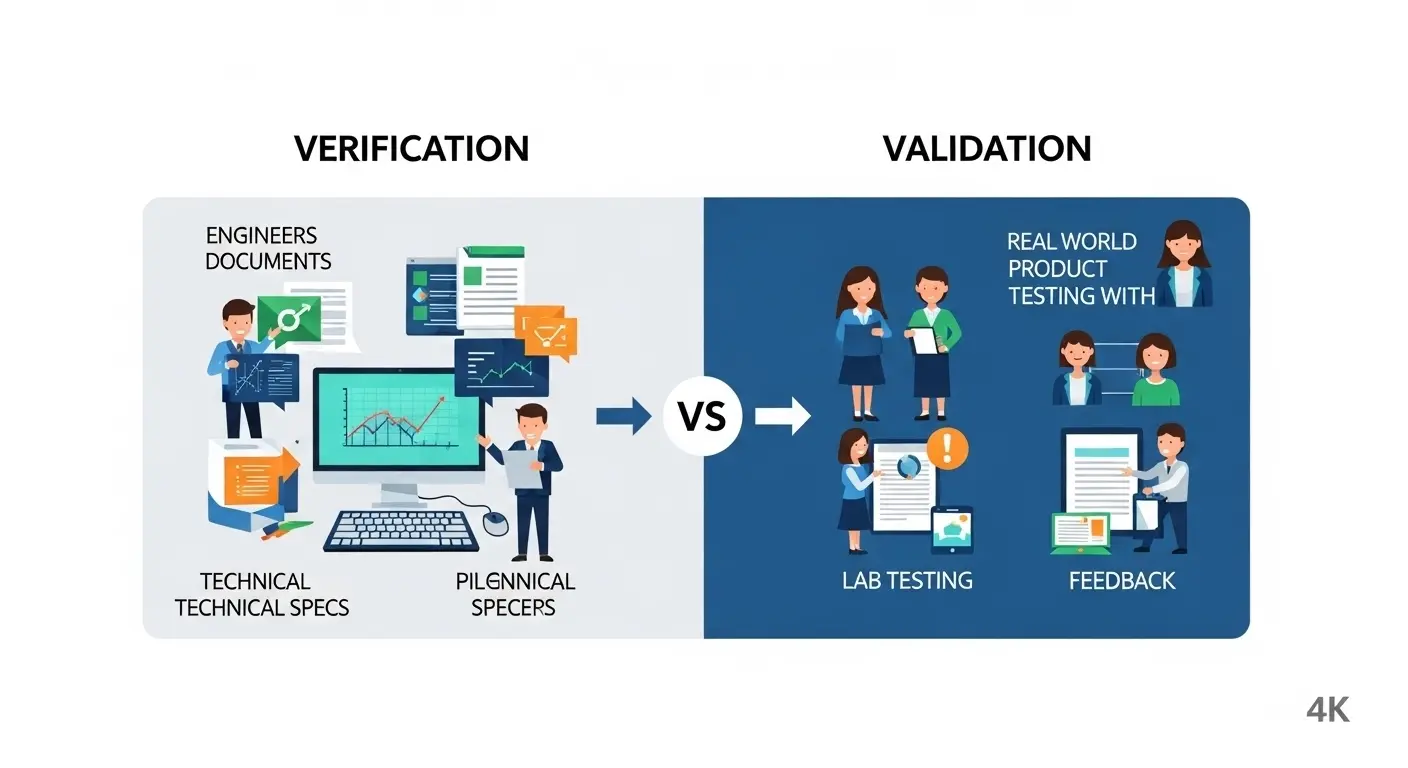
Imagine you ordered a custom-made suit for an important event. When you receive it, you first check whether it matches the measurements you provided. This is verification. Then you try it on to see if it actually fits comfortably and looks good on you. This is validation.
This simple story explains the difference between validation and verification in real life. While both terms sound similar, they serve different purposes. Understanding the difference between validation and verification is essential not only in software development but also in education, manufacturing, and everyday decision-making.
People often mix them up because both involve checking something. However, the difference between validation and verification lies in what is being checked and why. Knowing the difference between validation and verification helps ensure quality, accuracy, and user satisfaction in any field.
Key Difference Between the Both
- Verification checks whether you built something correctly (process-oriented).
- Validation checks whether you built the right thing (result-oriented).
Difference Between Epoxy and Resin: in (2026)
Why Is Their Difference Necessary to Know for Learners and Experts?
Understanding the difference between validation and verification is crucial for both beginners and professionals. For learners, it builds a strong foundation in quality control and logical thinking. For experts, it ensures efficient workflows, reduces errors, and improves outcomes.
In society, this distinction plays a role in healthcare (testing medicines), engineering (building safe structures), and education (assessing knowledge vs. application). Without clear validation and verification, systems may be technically correct but practically useless or useful but poorly built.
Pronunciation (US & UK)
- Validation
- US: /ˌvæl.əˈdeɪ.ʃən/
- UK: /ˌvæl.ɪˈdeɪ.ʃən/
- Verification
- US: /ˌver.ə.fəˈkeɪ.ʃən/
- UK: /ˌver.ɪ.fɪˈkeɪ.ʃən/
- Recognising or Recognizing : Which Spelling Is Correct?
Linking Hook
Now that you understand the basic idea, let’s explore the difference between validation and verification in detail with clear explanations and real-life examples.
H2: Difference Between Validation and Verification
1. Purpose
- Verification: Ensures the product is built correctly.
- Example 1: Checking if code follows design specifications
- Example 2: Reviewing a blueprint for accuracy
- Validation: Ensures the product meets user needs.
- Example 1: Testing if software solves user problems
- Example 2: Trying a product to see if it is useful
2. Process Type
- Verification: Static (no execution required)
- Example 1: Document review
- Example 2: Code inspection
- Validation: Dynamic (requires execution/testing)
- Example 1: Running software tests
- Example 2: Product usability testing
3. Focus
- Verification: Focuses on correctness
- Example 1: Checking grammar in writing
- Example 2: Ensuring calculations are accurate
- Validation: Focuses on usefulness
- Example 1: Is the content understandable?
- Example 2: Does the result solve the problem?
4. Timing
- Verification: Done during development
- Example 1: Reviewing requirements
- Example 2: Checking design documents
- Validation: Done after development
- Example 1: Final product testing
- Example 2: User acceptance testing
5. Objective
- Verification: “Are we building it right?”
- Example 1: Code follows rules
- Example 2: Structure meets standards
- Validation: “Are we building the right thing?”
- Example 1: Product satisfies user
- Example 2: Solution meets need
6. Involvement
- Verification: Mainly developers or internal team
- Example 1: Engineers review designs
- Example 2: QA checks documents
- Validation: Involves users or clients
- Example 1: Customer testing
- Example 2: Feedback sessions
7. Tools Used
- Verification: Checklists, reviews
- Example 1: Audit reports
- Example 2: Code review tools
- Validation: Testing tools, user surveys
- Example 1: Beta testing
- Example 2: User feedback forms
8. Outcome
- Verification: Confirms correctness
- Example 1: No errors in design
- Example 2: Accurate documentation
- Validation: Confirms satisfaction
- Example 1: Users are happy
- Example 2: Product works in real life
9. Nature of Errors Found
- Verification: Finds technical errors
- Example 1: Wrong formula
- Example 2: Missing requirement
- Validation: Finds functional errors
- Example 1: Product not useful
- Example 2: Poor user experience
10. Approach
- Verification: Preventive
- Example 1: Early checks
- Example 2: Avoid mistakes
- Validation: Corrective
- Example 1: Fix after testing
- Example 2: Improve based on feedback
Nature and Behaviour
- Verification: Logical, rule-based, and systematic. It follows standards and focuses on internal correctness.
- Validation: Practical, user-focused, and experience-based. It ensures real-world effectiveness.
Why Are People Confused About Their Use?
People confuse validation and verification because both involve checking and quality assurance. The terms are often used interchangeably in casual conversation. Additionally, both processes may occur together in projects, making their boundaries unclear. The key confusion lies in not distinguishing between correctness and usefulness.
Table: Difference and Similarity
| Aspect | Verification | Validation | Similarity |
| Purpose | Check correctness | Check usefulness | Both ensure quality |
| Process | Static | Dynamic | Both involve evaluation |
| Timing | During development | After development | Both are essential steps |
| Focus | Internal quality | User satisfaction | Improve product |
| Involvement | Developers | Users | Team effort |
Which Is Better in What Situation?
Verification is better when you are in the early stages of a project. It helps catch errors before they grow bigger. For example, in software development, verifying requirements and designs ensures a strong foundation.
Validation is better when the product is ready to be tested in real life. It ensures that the final output actually meets user needs. For example, testing a mobile app with real users confirms whether it is helpful and easy to use.
Metaphors and Similes
- Verification: Like checking a recipe before cooking
- Validation: Like tasting the food after cooking
- Verification: As precise as a ruler
- Validation: As practical as real-life experience
Connotative Meaning
- Validation: Positive (approval, acceptance)
- Example: “Her efforts were validated by success.”
- Verification: Neutral (checking facts)
- Example: “The data needs verification.”
Idioms or Proverbs
- “Trust but verify” (Verification)
- Example: Always check facts before believing them.
- “Proof is in the pudding” (Validation)
- Example: The real test is in the result.
Works in Literature
- The Logic of Scientific Discovery – Philosophy, Karl Popper, 1934
- Zen and the Art of Motorcycle Maintenance – Philosophy, Robert Pirsig, 1974
Movies Related to the Concepts
- The Imitation Game (2014, UK/USA) – Verification of codes
- Moneyball (2011, USA) – Validation of data-driven decisions
FAQs
1. What is the main difference between validation and verification?
Verification checks correctness, while validation checks usefulness.
2. Which comes first, validation or verification?
Verification comes first, followed by validation.
3. Can a product pass verification but fail validation?
Yes, it can be correct but not useful.
4. Is validation more important than verification?
Both are equally important in different stages.
5. Where are these terms commonly used?
Software development, engineering, and research.
How Both Are Useful for Surroundings
Verification ensures systems are safe and accurate, while validation ensures they are practical and beneficial. Together, they improve product quality, user satisfaction, and overall efficiency in society.
Final Words for Both
Verification builds the foundation, and validation ensures success. One checks the path; the other confirms the destination.
Conclusion
The difference between validation and verification lies in their purpose and application. Verification ensures that something is built correctly, while validation ensures it meets real-world needs.
Both are essential steps in achieving quality and reliability. Ignoring either can lead to failure either technically or practically. By understanding and applying both concepts, individuals and organizations can create better, more effective outcomes.

Henry is a passionate English professor, language specialist, and the founder of SpellCompare.com. With years of academic experience and a deep understanding of grammar, vocabulary, and linguistic nuances, he has dedicated his career to helping students and writers master the English language with clarity and confidence.
As an expert in word comparisons, spelling differences, and grammar rules, Henry simplifies complex language concepts into easy-to-understand explanations. His mission is to eliminate confusion between commonly misused words and provide accurate, research-based guidance that improves writing skills for learners worldwide.
Through SpellCompare.com, Henry combines academic expertise with practical examples, creating content that is clear, reliable, and reader-friendly. His work focuses on precision, correctness, and helping others communicate effectively in both academic and professional settings.
When he’s not teaching or writing, Henry continues researching evolving language trends to ensure his content remains current, helpful, and authoritative.