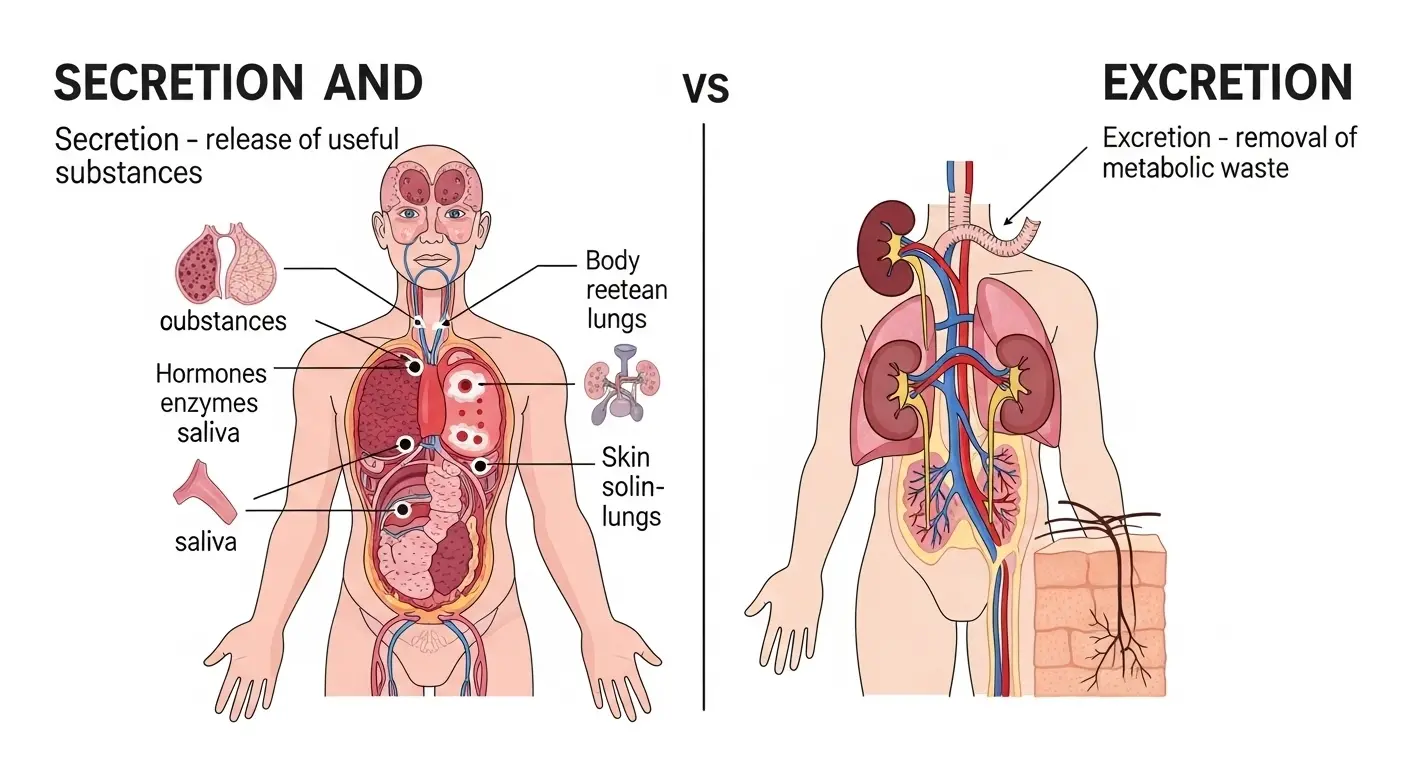
Have you ever wondered why our bodies produce different substances, some to aid life and others to remove waste? This is where understanding the difference between secretion and excretion becomes important. Imagine a chef in a busy kitchen: some ingredients are used to make delicious dishes (like enzymes and hormones), while scraps are thrown away. In our body, secretion is like preparing the dish; it releases useful substances such as saliva, hormones, or enzymes for specific purposes.
On the other hand, excretion is like taking out the trash. It removes harmful or unnecessary substances such as urine, sweat, and carbon dioxide. Knowing the difference between secretion and excretion helps students, medical professionals, and biology enthusiasts understand the body’s efficiency. Learning this distinction also highlights how our organs carefully manage both creation and elimination processes, making the knowledge practically essential.
Pronunciation:
- Secretion: /sɪˈkriː.ʃən/ (US & UK)
- Excretion: /ɪkˈskriː.ʃən/ (US & UK)
Understanding these concepts is crucial before diving deeper into their differences, behavior, and applications in everyday life.
H2: Difference Between Secretion and Excretion
Here’s a detailed 10-point distinction with examples:
- Purpose
- Secretion: Serves a functional purpose, e.g., enzymes digest food, hormones regulate growth.
- Example 1: Saliva helps break down starch in the mouth.
- Example 2: Insulin regulates blood sugar levels.
- Excretion: Removes waste or harmful substances.
- Example 1: Urine removes urea from the body.
- Example 2: Sweating removes excess salts and toxins.
- Secretion: Serves a functional purpose, e.g., enzymes digest food, hormones regulate growth.
- Nature of Substance
- Secretion: Generally beneficial.
- Example 1: Gastric juice aids digestion.
- Example 2: Tears lubricate the eyes.
- Excretion: Usually harmful or waste.
- Example 1: Carbon dioxide from lungs.
- Example 2: Ammonia from kidney metabolism.
- Secretion: Generally beneficial.
- Organ Involved
- Secretion: Specialized glands like salivary, endocrine glands.
- Excretion: Organs like kidneys, lungs, liver, skin.
- Process Control
- Secretion: Often regulated by hormones or signals.
- Excretion: Mostly a physical or chemical filtration process.
- Chemical Composition
- Secretion: Complex molecules, proteins, enzymes, hormones.
- Excretion: Waste products, nitrogenous compounds, salts.
- Frequency
- Secretion: Continuous or periodic, based on body needs.
- Excretion: Continuous but often more frequent under stress or diet changes.
- End Result
- Secretion: Used within the body for specific functions.
- Excretion: Eliminated from the body entirely.
- Visibility
- Secretion: Usually less visible externally, inside body systems.
- Excretion: Often observable, e.g., urine, sweat, feces.
- Health Indicator
- Secretion: Proper secretion maintains health and balance.
- Excretion: Proper excretion prevents toxicity.
- Examples in Environment
- Secretion: Plant nectar attracts pollinators.
- Excretion: Animal droppings recycle nutrients in soil.
Nature and Behaviour
- Secretion: Active process, selective, and regulated; supports growth, repair, digestion, and communication in the body.
- Excretion: Passive or semi-active, non-selective; focuses on detoxification and maintenance of internal balance.
Why People Are Confused
Both processes involve moving substances from cells or glands, so people often assume they serve the same purpose. The key difference lies in function and usefulness.
Difference & Similarity Table
| Feature | Secretion | Excretion | Similarity |
| Purpose | Functional, beneficial | Waste removal | Both involve transport of substances |
| Nature of Substance | Useful, complex | Waste, harmful | Both involve chemical release |
| Organ Involved | Glands | Kidneys, liver, lungs, skin | Both involve body organs |
| Process Control | Hormonal or neural | Filtration or passive | Both are regulated to some extent |
| End Result | Used inside body | Eliminated from body | Both maintain homeostasis |
Which is Better in What Situation?
- Secretion is better when the body needs substances for digestion, repair, or signaling. For example, digestive enzymes in the stomach break down food effectively, enabling nutrient absorption. Without secretion, the body cannot maintain normal physiological functions.
- Excretion is better when the body needs to eliminate toxins and prevent buildup of harmful substances. For instance, the kidneys filter out urea, while sweat removes excess salts. Excretion ensures survival by maintaining a healthy internal environment.
Use in Metaphors and Similes
- Secretion: “Ideas flowed like a constant secretion from her mind.” (Positive connotation)
- Excretion: “He expelled negativity like excretion from a clogged system.” (Neutral/negative connotation)
Connotation:
- Secretion: Positive, useful
- Excretion: Neutral to negative, waste
Idioms / Proverbs:
- “Don’t cry over spilled milk” (excretion/waste concept – letting go of useless stuff)
- “The juice of life” (secretion, nourishment metaphor)
References in Literature & Media
Literature:
- “The Secretions of the Mind” – Psychological Essay, Dr. H. Keller, 1998
- “Excretion of Life” – Science Fiction Short Story, L. Norton, 2010
Movies:
- “Secretion” – Documentary on Human Biology, 2015, USA
- “Excretion: Waste of Life” – Environmental Doc, 2018, UK
FAQs
- Are secretion and excretion the same?
No, secretion is functional, excretion removes waste. - Can excretion be useful?
Yes, excretion maintains health and environmental balance. - Is sweat a secretion or excretion?
Mainly excretion, though minor secretion occurs. - Why study secretion and excretion?
Understanding helps in medicine, biology, and environmental science. - Do plants secrete or excrete?
Plants mainly secrete useful substances like nectar; waste is minimal.
How Both Are Useful for Surroundings
- Secretion: Plant nectar supports pollinators; enzymes aid soil nutrient cycling.
- Excretion: Animal and human waste enriches soil and supports ecological cycles.
Final Words
Understanding the difference between secretion and excretion empowers students, researchers, and health professionals to appreciate the body’s efficiency. While secretion builds and sustains, excretion cleans and protects. Both are crucial for life and environmental balance.
Conclusion
In biology, the difference between secretion and excretion is fundamental. Secretion provides essential substances like hormones, enzymes, and saliva for proper body function, while excretion removes harmful wastes like urine, sweat, and carbon dioxide. Although they are sometimes confused because both involve moving substances from the body, their purposes, nature, and outcomes are distinct.
Recognizing this distinction aids in understanding human physiology, environmental science, and even medical applications. Both processes are vital: secretion nourishes and regulates life, while excretion maintains health and prevents toxicity. Learning their differences not only benefits students and professionals but also enriches our appreciation for the complex, efficient systems of life.

SwiftHarbor is a dedicated English professor, language researcher, and the founder of SpellCompare.com. With years of academic experience in English grammar, vocabulary development, and linguistic comparison, SwiftHarbor specializes in simplifying complex language rules into clear, practical explanations.
As an expert in word usage, spelling differences, and commonly confused terms, SwiftHarbor has helped thousands of learners improve their writing accuracy and communication skills. Through SpellCompare.com, he provides detailed comparisons, easy examples, and research-based insights that make English learning accessible for students, writers, and professionals worldwide.
Known for a clear teaching style and structured explanations, SwiftHarbor focuses on eliminating confusion between similar words, improving grammar confidence, and promoting precise communication. His mission is simple: to make English easier, clearer, and more powerful for everyone.