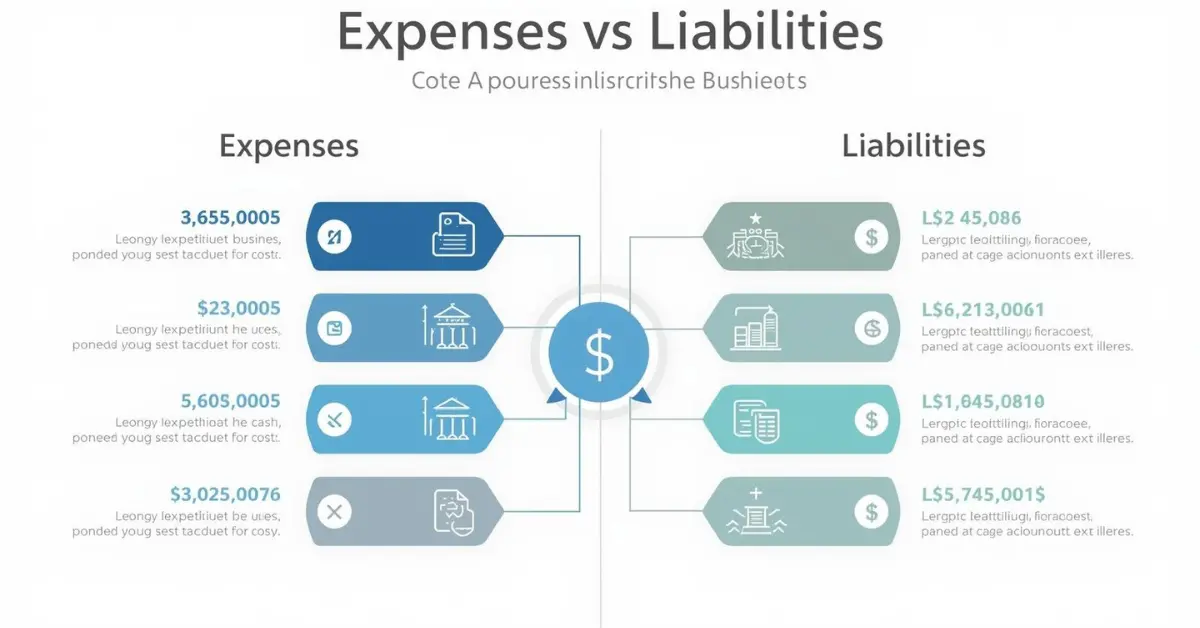
Imagine a small shop owner closing his store at night and reviewing his finances. He notices money spent on electricity, employee salaries, and supplies during the day. At the same time, he also remembers that he still owes money to a supplier and has a bank loan to repay next month. These two situations represent different financial concepts: expenses and liabilities.
Understanding the difference between expenses and liabilities is important for both individuals and businesses. Expenses refer to the money spent to run daily operations, while liabilities are obligations or debts that must be paid in the future.
Many learners often struggle with the difference between expenses and liabilities, especially when analyzing financial statements. In accounting and financial management, knowing the difference between expenses and liabilities helps people manage budgets, track obligations, and make better financial decisions. In simple terms, the difference between expenses and liabilities lies in how money flows out of a business and how financial responsibilities are recorded.
Pronunciation
Expenses
- US: /ɪkˈspɛn.sɪz/
- UK: /ɪkˈspen.sɪz/
Liabilities
- US: /ˌlaɪ.əˈbɪl.ə.tiz/
- UK: /ˌlaɪ.əˈbɪl.ə.tiz/
Before exploring deeper financial concepts, it is helpful to clearly understand how these two terms differ in practice.
Key Difference Between the Two
The main difference is that expenses represent costs incurred during daily operations, while liabilities represent debts or financial obligations that must be paid in the future.
Why Is Their Difference Necessary to Know for Learners and Experts?
Understanding financial concepts helps individuals, businesses, and professionals make responsible decisions. Recognizing the difference between expenses and liabilities allows students of accounting, business owners, and financial analysts to understand where money goes and what obligations remain.
For learners, it builds a strong foundation in accounting principles and financial literacy. For experts, distinguishing between expenses and liabilities helps in preparing accurate financial statements, managing cash flow, and assessing a company’s financial health.
In society, this knowledge encourages better budgeting, responsible borrowing, and transparent financial reporting. Without understanding the difference, people might underestimate debts or miscalculate profits, which could lead to financial problems.
Difference Between Expenses and Liabilities
1. Definition
Expenses are the costs incurred in running daily operations.
Examples:
- Paying electricity bills for an office.
- Buying raw materials for production.
Liabilities are debts or obligations that must be paid in the future.
Examples:
- A bank loan taken for business expansion.
- Money owed to suppliers.
2. Nature
Expenses are operational costs used to generate revenue.
Examples:
- Advertising costs for promoting products.
- Office rent for business premises.
Liabilities are financial obligations owed to others.
Examples:
- Mortgage payments for a company building.
- Outstanding credit card balance.
3. Time Perspective
Expenses are usually related to the current accounting period.
Examples:
- Monthly internet bill.
- Salaries paid to employees.
Liabilities are obligations due in the future.
Examples:
- A long-term bank loan payable in five years.
- Bonds issued by a company.
4. Financial Statement Placement
Expenses appear on the income statement.
Examples:
- Utility expenses listed under operating costs.
- Marketing expenses recorded in company accounts.
Liabilities appear on the balance sheet.
Examples:
- Accounts payable listed under current liabilities.
- Long-term debt recorded as non-current liability.
5. Effect on Profit
Expenses reduce profit because they are costs of doing business.
Examples:
- High advertising expenses lowering net income.
- Increased fuel expenses reducing profit margin.
Liabilities do not directly reduce profit, but they increase financial obligations.
Examples:
- Taking a loan does not immediately reduce profit.
- Supplier credit increases liabilities but not expenses initially.
6. Payment Timing
Expenses are often paid immediately or within a short time.
Examples:
- Paying for office supplies.
- Paying monthly rent.
Liabilities may be paid later or over a long period.
Examples:
- Repaying a loan over ten years.
- Paying outstanding invoices after 60 days.
7. Purpose
Expenses help maintain operations.
Examples:
- Maintenance costs for machines.
- Internet expenses for communication.
Liabilities help finance business activities.
Examples:
- Loans used to buy equipment.
- Credit used to purchase inventory.
8. Accounting Treatment
Expenses are recorded when incurred.
Examples:
- Recording travel expenses for business trips.
- Recording insurance costs.
Liabilities are recorded when the obligation arises.
Examples:
- Recording debt after signing a loan agreement.
- Recording accounts payable after receiving goods on credit.
9. Impact on Cash Flow
Expenses cause immediate or short-term cash outflow.
Examples:
- Paying wages to employees.
- Paying for fuel used in company vehicles.
Liabilities cause future cash outflows.
Examples:
- Scheduled loan repayments.
- Payment of deferred taxes.
10. Duration
Expenses are usually short-term financial events.
Examples:
- Daily operational costs.
- Utility bills.
Liabilities can be short-term or long-term.
Examples:
- Short-term accounts payable.
- Long-term corporate bonds.
Nature and Behaviour
Expenses
They are recurring and necessary for running operations. Their amount may increase or decrease depending on business activity.
Liabilities
They represent obligations that accumulate over time and must eventually be settled through payment or asset transfer.
Why Are People Confused About Their Use?
People often confuse expenses and liabilities because both involve money leaving the business. Another reason is that some transactions include both elements. For example, buying goods on credit first creates a liability, but when the goods are used in operations, they become an expense.
Table Showing Difference and Similarity
| Aspect | Expenses | Liabilities | Similarity |
| Meaning | Cost of operations | Debt or obligation | Both involve financial outflow |
| Time | Current period | Future obligation | Affect financial planning |
| Financial Statement | Income statement | Balance sheet | Both appear in accounting records |
| Impact | Reduce profit | Increase obligations | Affect financial health |
| Duration | Mostly short-term | Short or long-term | Related to financial management |
Which Is Better in What Situation?
Expenses
Expenses are beneficial when they contribute to productivity and growth. Spending money on marketing, employee training, or better equipment can increase business efficiency and profits. Controlled expenses ensure smooth operations and sustainable growth.
Liabilities
Liabilities can be useful when they help finance expansion. For example, taking a loan to build a factory or purchase machinery can increase production and revenue. However, excessive liabilities may lead to financial risk if the business cannot repay them.
Use in Metaphors and Similes
People sometimes use these words metaphorically.
Examples:
- “His constant complaints became emotional expenses draining everyone’s energy.”
- “Unresolved mistakes turned into liabilities in his career.”
Connotative Meaning
Expenses – Usually neutral, sometimes negative when they are excessive.
Example: “Unexpected medical expenses created stress.”
Liabilities – Often negative because they represent obligations.
Example: “Poor management decisions became a liability for the company.”
Idioms or Proverbs Related to the Words
“Cut your expenses.”
Example: “During the economic crisis, families tried to cut their expenses.”
“A liability rather than an asset.”
Example: “The outdated machine became a liability rather than an asset.”
Works in Literature Using the Keywords
- “Liabilities and Assets in Modern Economics” – Academic nonfiction, John Smith, 2008
- “The Cost of Living” – Economic memoir discussing personal expenses, Deborah Levy, 2018
- “Debt: The First 5000 Years” – Economic history, David Graeber, 2011
Movies Related to the Theme
- “The Big Short” – 2015, USA
- “Margin Call” – 2011, USA
- “Wall Street” – 1987, USA
Frequently Asked Questions
1. What is the main difference between expenses and liabilities?
Expenses are operational costs, while liabilities are debts that must be paid later.
2. Do liabilities affect profit?
Liabilities do not directly reduce profit, but expenses related to them may affect profitability.
3. Can a transaction create both?
Yes. Buying goods on credit creates a liability first and later becomes an expense when used.
4. Where are expenses recorded?
They are recorded in the income statement.
5. Where are liabilities recorded?
They appear in the balance sheet.
How Both Are Useful for Surroundings
Expenses support daily economic activities such as salaries, services, and infrastructure. Liabilities allow businesses and governments to finance large projects like buildings, roads, and industrial development.
Final Words for Both
Expenses represent the cost of living and running activities, while liabilities represent the responsibilities we owe to others. Together they form a crucial part of financial systems.
Conclusion
Understanding the difference between expenses and liabilities is essential for financial literacy and business management. Expenses are the everyday costs that keep operations running, while liabilities are financial obligations that must be settled in the future.
Although both involve money leaving an organization, they serve different purposes in accounting and financial planning. Recognizing their differences helps individuals and businesses manage resources wisely, maintain accurate records, and avoid financial confusion.
In today’s complex economic environment, knowing the difference between expenses and liabilities empowers people to make informed financial decisions and maintain long-term stability.

SwiftHarbor is a dedicated English professor, language researcher, and the founder of SpellCompare.com. With years of academic experience in English grammar, vocabulary development, and linguistic comparison, SwiftHarbor specializes in simplifying complex language rules into clear, practical explanations.
As an expert in word usage, spelling differences, and commonly confused terms, SwiftHarbor has helped thousands of learners improve their writing accuracy and communication skills. Through SpellCompare.com, he provides detailed comparisons, easy examples, and research-based insights that make English learning accessible for students, writers, and professionals worldwide.
Known for a clear teaching style and structured explanations, SwiftHarbor focuses on eliminating confusion between similar words, improving grammar confidence, and promoting precise communication. His mission is simple: to make English easier, clearer, and more powerful for everyone.