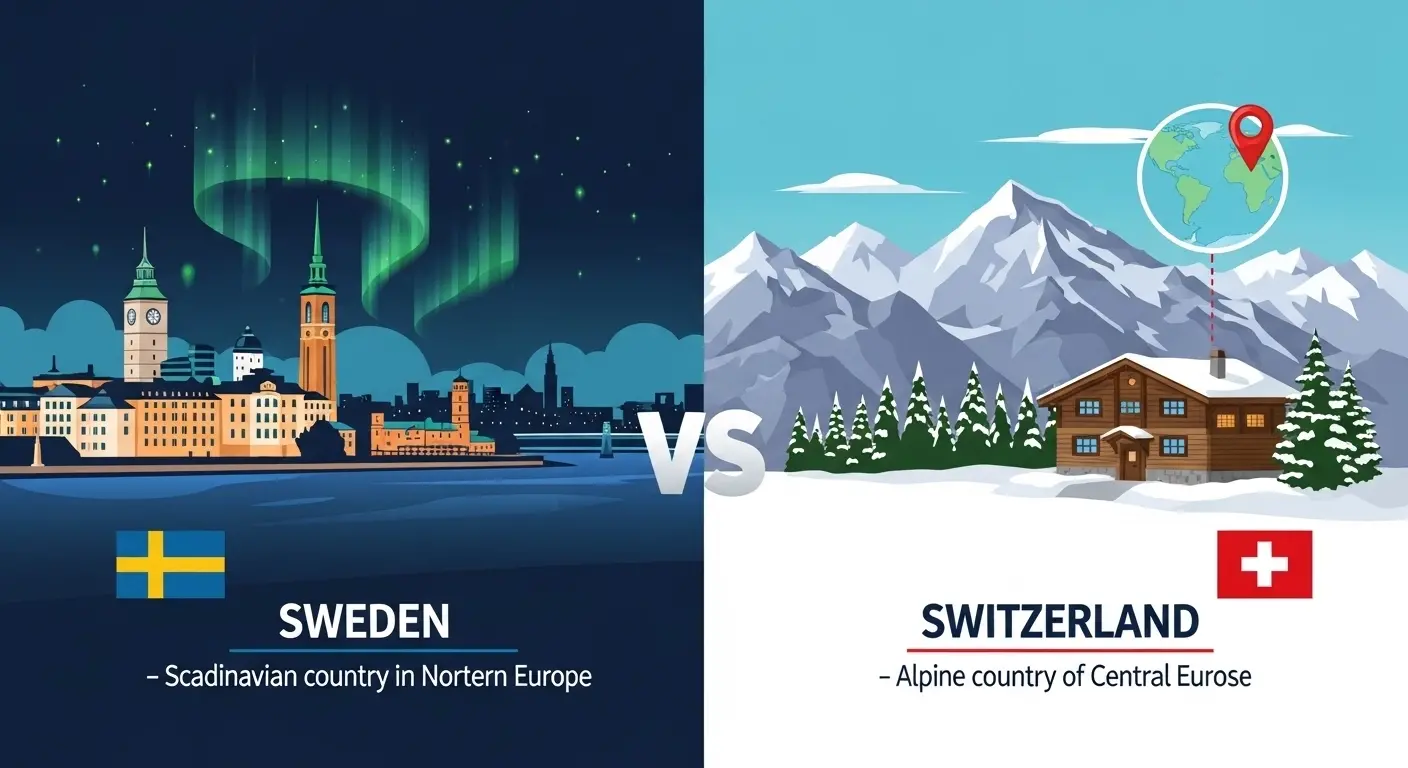
When traveling through Europe, many people often confuse Sweden and Switzerland. Both countries are highly developed, picturesque, and known for their high quality of life, but they are completely different in geography, culture, and language.
Imagine you are planning a winter holiday: you might think of Switzerland for skiing in the Alps, but Sweden offers vast forests, northern lights, and unique Scandinavian experiences.
Understanding the difference between Sweden and Switzerland helps travelers, students, and professionals make informed decisions. The difference between Sweden and Switzerland is not just about names; it affects culture, economy, politics, and even lifestyle. In this article, we’ll explore the difference between Sweden and Switzerland, their pronunciation, behavior, usage, and cultural significance, providing a complete guide for both learners and experts.
Pronunciation:
- Sweden: US /ˈswiː.dən/, UK /ˈswiː.dən/
- Switzerland: US /ˈswɪt.sɚ.lənd/, UK /ˈswɪt.sə.lənd/
Let’s dive deeper into the main aspects that differentiate these two European nations.
Difference Between Sweden and Switzerland
Here are 10 key differences explained with examples for better understanding:
1. Geography
- Sweden: Located in Northern Europe, part of Scandinavia. Known for flatlands, forests, and lakes.
Example 1: Stockholm, the capital, has many islands and waterfronts.
Example 2: Lapland in Sweden is famous for northern lights. - Switzerland: Located in Central Europe, landlocked, famous for the Alps mountains.
Example 1: The Matterhorn is a famous Swiss peak.
Example 2: Geneva is surrounded by mountains and lakes.
2. Language
- Sweden: Official language is Swedish.
Example: Road signs in Swedish like “Väg” for road.
Example: Swedish is spoken in schools and offices. - Switzerland: Four official languages – German, French, Italian, Romansh.
Example: Zurich predominantly speaks German.
Example: Geneva predominantly speaks French.
3. Government
- Sweden: Constitutional monarchy with parliamentary system.
Example: King Carl XVI Gustaf is the ceremonial monarch.
Example: Swedish parliament handles legislation. - Switzerland: Federal republic with direct democracy.
Example: Citizens vote regularly on national referendums.
Example: The Swiss government is made up of seven Federal Council members.
4. Currency
- Sweden: Swedish Krona (SEK).
Example: Shopping in Stockholm uses Krona.
Example: Currency exchange needed when visiting from the Eurozone. - Switzerland: Swiss Franc (CHF).
Example: Swiss Franc used in Zurich and Lucerne.
Example: Often considered a stable international currency.
5. Climate
- Sweden: Cold winters, mild summers, subarctic regions in the north.
Example: Skiing in northern Sweden in December.
Example: Summers are long with midnight sun. - Switzerland: Alpine climate, colder mountains, temperate lowlands.
Example: Ski resorts like Zermatt are popular.
Example: Geneva has mild summers and snowy winters.
6. Economy
- Sweden: Known for automotive, tech, and innovation industries.
Example: Volvo and Ericsson are Swedish brands.
Example: IKEA started in Sweden. - Switzerland: Known for banking, watches, and chocolate industries.
Example: Rolex and Lindt are Swiss brands.
Example: Switzerland is a global finance hub.
7. Population
- Sweden: ~10 million people, low population density.
Example: Stockholm is the most populated city.
Example: Rural areas have vast open spaces. - Switzerland: ~8.5 million people, higher density in cities.
Example: Zurich is a major urban center.
Example: Basel is another densely populated city.
8. Culture
- Sweden: Known for Scandinavian design, minimalism, egalitarian society.
Example: Swedish furniture is modern and simple.
Example: Fika culture – coffee breaks social tradition. - Switzerland: Known for precise craftsmanship, neutrality, multicultural festivals.
Example: Swiss watches and chocolates.
Example: Basel hosts international art and music events.
9. Nature and Landscape
- Sweden: Forests, lakes, archipelagos, and tundra.
Exampel: Vättern Lake, Northern Lapland.
Example: Hiking and camping are popular. - Switzerland: Alps, rivers, and valleys dominate the landscape.
Example: Jungfrau region attracts climbers.
Example: Rhine River flows through Switzerland.
10. Tourism
- Sweden: Focus on cultural tourism, northern lights, historic cities.
Example: Gamla Stan in Stockholm attracts tourists.
Example: Icehotel in Jukkasjärvi is unique. - Switzerland: Focus on skiing, mountain sports, luxury tourism.
Example: Zermatt and St. Moritz are ski resorts.
Example: Swiss Alps hiking is a major attraction.
Nature and Behaviour of the People
- Sweden: Calm, reserved, environmentally conscious, polite.
Example: People follow recycling rules strictly.
Example: Quiet public spaces are respected. - Switzerland: Neutral, precise, punctual, and industrious.
Example: Swiss trains run exactly on schedule.
Example: Banking and financial services are highly reliable.
Why People Are Confused
Both countries start with “Sw-” and are wealthy European nations, which creates mix-ups. Also, both have strong global reputations but differ in language, culture, and geography.
Sweden vs Switzerland: Comparison Table
| Feature | Sweden | Switzerland | Similarity |
| Location | Northern Europe | Central Europe | Both are in Europe |
| Language | Swedish | German, French, Italian, Romansh | Multiple languages in Europe |
| Currency | Krona (SEK) | Swiss Franc (CHF) | Both have stable currencies |
| Government | Constitutional monarchy | Federal republic | Democratic principles |
| Climate | Cold winters, mild summers | Alpine, temperate | Cold winters |
| Famous For | IKEA, Volvo, northern lights | Watches, chocolate, banking | High living standards |
| Population | ~10 million | ~8.5 million | Moderate populations |
| Tourism | Culture, nature | Skiing, mountains | Attractive destinations |
| Culture | Minimalist, egalitarian | Precise, neutral | Unique European culture |
| Nature | Forests, lakes, archipelagos | Alps, rivers, valleys | Scenic landscapes |
Which is Better in What Situation?
- Sweden: Better for cultural exploration, nature adventures, and experiencing Scandinavian lifestyle. Ideal for those who love forests, lakes, and quiet vacations.
- Switzerland: Better for mountain sports, luxury tourism, and financial opportunities. Ideal for skiing, hiking in Alps, and high-end shopping experiences.
Metaphors, Similes, and Connotation
- Sweden:
Metaphor: “Sweden is the calm lake of Europe” – calm and peaceful.
Connotation: Positive – serene, eco-friendly, advanced. - Switzerland:
Simile: “Switzerland is like a clock – precise and reliable.”
Connotation: Positive – neutral, precise, efficient.
Idioms/Proverbs:
- Sweden: “As cool as a Swede in summer” – calm under pressure.
- Switzerland: “Neutral as Switzerland” – impartial, unbiased.
Works in Literature
- “Sweden: A Modern History” – Neil Kent, 2008, non-fiction
- “Swiss Family Robinson” – Johann David Wyss, 1812, novel
Movies
- “The Girl with the Dragon Tattoo” – 2009, Sweden
- “Youth” – 2015, Switzerland
Frequently Asked Questions
- Are Sweden and Switzerland the same?
No, Sweden is in Northern Europe, Switzerland in Central Europe. - Which languages are spoken?
Sweden: Swedish. Switzerland: German, French, Italian, Romansh. - Do both use the Euro?
No, Sweden uses Krona; Switzerland uses Franc. - Which is colder?
Both have cold winters, but Sweden’s north is colder due to subarctic climate. - Are they politically similar?
Sweden is a monarchy; Switzerland is a federal republic with direct democracy.
Usefulness for Surroundings
- Sweden: Environmental policies, green energy, forests help global ecology.
- Switzerland: Financial stability, neutral diplomacy, eco-friendly urban planning.
Final Words
Sweden and Switzerland are unique, remarkable countries. Understanding the difference between Sweden and Switzerland enriches travel, education, and cultural knowledge. Both contribute positively to society and the environment in their ways.
Conclusion
Sweden and Switzerland, though often confused, have distinct identities shaped by geography, culture, and governance. Sweden is synonymous with Scandinavian calm, nature, and social equality. Switzerland, on the other hand, embodies neutrality, precision, and Alpine beauty.
Knowing the difference between Sweden and Switzerland is essential for travelers, students, and global citizens who want accurate knowledge. By exploring languages, landscapes, climate, culture, and economy, learners and experts gain a clear perspective of these two iconic European nations. Both countries, in their uniqueness, showcase the diversity and richness of Europe.

Henry is a passionate English professor, language specialist, and the founder of SpellCompare.com. With years of academic experience and a deep understanding of grammar, vocabulary, and linguistic nuances, he has dedicated his career to helping students and writers master the English language with clarity and confidence.
As an expert in word comparisons, spelling differences, and grammar rules, Henry simplifies complex language concepts into easy-to-understand explanations. His mission is to eliminate confusion between commonly misused words and provide accurate, research-based guidance that improves writing skills for learners worldwide.
Through SpellCompare.com, Henry combines academic expertise with practical examples, creating content that is clear, reliable, and reader-friendly. His work focuses on precision, correctness, and helping others communicate effectively in both academic and professional settings.
When he’s not teaching or writing, Henry continues researching evolving language trends to ensure his content remains current, helpful, and authoritative.