In the modern business world, understanding the difference between stakeholders and shareholders is essential for students, managers, and professionals. Many people often confuse the difference between stakeholders and shareholders because both terms are used in corporate discussions.
However, the difference between stakeholders and shareholders is significant in terms of roles, responsibilities, and influence in a company.
Imagine a company opening a new factory in a small town. The investors expect profit, employees expect jobs, customers expect good products, and the local community expects environmental safety. All these groups are connected to the company in different ways. This is where the idea of stakeholders and shareholders becomes important.
A shareholder mainly owns part of the company, while a stakeholder is anyone affected by the company’s actions. Understanding the difference between stakeholders and shareholders helps in making better business, ethical, and social decisions.
Pronunciation
- Stakeholders
- US: /ˈsteɪkˌhoʊldərz/
- UK: /ˈsteɪkˌhəʊldəz/
- Shareholders
- US: /ˈʃerˌhoʊldərz/
- UK: /ˈʃeəˌhəʊldəz/
Before going deeper, let’s clearly explore how both groups differ in meaning, role, and importance.
Key Difference Between Stakeholders and Shareholders
The main difference is simple:
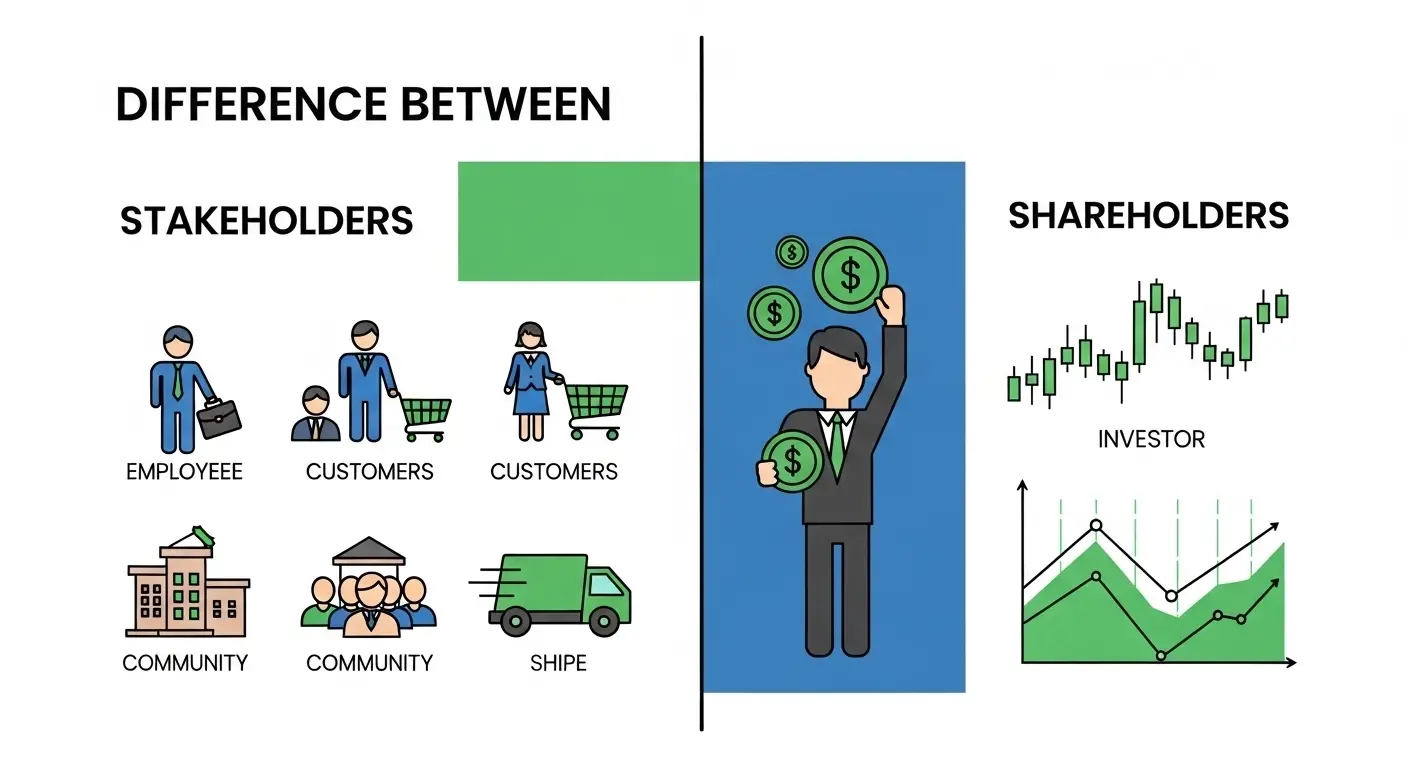
- Shareholders are owners of company shares.
- Stakeholders are all individuals or groups affected by the company.
Shareholders focus mainly on financial returns, while stakeholders focus on broader impact including social, environmental, and operational concerns.
Difference Between MSDS and SDS: in (2026)
Why Their Difference is Important in Society
Understanding this difference is important for learners and experts because it shapes decision-making in business and society. Companies that only focus on shareholders may ignore social responsibilities, while companies that consider stakeholders create sustainable growth. In today’s world, businesses must balance profit with responsibility. This balance improves trust, protects the environment, and supports economic stability. Knowing the difference between stakeholders and shareholders helps leaders build ethical and long-term successful organizations.
Difference Between Stakeholders and Shareholders (Detailed Points)
1. Meaning
- Shareholders: People who own company shares.
- Example 1: An investor holding Apple shares.
- Example 2: A person owning Tesla stock.
- Stakeholders: Anyone affected by the company.
- Example 1: Employees of Apple.
- Example 2: Customers of Tesla.
- Difference Between Trademark and Registered: in (2026)
2. Ownership
- Shareholders have ownership in the company.
- Stakeholders may or may not own the company.
3. Profit Interest
- Shareholders are mainly interested in profit.
- Example: Dividends from shares.
- Example: Increase in stock price.
- Stakeholders are interested in outcomes like jobs, safety, or services.
- Example: Employees want salaries.
- Example: Customers want quality products.
4. Risk Involvement
- Shareholders risk their invested money.
- Example: Stock market loss.
- Example: Company bankruptcy.
- Stakeholders risk impact on life or work.
- Example: Job loss.
- Example: Environmental damage.
5. Decision Influence
- Shareholders vote in company meetings.
- Example: Voting for board members.
- Example: Approving mergers.
- Stakeholders influence indirectly.
- Example: Employee strikes.
- Example: Customer feedback.
6. Relationship with Company
- Shareholders have a financial relationship.
- Stakeholders have social, economic, or environmental relationships.
7. Objective
- Shareholders aim for maximum returns.
- Stakeholders aim for balanced outcomes.
8. Time Focus
- Shareholders often focus on short-term profits.
- Stakeholders focus on long-term sustainability.
9. Legal Position
- Shareholders have legal rights in ownership.
- Stakeholders may have moral or indirect rights.
10. Examples
- Shareholders: Warren Buffett, stock investors.
- Stakeholders: employees, suppliers, government, community.
Nature and Behaviour
Shareholders
Shareholders behave like investors. Their main concern is return on investment. They monitor company performance, stock prices, and dividends. Their nature is financial and strategic.
Stakeholders
Stakeholders behave more broadly. They care about how the company affects society. Their nature is social, ethical, and practical.
Why People Get Confused
People often confuse these terms because:
- Both are connected to companies
- Both can influence decisions
- Some shareholders are also stakeholders
- Business news uses both terms interchangeably
Table: Difference Between Stakeholders and Shareholders
| Aspect | Shareholders | Stakeholders |
| Meaning | Company owners | Affected groups |
| Ownership | Yes | Not necessary |
| Focus | Profit | Overall impact |
| Risk | Financial loss | Social/operational impact |
| Decision Power | Voting rights | Indirect influence |
| Examples | Investors | Employees, customers |
Which is Better in What Situation?
Shareholders are more important when a company needs capital, investment, and financial growth. They provide funding and expect returns, which helps businesses expand. In contrast, stakeholders are more important when focusing on sustainability, ethics, and long-term stability. A successful company balances both. If a business only serves shareholders, it may ignore society. If it only serves stakeholders without profit, it may collapse financially. Therefore, both are essential depending on the situation.
Metaphors and Similes
- Shareholders are like “fuel suppliers of a machine” because they provide money that powers the business.
- Stakeholders are like “passengers in a moving train” because they are affected by its journey and direction.
Connotative Meaning
- Shareholders:
- Positive: Wealth creators, investors
- Negative: Profit-driven, self-interested
- Neutral: Company owners
- Stakeholders:
- Positive: Responsible, community-focused
- Negative: Pressure groups in some cases
- Neutral: Affected parties
Idioms and Proverbs
- “Having a stake in something” – used for both shareholders and stakeholders.
- Example: He has a stake in the company’s success.
- “Put all your eggs in one basket” – relates to shareholders investing in one company.
- Example: Investors should avoid putting all eggs in one basket.
Literature References
- The Big Short (Michael Lewis, 2010) – Finance genre, includes shareholder-driven markets
- Barbarians at the Gate (Bryan Burrough & John Helyar, 1989) – Business finance non-fiction
- Corporate Governance and Ethics (various academic works, 2000s) – discusses stakeholder theory
Movies Related to the Concept
- The Social Network (2010, USA) – shows shareholder disputes
- Wall Street (1987, USA) – highlights shareholder greed and profit mindset
- The Wolf of Wall Street (2013, USA) – focuses on investor-driven behavior
Frequently Asked Questions
1. Are shareholders also stakeholders?
Yes, shareholders are a type of stakeholder because they are affected by company performance.
2. Can stakeholders influence business decisions?
Yes, through feedback, protests, or participation in public opinion.
3. Do shareholders always earn profit?
No, they can also face financial losses.
4. Why are stakeholders important?
They ensure companies act responsibly toward society.
5. What is the main difference?
Shareholders own the company; stakeholders are affected by it.
How Both Are Useful for Surroundings
Shareholders provide capital that helps companies grow, create jobs, and boost the economy. Stakeholders ensure that this growth is ethical, sustainable, and socially responsible. Together, they create a balanced business ecosystem where profit and responsibility work side by side for the benefit of society.
Final Words
Both shareholders and stakeholders play essential roles in the modern business world. Shareholders drive financial growth, while stakeholders ensure ethical balance and social responsibility. A successful organization respects both groups equally. Ignoring either can lead to financial loss or social damage. Therefore, understanding their roles is crucial for building sustainable businesses and a better society.
Conclusion
In conclusion, the difference between stakeholders and shareholders is a fundamental concept in business and economics. Shareholders are individuals or institutions that own shares in a company and primarily focus on financial returns. On the other hand, stakeholders include a wider group such as employees, customers, suppliers, and society, all of whom are affected by the company’s actions.
Understanding the difference between stakeholders and shareholders helps in making better decisions in corporate governance and ethical business practices. It also highlights the importance of balancing profit with social responsibility. In today’s interconnected world, companies cannot survive by focusing only on profit; they must also consider their impact on people and the environment. Therefore, both shareholders and stakeholders are essential for sustainable business growth and long-term success.

SwiftHarbor is a dedicated English professor, language researcher, and the founder of SpellCompare.com. With years of academic experience in English grammar, vocabulary development, and linguistic comparison, SwiftHarbor specializes in simplifying complex language rules into clear, practical explanations.
As an expert in word usage, spelling differences, and commonly confused terms, SwiftHarbor has helped thousands of learners improve their writing accuracy and communication skills. Through SpellCompare.com, he provides detailed comparisons, easy examples, and research-based insights that make English learning accessible for students, writers, and professionals worldwide.
Known for a clear teaching style and structured explanations, SwiftHarbor focuses on eliminating confusion between similar words, improving grammar confidence, and promoting precise communication. His mission is simple: to make English easier, clearer, and more powerful for everyone.