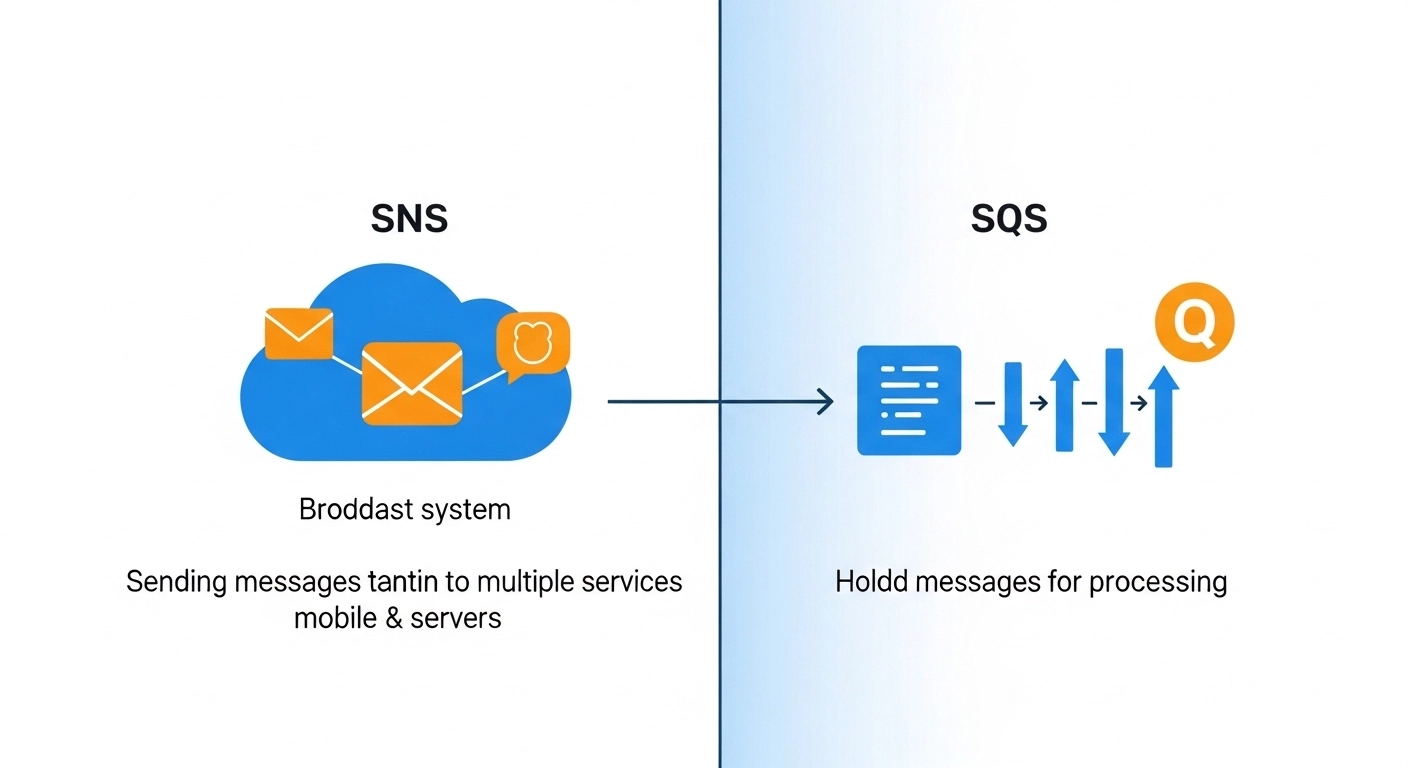
In the world of cloud computing, understanding the difference between SNS and SQS is very important for developers and system designers. Imagine a busy online shopping system where thousands of users place orders every second. Some messages need to be delivered instantly to many services, while others must be processed one by one in order.
This is where the difference between SNS and SQS becomes clear. In simple terms, SNS is like a broadcast system, while SQS is like a waiting queue. Many beginners confuse them because both are messaging services provided by AWS and both handle communication between applications.
In real-world cloud systems, the difference between SNS and SQS decides how efficiently data flows between services. Without understanding the difference between SNS and SQS, developers may design slow or unreliable systems. In this article, we will explore both concepts deeply with real examples and clear comparisons.
Meaning of SNS and SQS (Real-World Story)
Imagine a restaurant kitchen:
- SNS is like a bell system that rings and tells all staff at once: “Order is ready!”
- SQS is like a queue line where orders are processed one by one.
In AWS:
- SNS (Simple Notification Service) sends messages to many receivers.
- SQS (Simple Queue Service) stores messages until they are processed.
Key Difference Between SNS and SQS
- SNS = Pub/Sub (Push system)
- SQS = Message Queue (Pull system)
Why Their Difference is Important
Understanding SNS and SQS is important because modern applications depend on microservices. If messages are not handled correctly:
- Systems may crash
- Data may be lost
- Users may face delays
For learners and experts, knowing the difference between SNS and SQS helps design scalable, fast, and reliable cloud systems.
Pronunciation (US & UK)
- SNS → “Ess-En-Ess” (US & UK same)
- SQS → “Ess-Queue-Ess” (US & UK same)
Linking Hook
Now let’s move deeper and understand how SNS and SQS behave differently in real systems.
Difference Between SNS and SQS
1. Message Delivery Style
- SNS → Pushes messages
- Example 1: Email alerts sent to users
- Example 2: Mobile push notifications
- SQS → Stores messages for processing
- Example 1: Order processing system
- Example 2: Payment verification queue
2. Message Consumption
- SNS → Multiple subscribers receive messages
- Example 1: Stock price update to apps
- Example 2: News alerts
- SQS → One consumer processes one message
- Example 1: Inventory update system
- Example 2: Ticket booking system
3. Persistence
- SNS → No storage (instant delivery)
- Example 1: Live sports score updates
- Example 2: System alerts
- SQS → Messages stored until processed
- Example 1: Order backlog
- Example 2: Email sending queue
4. Architecture Type
- SNS → Pub/Sub model
- Example 1: Weather notifications
- Example 2: App broadcasts
- SQS → Queue model
- Example 1: Task scheduling
- Example 2: Job processing
5. Speed
- SNS → Faster delivery
- Example 1: Real-time alerts
- Example 2: Breaking news
- SQS → Slight delay due to processing
- Example 1: Data processing
- Example 2: Report generation
6. Message Order
- SNS → No guarantee of order
- Example 1: Social media updates
- Example 2: Notifications
- SQS → FIFO option available
- Example 1: Banking transactions
- Example 2: Booking systems
7. Reliability
- SNS → Best-effort delivery
- Example 1: Marketing messages
- Example 2: Alerts
- SQS → High reliability
- Example 1: Payment systems
- Example 2: Order systems
8. Scaling
- SNS → Highly scalable broadcasting
- Example 1: Global alerts
- Example 2: App notifications
- SQS → Scales processing workloads
- Example 1: Server jobs
- Example 2: Data pipelines
9. Use Case Type
- SNS → Communication
- Example 1: Notification systems
- Example 2: Event triggers
- SQS → Task processing
- Example 1: Backend jobs
- Example 2: Async processing
10. Failure Handling
- SNS → Limited retry support
- Example 1: Email notifications
- Example 2: Alerts
- SQS → Built-in retry & visibility timeout
- Example 1: Order retry system
- Example 2: Background jobs
Nature and Behaviour
SNS
SNS is reactive and broadcast-oriented. It immediately sends messages to all subscribers without waiting.
SQS
SQS is buffered and controlled. It stores messages and processes them safely one by one.
Why People Get Confused
People confuse SNS and SQS because:
- Both are AWS messaging services
- Both handle communication
- Both work together in systems
But their roles are completely different.
Table: SNS vs SQS
| Feature | SNS | SQS |
| Model | Pub/Sub | Queue |
| Delivery | Push | Pull |
| Storage | No | Yes |
| Consumers | Multiple | One at a time |
| Speed | Fast | Controlled |
| Use | Notifications | Processing |
Which is Better and When?
SNS is better when you need instant broadcasting. For example, sending alerts to millions of users at once. It is ideal for notifications, updates, and event-based systems.
SQS is better when you need reliable task processing. For example, handling e-commerce orders or background jobs. It ensures no message is lost.
In real-world systems, SNS and SQS are often used together. SNS sends the message, and SQS stores it for processing. This combination creates scalable and reliable cloud architecture used by large companies.
Metaphors and Similes
- SNS is like a megaphone in a stadium
- SQS is like a waiting line at a bank
Connotative Meaning
- SNS → Neutral, fast communication system
- SQS → Neutral, reliable processing system
Idioms / Proverbs
No direct idioms exist, but related expression:
- “Don’t miss the queue” → SQS concept of order processing
- Example: Always follow the queue like SQS in system design.
Literature / Technical References
- AWS Documentation (AWS, 2006–present) – Cloud Computing
- “Designing Data-Intensive Applications” – Martin Kleppmann (2017) – Distributed Systems
Movies / Media References
No direct movies are based on SNS or SQS, but:
- Cloud computing concepts appear in “The Social Network” (USA, 2010)
FAQs
1. What is SNS?
SNS is a messaging service that sends messages to multiple subscribers.
2. What is SQS?
SQS is a message queue service that stores and processes messages.
3. Can SNS and SQS work together?
Yes, they are often used together in cloud systems.
4. Which is faster?
SNS is faster because it delivers instantly.
5. Which is more reliable?
SQS is more reliable because it stores messages.
How Both Are Useful
SNS and SQS together make cloud systems scalable, fast, and reliable. SNS handles communication, while SQS handles processing. This combination is widely used in modern applications like e-commerce, banking, and streaming services.
Final Words
SNS and SQS are both essential AWS services but serve different roles. SNS is best for instant broadcasting, while SQS is best for reliable message processing. Together, they form a powerful system for modern cloud applications. Understanding both helps developers build scalable, efficient, and fault-tolerant systems. Whether you are a beginner or expert, mastering SNS and SQS is crucial for cloud architecture success.
Conclusion
The difference between SNS and SQS is simple once you understand their roles. SNS is a push-based system used for sending messages to multiple users instantly. SQS is a queue-based system used for processing messages one by one in a reliable way.
Both services solve different problems in cloud computing. SNS focuses on communication speed, while SQS focuses on processing reliability. In modern systems, they are often combined to create powerful and scalable architectures.
If you are designing cloud applications, choosing between SNS and SQS depends on your use case. For notifications and real-time updates, SNS is ideal. For background processing and task handling, SQS is better.
Understanding this difference helps developers avoid system failures and design efficient applications. In short, SNS is for broadcasting, and SQS is for processing and together they make cloud systems strong and scalable.

SwiftHarbor is a dedicated English professor, language researcher, and the founder of SpellCompare.com. With years of academic experience in English grammar, vocabulary development, and linguistic comparison, SwiftHarbor specializes in simplifying complex language rules into clear, practical explanations.
As an expert in word usage, spelling differences, and commonly confused terms, SwiftHarbor has helped thousands of learners improve their writing accuracy and communication skills. Through SpellCompare.com, he provides detailed comparisons, easy examples, and research-based insights that make English learning accessible for students, writers, and professionals worldwide.
Known for a clear teaching style and structured explanations, SwiftHarbor focuses on eliminating confusion between similar words, improving grammar confidence, and promoting precise communication. His mission is simple: to make English easier, clearer, and more powerful for everyone.