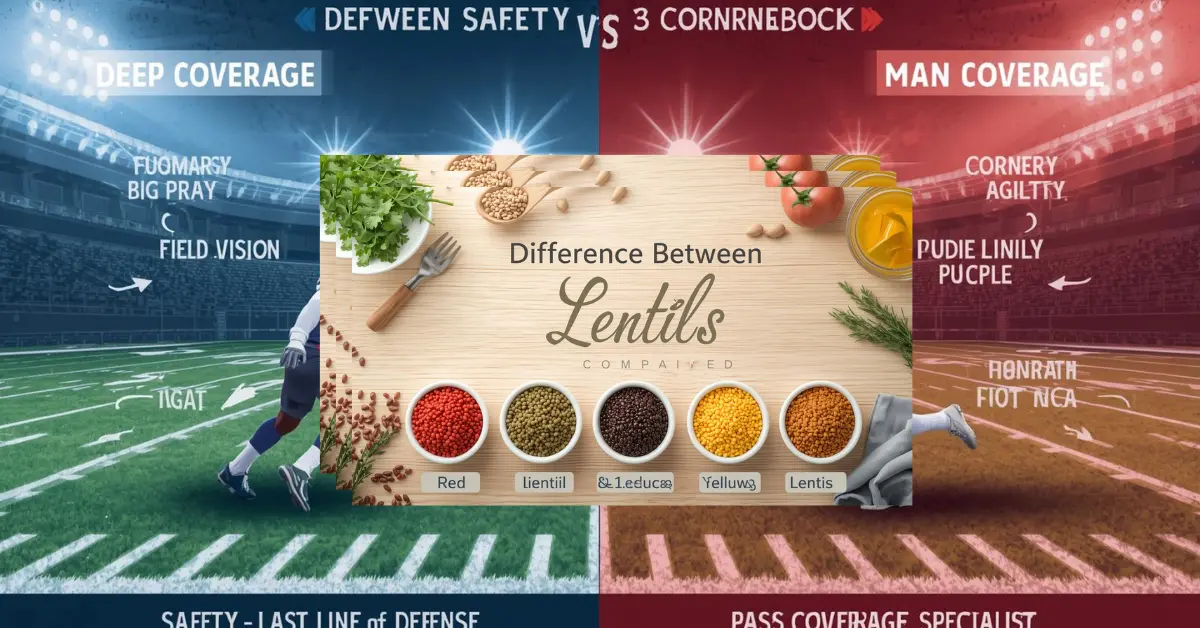
When you watch an American football game, you often hear commentators talk about a safety or a cornerback. These two positions are essential in defense, yet many beginners confuse them. Imagine a thrilling NFL match where a wide receiver is sprinting towards the end zone.
A cornerback covers him closely, trying to intercept the pass, while the safety stays deeper, ready to stop any long plays. Understanding the difference between safety and cornerback helps fans appreciate the strategies and roles of players on the field.
Coaches and analysts emphasize this difference because knowing who is responsible for deep coverage versus man-to-man defense can change the outcome of a game.
Pronunciation:
- Safety – US: /ˈseɪfti/ | UK: /ˈseɪfti/
- Cornerback – US: /ˈkɔːrnərˌbæk/ | UK: /ˈkɔːnəˌbæk/
Linking Hook:
To truly grasp how these two positions shape football defense, let’s dive deeper into the difference between safety and cornerback.
Difference Between Safety and Cornerback
Here are 10 key differences, explained with examples:
- Position on the Field
- Safety: Usually plays deep behind the linebackers. Example: The free safety stayed 20 yards behind the line to intercept a long throw.
- Cornerback: Stays near wide receivers to cover them closely. Example: The cornerback shadowed the receiver from the snap to the catch.
- Primary Role
- Safety: Focuses on preventing big plays. Example: The safety prevented a touchdown by tackling the receiver at midfield.
- Cornerback: Prevents receivers from catching the ball. Example: The cornerback deflected the pass just in time.
- Coverage Type
- Safety: Covers zones or helps cornerbacks with double coverage. Example: Zone coverage by the safety stopped the deep pass.
- Cornerback: Usually assigned to a specific player (man-to-man). Example: Cornerback followed the top receiver all game.
- Run Support
- Safety: Supports linebackers in stopping runs. Example: Strong safety tackled the running back at the line.
- Cornerback: Rarely involved in run defense. Example: Cornerback stayed back in coverage as the run went to the opposite side.
- Physical Attributes
- Safety: Taller and heavier for tackling power. Example: The safety’s height allowed him to intercept high passes.
- Cornerback: Faster and agile to match receivers’ speed. Example: Cornerback sprinted 40 yards to cover a receiver.
- Tendency to Blitz
- Safety: Occasionally blitzes the quarterback. Example: Safety rushed the QB during a surprise play.
- Cornerback: Rarely blitzes unless in special schemes. Example: Cornerback stayed in coverage rather than blitzing.
- Awareness and Vision
- Safety: Needs excellent field vision to read the quarterback. Example: Safety anticipated the pass and moved to intercept.
- Cornerback: Focuses on the receiver’s movements. Example: Cornerback reacted instantly to the receiver’s cut.
- Number on the Field
- Safety: Typically 2 safeties per team. Example: Free and strong safety coordinated deep coverage.
- Cornerback: Typically 2–4 cornerbacks depending on formation. Example: Nickel cornerback covered slot receiver.
- Risk Level
- Safety: Plays deeper, less likely to be involved in collisions. Example: Safety prevented long plays without heavy hits.
- Cornerback: Faces high-speed collisions frequently. Example: Cornerback collided with receiver after breaking up a pass.
- Key Skillset
- Safety: Tackling, reading plays, and anticipation. Example: Safety intercepted a pass because he read the QB perfectly.
- Cornerback: Speed, agility, and man coverage. Example: Cornerback stayed step-for-step with the receiver.
Nature and Behavior
- Safety: Strategic, anticipative, and protective. They act like the last line of defense, always scanning the field.
- Cornerback: Agile, reactive, and aggressive in coverage. They shadow the receiver closely and challenge every catch.
Why People Get Confused:
Both defend against passing plays, but their positions and responsibilities differ. Beginners often assume any defensive player covering a receiver is the same.
Comparison Table: Safety vs Cornerback
| Feature | Safety | Cornerback | Similarity |
| Field Position | Deep, behind linebackers | Near receivers, sideline | Both are defensive backs |
| Role | Prevent big plays | Prevent receptions | Defensive coverage |
| Coverage | Zone & support | Man-to-man | Protect passing game |
| Run Support | Yes | Rare | Involved sometimes |
| Physicality | Taller, stronger | Faster, agile | Athletic demands |
| Blitz | Occasional | Rare | Can blitz in schemes |
| Vision | Reads field | Watches receiver | Requires awareness |
| Collision Risk | Medium | High | Engage opponents |
| Numbers | Usually 2 | 2–4 depending on formation | Multiple on field |
| Skill Focus | Tackling & anticipation | Speed & agility | Defensive expertise |
Which is Better in What Situation?
Safety: Ideal when preventing long passes or as the last line of defense. They are crucial against deep threats and unpredictable plays. A strong safety can change the game with a single interception.
Cornerback: Essential in stopping top receivers and controlling short to medium passing plays. Agile cornerbacks are perfect for man-to-man coverage and preventing key receptions.
Metaphors and Similes
- Safety: “Like a guardian angel in the backfield,” highlighting protection.
- Cornerback: “As swift as a shadow,” emphasizing speed and tracking.
Connotation:
- Safety: Neutral-positive; implies vigilance and defense. Example: “He played safety with careful attention.”
- Cornerback: Positive; implies agility and skill. Example: “The cornerback was lightning-fast on the field.”
Idioms / Proverbs
- “Better safe than sorry” – relates to safety. Example: The safety’s positioning reflected “better safe than sorry.”
- “Keep your eye on the ball” – relates to cornerback. Example: Cornerback followed the receiver, truly keeping his eye on the ball.
Appearances in Literature & Media
Literature:
- Friday Night Lights – Sports, H. G. Bissinger, 1990 – Features defensive roles including safeties and cornerbacks.
- The Blind Side – Biography/Sports, Michael Lewis, 2006 – Discusses positions like cornerback and safety.
Movies:
- The Blind Side – 2009, USA – Focus on defensive back positions.
- Safety – 2020, USA – True story emphasizing safety role in football.
FAQs
- What is the main difference between safety and cornerback?
Safety plays deep; cornerback covers receivers closely. - Do safeties ever cover receivers one-on-one?
Rarely; mostly in zone or double coverage. - Which position is faster?
Cornerbacks tend to be faster to match receiver speed. - Can a safety blitz?
Yes, occasionally in certain defensive schemes. - Why do people confuse these positions?
Both defend passes, but their depth and responsibilities differ.
Contribution to Surroundings
Both positions protect the team and maintain order in defense. Their awareness and quick decision-making prevent costly mistakes, just as safety measures in society prevent harm.
Final Words
Understanding the difference between safety and cornerback is crucial for players, coaches, and fans. Each position has unique responsibilities, and together they form a strong defensive backbone. Appreciating their roles enhances both gameplay and fan knowledge.
Conclusion
The difference between safety and cornerback is subtle but important. Safeties guard the deep field, providing a last line of defense, while cornerbacks shadow receivers, preventing short and medium gains.
Both positions require specific skills safeties excel in anticipation and tackling, cornerbacks in speed and coverage. Recognizing this difference improves understanding of football strategy and player contributions. From casual fans to sports analysts, knowing these roles clarifies gameplay and highlights how defense shapes outcomes. Both positions are vital, complementary, and essential for a successful team.

My name is SwiftSphere, and I am a passionate English language author and the creator of Spellcompare.com. I specialize in word comparisons, grammar clarity, and simplifying confusing English terms for readers around the world.
As a professional writer, I focus on breaking down commonly misunderstood words, phrases, and language rules into clear, practical explanations. My goal is to make English easier, more accurate, and more accessible for students, professionals, and everyday learners.
Through Spellcompare.com, I provide well-researched, easy-to-understand content that helps readers confidently choose the right words in writing and speech. Whether it’s comparing similar spellings, explaining grammar rules, or clarifying tricky vocabulary, I am committed to delivering precise and reliable guidance.
I believe that strong language skills create strong communication — and strong communication creates opportunity. That belief drives my work every day.