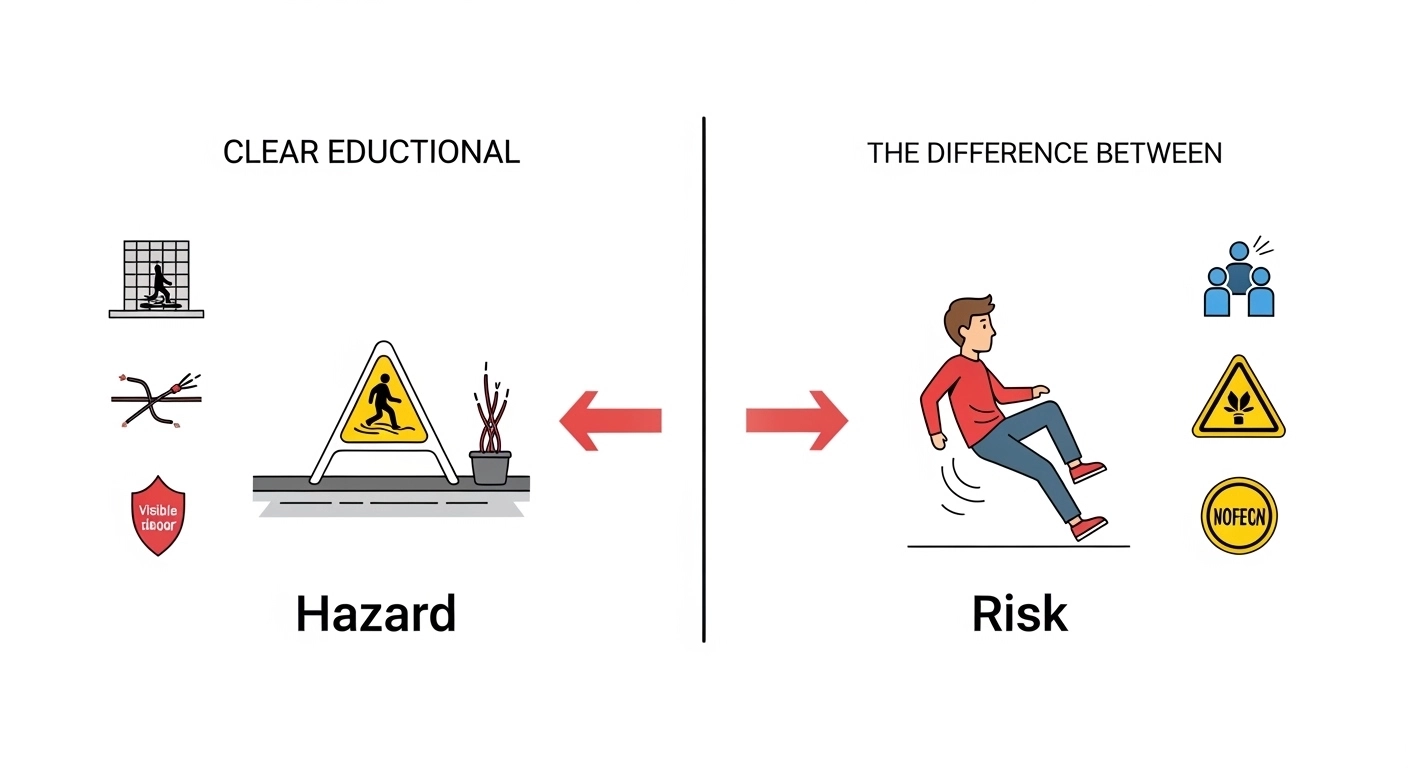
Imagine a construction worker walking onto a building site early in the morning. On the ground lies a loose electrical wire, and nearby a wet surface makes the floor slippery. The wire and the wet floor are dangerous conditions but the worker might or might not get hurt depending on the situation.
This simple scenario helps explain the difference between risk and hazard. A hazard is something that has the potential to cause harm, such as the exposed wire or slippery floor. Risk, however, refers to the chance that the hazard will actually cause harm.
Understanding the difference between risk and hazard is essential in daily life, workplaces, and safety management. People often use these terms interchangeably, but they are not the same. The difference between risk and hazard becomes clear when we look at how danger exists versus how likely it is to cause damage.
Learning the difference between risk and hazard helps individuals make better decisions, reduce accidents, and improve safety awareness in society.
Key Difference Between the Both
The difference between risk and hazard lies mainly in their meaning. A hazard is a source of possible harm, while risk is the likelihood that the harm will actually occur because of that hazard.
Why Their Difference Is Necessary to Know for Learners and Experts
Understanding the difference between risk and hazard is vital in fields like engineering, medicine, construction, environmental science, and workplace safety. When experts recognize hazards, they can eliminate them. When they understand risks, they can estimate the probability of harm and create preventive strategies. This knowledge protects workers, improves public safety policies, and reduces accidents in society. For learners, it builds awareness and critical thinking about safety in everyday environments.
Pronunciation
Risk
- US: /rɪsk/
- UK: /rɪsk/
Hazard
- US: /ˈhæzərd/
- UK: /ˈhæzəd/
Before exploring the detailed explanation, let us look deeper into the difference between risk and hazard with practical comparisons and examples.
Difference Between Risk and Hazard
1. Meaning
Risk: Refers to the probability or chance that harm will occur.
Examples:
- Walking on a slippery floor increases the risk of falling.
- Driving fast increases the risk of accidents.
Hazard: Refers to something that can cause harm or danger.
Examples:
- A slippery floor is a hazard.
- Broken glass on the road is a hazard.
2. Nature
Risk: Abstract concept involving probability.
Examples:
- Smoking increases the risk of lung disease.
- Poor diet increases the risk of health issues.
Hazard: Physical or situational source of danger.
Examples:
- Toxic chemicals are hazards in laboratories.
- Open flames are hazards in factories.
3. Focus
Risk: Focuses on likelihood of damage.
Examples:
- The risk of fire increases during dry seasons.
- The risk of infection increases in crowded areas.
Hazard: Focuses on the source of danger.
Examples:
- Flammable liquids are hazards.
- Faulty wiring is a hazard.
4. Measurement
Risk: Can be measured and calculated.
Examples:
- Engineers calculate earthquake risk.
- Insurance companies calculate accident risk.
Hazard: Usually identified rather than measured.
Examples:
- Loud noise is a hazard in factories.
- Radiation is a hazard in nuclear plants.
5. Control
Risk: Reduced through safety measures.
Examples:
- Wearing helmets reduces accident risk.
- Vaccination reduces disease risk.
Hazard: Removed or controlled to eliminate danger.
Examples:
- Removing broken glass removes the hazard.
- Fixing wiring removes electrical hazards.
6. Existence
Risk: Exists only when people interact with hazards.
Examples:
- Standing near a cliff increases risk of falling.
- Crossing a busy road increases risk of accidents.
Hazard: Can exist even if no one is present.
Examples:
- A toxic chemical remains a hazard in storage.
- A deep hole in the ground is a hazard.
7. Scope
Risk: Concerned with outcomes and consequences.
Examples:
- Risk of illness from polluted water.
- Risk of injury in extreme sports.
Hazard: Concerned with the source causing harm.
Examples:
- Polluted water itself is a hazard.
- Sharp rocks are hazards in climbing.
8. Role in Safety
Risk: Helps in planning safety policies.
Examples:
- Risk assessments guide workplace rules.
- Risk analysis improves disaster planning.
Hazard: Identified during safety inspections.
Examples:
- Inspectors check for fire hazards.
- Engineers detect structural hazards.
9. Relationship
Risk: Depends on hazard presence and exposure.
Examples:
- Risk increases if workers touch chemicals.
- Risk rises if safety equipment is missing.
Hazard: Independent source of danger.
Examples:
- Electricity is a hazard in open wires.
- Ice on roads is a hazard.
10. Example in Daily Life
Risk: The possibility of harm.
Examples:
- Risk of slipping during rain.
- Risk of sunburn in hot weather.
Hazard: The cause of harm.
Examples:
- Wet roads are hazards.
- Strong sunlight is a hazard.
Nature and Behaviour of Both
Risk:
Risk behaves as a variable factor. It increases or decreases depending on conditions, exposure, and preventive measures.
Hazard:
Hazard behaves as a constant source of danger until it is removed or controlled.
Why People Are Confused About Their Use
Many people confuse risk and hazard because they both relate to danger. In everyday speech, people often use them interchangeably. However, technically they describe different aspects of safety: hazards create potential harm, while risks measure the likelihood of that harm occurring.
Table Showing Difference and Similarity
| Aspect | Risk | Hazard |
| Meaning | Chance of harm | Source of harm |
| Nature | Probability-based | Physical or situational |
| Role | Measures likelihood | Identifies danger |
| Measurement | Calculated or estimated | Usually identified |
| Relation | Depends on exposure | Exists independently |
| Similarity | Both relate to safety and danger | Both require management |
Which Is Better in What Situation?
Risk:
Risk is more useful when planning safety strategies or evaluating potential outcomes. For example, businesses use risk analysis to decide whether a project is safe or profitable. Governments also calculate risk to prepare for disasters or health crises.
Hazard:
Hazard identification is more useful during inspections and prevention. Removing hazards directly reduces danger. For example, fixing broken machinery removes the hazard and therefore lowers the risk.
Use in Metaphors and Similes
Risk
- “Life is a risk worth taking.”
- “Starting a business is like walking on a risky path.”
Hazard
- “His temper is a hazard to teamwork.”
- “Rumors can be a social hazard.”
Connotative Meaning
Risk – Usually neutral or slightly negative, sometimes positive in adventure contexts.
Examples:
- “Taking risks leads to innovation.”
- “High risk can bring high reward.”
Hazard – Generally negative, associated with danger.
Examples:
- “Smoking is a health hazard.”
- “Pollution is an environmental hazard.”
Idioms or Proverbs
Risk-related idioms
- “Nothing ventured, nothing gained.”
Example: Starting a new business always involves risk.
Hazard-related expressions
- “A hazard of the job.”
Example: Long working hours are a hazard of being a doctor.
Works in Literature
Risk
- Risk – Thriller novel by Dick Francis (1977)
Hazard
- Hardy and Hazard – Historical narrative work by Elinor Glyn (1918)
Movies Related to the Keywords
Risk
- Risk (2016, USA documentary)
Hazard
- Hazard (2005, Japan)
Frequently Asked Questions
1. What is the basic difference between risk and hazard?
A hazard is a source of danger, while risk is the probability that the hazard will cause harm.
2. Can a hazard exist without risk?
Yes. If no one is exposed to a hazard, the risk may be very low or nonexistent.
3. Why are both important in safety management?
Hazards identify dangers, while risk assessment determines how serious those dangers are.
4. Which comes first: risk or hazard?
Hazard comes first because it is the source of potential harm.
5. Are risk and hazard used in workplaces?
Yes, they are essential terms in occupational health and safety.
How Both Are Useful for Surroundings
Both concepts help people maintain safer environments. Hazard identification removes sources of danger, while risk assessment helps prioritize which dangers require urgent attention. Together, they guide safety policies in homes, industries, healthcare, and public spaces.
Final Words for Both
Risk and hazard are closely related but distinct ideas in safety science. Understanding both allows individuals and organizations to recognize danger and respond effectively.
Conclusion
The difference between risk and hazard is fundamental in understanding safety and danger in everyday life. A hazard represents the source of possible harm, while risk describes the likelihood that this harm will occur.
Although these terms are often used interchangeably, their meanings serve different purposes in risk management, safety planning, and environmental protection.
Recognizing hazards helps remove potential threats, while analyzing risks helps evaluate how serious those threats may be. Together, they create a complete framework for preventing accidents and protecting people in homes, workplaces, and communities.

My name is SwiftSphere, and I am a passionate English language author and the creator of Spellcompare.com. I specialize in word comparisons, grammar clarity, and simplifying confusing English terms for readers around the world.
As a professional writer, I focus on breaking down commonly misunderstood words, phrases, and language rules into clear, practical explanations. My goal is to make English easier, more accurate, and more accessible for students, professionals, and everyday learners.
Through Spellcompare.com, I provide well-researched, easy-to-understand content that helps readers confidently choose the right words in writing and speech. Whether it’s comparing similar spellings, explaining grammar rules, or clarifying tricky vocabulary, I am committed to delivering precise and reliable guidance.
I believe that strong language skills create strong communication — and strong communication creates opportunity. That belief drives my work every day.