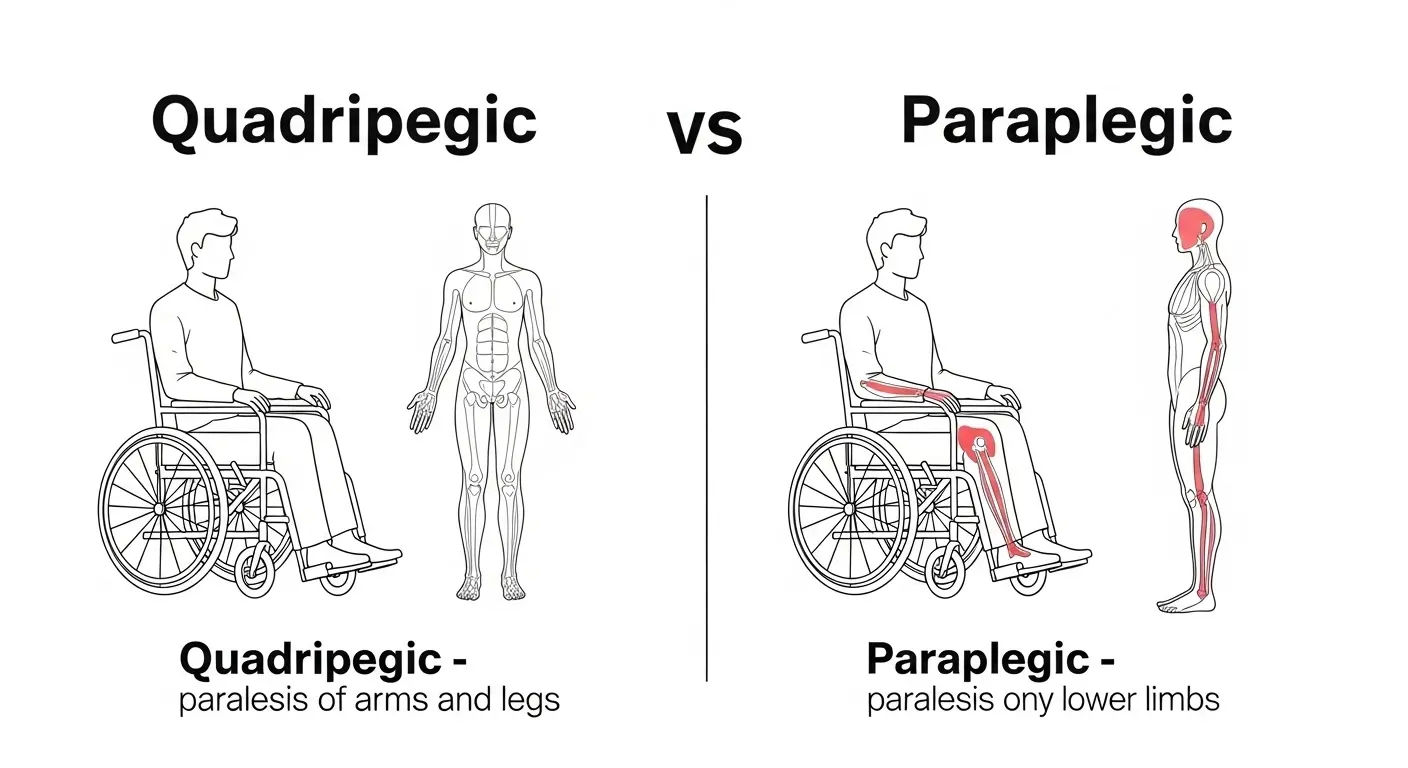
Imagine a world where simple movements like walking or lifting your arms become impossible. People with spinal cord injuries often face such challenges. Among them, understanding the difference between quadriplegic and paraplegic is crucial. A quadriplegic is someone who experiences paralysis in all four limbs, while a paraplegic typically has paralysis in the lower half of the body.
Knowing the difference between quadriplegic and paraplegic not only helps in medical care but also fosters empathy and awareness in society. In real-life situations, families, caregivers, and even educators need to clearly identify whether a patient is quadriplegic or paraplegic to provide appropriate support, therapy, and tools for daily life. Pronunciation: Quadriplegic: UK /ˌkwɒdrɪˈpliːdʒɪk/, US /ˌkwɑːdrɪˈpliːdʒɪk/; Paraplegic: UK /ˌpærəˈpliːdʒɪk/, US /ˌpærəˈpliːdʒɪk/.
Linking Hook: Now that we understand their basic definitions and pronunciations, let’s dive into the key differences and nuances that set quadriplegic and paraplegic apart.
Difference Between Quadriplegic and Paraplegic
1. Area of Paralysis
- Quadriplegic: Paralysis affects both arms and legs.
- Example 1: A car accident victim cannot move hands or feet.
- Example 2: A spinal cord injury in the neck leads to loss of limb movement.
- Paraplegic: Paralysis is limited to the lower body.
- Example 1: A fall causes paralysis in legs, but arms remain functional.
- Example 2: Spinal injury at the thoracic region affects legs only.
2. Cause of Injury
- Quadriplegic: Often caused by cervical spinal injuries.
- Paraplegic: Typically due to injuries in the thoracic, lumbar, or sacral spinal cord.
3. Mobility Support
- Quadriplegic: Requires advanced assistive devices like powered wheelchairs.
- Paraplegic: Can use manual wheelchairs or crutches more effectively.
4. Daily Living Assistance
- Quadriplegic: Needs help with eating, dressing, and personal hygiene.
- Paraplegic: Can perform upper-body activities independently.
5. Muscle Control
- Quadriplegic: Limited or no control of upper and lower muscles.
- Paraplegic: Upper-body muscles remain strong and functional.
6. Rehabilitation Focus
- Quadriplegic: Therapy focuses on upper and lower limb movement, breathing, and speech.
- Paraplegic: Therapy emphasizes leg mobility, strengthening, and endurance.
7. Life Expectancy Impact
- Quadriplegic: Higher risk of complications like respiratory infections.
- Paraplegic: Fewer systemic complications if the upper body is healthy.
8. Emotional Challenges
- Quadriplegic: Greater psychological adjustment due to extensive dependency.
- Paraplegic: Emotional stress is present but mobility independence helps confidence.
9. Employment Possibilities
- Quadriplegic: Often limited to remote or desk-based jobs.
- Paraplegic: Can engage in various professions with adaptive tools.
10. Social Interaction
- Quadriplegic: Social life may rely heavily on family or caregivers.
- Paraplegic: More independent in social and outdoor activities.
Examples for Clarity:
- Quadriplegic: Christopher Reeve (movie actor, injured in 1995 accident)
- Paraplegic: A sports player using wheelchair basketball
Nature and Behavior
- Quadriplegic: Highly dependent on caregivers, may require constant medical supervision.
- Paraplegic: More independent, can participate in sports, travel, and daily activities with minimal help.
Why People Are Confused
Many confuse the terms because both involve paralysis and wheelchair use, but the critical difference lies in the number of limbs affected.
Table: Difference and Similarity
| Feature | Quadriplegic | Paraplegic | Similarity |
| Limbs affected | All four | Lower body only | Both have spinal paralysis |
| Cause | Cervical spinal injury | Thoracic/lumbar injury | Both result from spinal injury |
| Mobility | Powered wheelchair needed | Manual wheelchair possible | Use assistive devices |
| Daily activity | Requires assistance | Partially independent | Both need rehabilitation |
| Emotional impact | Higher dependency | Moderate dependency | Adjustment required |
Which is Better in What Situation?
- Quadriplegic: Best support systems are needed when full-body paralysis occurs, ensuring respiratory and mobility safety.
- Paraplegic: Ideal scenarios involve partial independence, enabling sports, work, and travel with minimal adaptations.
Metaphors, Similes, and Connotations
- Quadriplegic: Often used metaphorically to describe “total helplessness” (negative connotation).
- Paraplegic: Can symbolize “partial limitation but ability to overcome” (neutral/positive).
Examples:
- “The project left him quadriplegic in spirit, unable to act.”
- “She faced paraplegic challenges in her career but thrived despite obstacles.”
Idioms/Proverbs Related
- “Lean on someone” → Reflects reliance like quadriplegic patients.
- “Stand on your own feet” → Paraplegic metaphor for partial independence.
Works in Literature
- Still Me by Christopher Reeve (Autobiography, 1998) – Quadriplegia
- Gimp: Adventures in the Curious World of Disability by Carla Power (Non-fiction, 2002) – Paraplegia
Movies
- The Brooke Ellison Story (2004, USA) – Quadriplegic
- Murderball (2005, USA) – Paraplegic athletes
Frequently Asked Questions
- Can a quadriplegic use a wheelchair?
- Yes, usually a powered wheelchair is needed.
- Do paraplegics have arm function?
- Yes, they can use their arms normally.
- Are quadriplegics always fully paralyzed?
- Severity varies; some retain partial movement.
- Which condition is more common?
- Paraplegia is more common than quadriplegia.
- Can both return to work?
- Yes, with proper adaptations and assistive technology.
How Both Are Useful for Surroundings
Quadriplegics inspire society through resilience; paraplegics showcase adaptability, promoting awareness of disability challenges and accessibility needs.
Final Words:
Understanding quadriplegic and paraplegic differences fosters empathy, improves support systems, and promotes inclusive communities.
Conclusion
The difference between quadriplegic and paraplegic is not just medical; it shapes how society interacts, aids, and adapts to individuals with disabilities. While quadriplegics face total limb paralysis, paraplegics experience partial lower-body limitations.
Recognizing these distinctions allows caregivers, educators, and communities to provide accurate assistance, develop adaptive technologies, and enhance the lives of those affected. Awareness about quadriplegic and paraplegic conditions strengthens societal inclusion, medical response, and overall empathy, making it essential knowledge for experts, learners, and families alike.

SwiftHarbor is a dedicated English professor, language researcher, and the founder of SpellCompare.com. With years of academic experience in English grammar, vocabulary development, and linguistic comparison, SwiftHarbor specializes in simplifying complex language rules into clear, practical explanations.
As an expert in word usage, spelling differences, and commonly confused terms, SwiftHarbor has helped thousands of learners improve their writing accuracy and communication skills. Through SpellCompare.com, he provides detailed comparisons, easy examples, and research-based insights that make English learning accessible for students, writers, and professionals worldwide.
Known for a clear teaching style and structured explanations, SwiftHarbor focuses on eliminating confusion between similar words, improving grammar confidence, and promoting precise communication. His mission is simple: to make English easier, clearer, and more powerful for everyone.