Imagine you’re at a local market, deciding whether to buy a handcrafted vase. The seller explains how it can brighten your home, showing you its unique design. You feel genuinely convinced and happily purchase it.
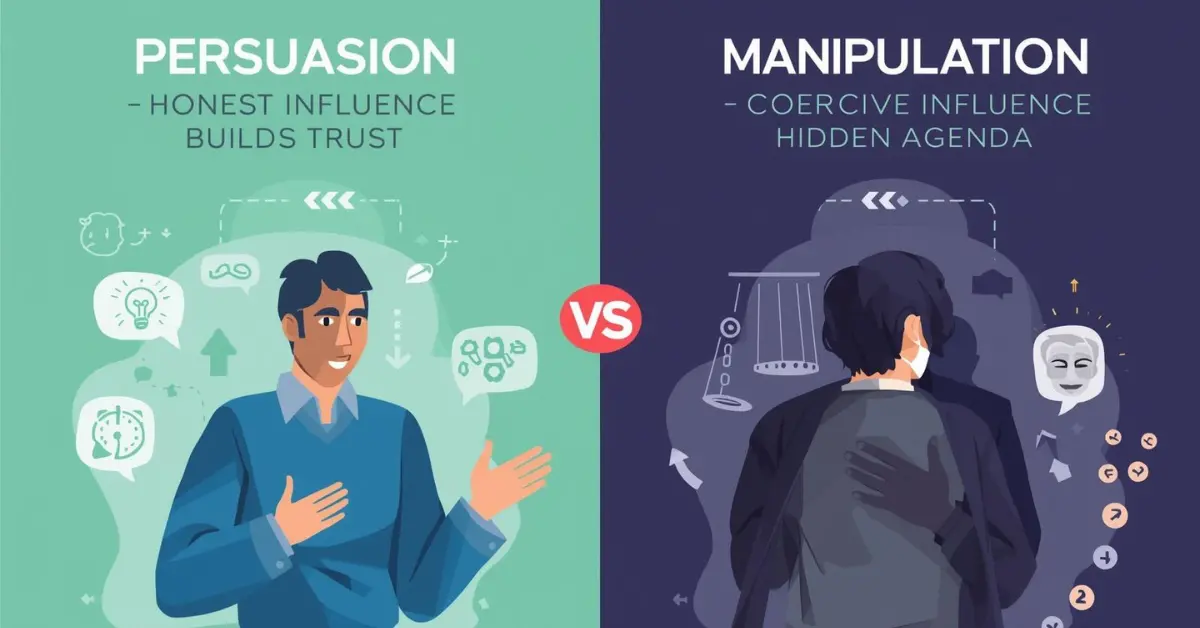
This is persuasion in action, guiding choices through logic, emotion, or credibility. Now, imagine another seller who pressures you with exaggerated claims, guilt, or fear to make you buy the vase. That is manipulation, where influence is achieved through deception or coercion.
Understanding the difference between persuasion and manipulation is crucial for everyday life, from marketing to leadership. Both affect human decisions, but knowing their distinction helps individuals make ethical choices and avoid being exploited. The key lies in intent: persuasion respects autonomy, while manipulation exploits it.
Pronunciation:
- Persuasion – US: /pərˈsweɪʒən/ | UK: /pəˈsweɪʒən/
- Manipulation – US: /məˌnɪpjəˈleɪʃən/ | UK: /məˌnɪpjʊˈleɪʃən/
Let’s explore the nuanced differences and see how knowing them can make a real impact in society.
Difference Between Persuasion and Manipulation
1. Intent
- Persuasion: Seeks a voluntary and informed agreement.
- Example 1: A teacher encourages students to join a science fair to build skills.
- Example 2: An environmental campaign highlights the benefits of recycling.
- Manipulation: Aims to control or deceive for personal gain.
- Example 1: A salesperson exaggerates product benefits to meet a quota.
- Example 2: A politician spreads fear to gain votes.
2. Transparency
- Persuasion: Open and honest about facts.
- Example 1: A dietitian explains pros and cons of a nutrition plan.
- Example 2: A charity shows exactly where donations go.
- Manipulation: Conceals or distorts the truth.
- Example 1: False advertising claims a cream cures all skin problems.
- Example 2: Hidden fees in online subscriptions.
3. Emotional Approach
- Persuasion: Appeals to reason and empathy.
- Example 1: A campaign encourages donating through heartfelt stories.
- Example 2: A parent convinces a child to study by highlighting achievements.
- Manipulation: Exploits fear, guilt, or insecurity.
- Example 1: Threatening someone to conform to rules.
- Example 2: A scammer creates panic to get sensitive information.
4. Choice Freedom
- Persuasion: Audience retains free choice.
- Example 1: Offering options in workplace training.
- Example 2: Presenting pros and cons before signing contracts.
- Manipulation: Restricts or pressures choice.
- Example 1: Forcing agreement under peer pressure.
- Example 2: “Buy now or lose the deal forever” tactics.
5. Outcome Orientation
- Persuasion: Beneficial for both parties.
- Example 1: Negotiating salary fairly.
- Example 2: Educating people about healthy lifestyles.
- Manipulation: Benefits manipulator, often harming others.
- Example 1: Fraudulent schemes that drain money.
- Example 2: Rumors to ruin reputations.
6. Ethical Standing
- Persuasion: Ethically sound.
- Example 1: Encouraging volunteers for social causes.
- Example 2: Influencing peers through constructive advice.
- Manipulation: Unethical or morally questionable.
- Example 1: Blackmail to achieve goals.
- Example 2: Lying to win negotiations.
7. Techniques Used
- Persuasion: Facts, logic, emotional storytelling.
- Example 1: Infographics explaining climate change.
- Example 2: Testimonials from satisfied clients.
- Manipulation: Deception, coercion, flattery, fear.
- Example 1: Fake scarcity marketing (“Only 1 left!”)
- Example 2: Emotional blackmail in relationships.
8. Duration of Effect
- Persuasion: Long-term influence.
- Example 1: Teaching sustainable habits.
- Example 2: Mentorship inspiring lifelong growth.
- Manipulation: Short-term compliance.
- Example 1: Quick sales using false promises.
- Example 2: Temporary submission to peer pressure.
9. Nature of Communication
- Persuasion: Collaborative and respectful.
- Example 1: Team discussions for solutions.
- Example 2: Open debate on social issues.
- Manipulation: One-sided and controlling.
- Example 1: Dictatorial orders at work.
- Example 2: Gaslighting in personal relationships.
10. Social Perception
- Persuasion: Respected and admired.
- Example 1: Leaders inspiring followers through vision.
- Example 2: Teachers motivating students creatively.
- Manipulation: Distrusted and criticized.
- Example 1: Politicians exposed for false promises.
- Example 2: Influencers promoting scams.
Nature and Behaviour
- Persuasion: Transparent, empathetic, collaborative, ethical. Promotes trust and respect.
- Manipulation: Secretive, exploitative, coercive, often unethical. Can erode relationships.
Why People Are Confused
The confusion arises because both involve influencing others. However, the line blurs when persuasion uses strong emotional appeals or when manipulation appears subtle or rational.
Comparison Table: Persuasion vs Manipulation
| Feature | Persuasion | Manipulation | Similarity |
| Intent | Mutual benefit | Self-benefit | Both influence decisions |
| Transparency | Open, honest | Deceptive | Both aim to change minds |
| Emotional Approach | Empathy & logic | Exploit fear or guilt | Both use psychology |
| Choice Freedom | Maintains autonomy | Restricts freedom | Both affect behavior |
| Ethical Standing | Ethical | Unethical | Both are human behaviors |
Which Is Better in What Situation?
Persuasion: Ideal in education, leadership, marketing, and relationships where long-term trust and mutual benefit are key. Ethical persuasion fosters credibility and sustainable influence.
Manipulation: Rarely recommended, but may achieve quick compliance in high-stakes or emergency situations. However, overuse damages trust and relationships.
Metaphors and Similes
- Persuasion: “As gentle as a summer breeze,” convincing without pressure.
- Manipulation: “Like a puppeteer pulling strings,” controlling subtly and covertly.
Connotative Meaning:
- Persuasion – Positive: “He used persuasion to inspire change.”
- Manipulation – Negative: “She manipulated her friends for personal gain.”
Idioms / Proverbs:
- Persuasion: “Win hearts and minds” – influencing ethically.
- Manipulation: “Pull strings behind the scenes” – exerting hidden control.
Literature References
- “Influence: The Psychology of Persuasion” – Robert Cialdini (Non-fiction, 1984)
- “The Manipulators” – Donald Bain (Non-fiction, 1972)
Movies on Keywords
- Persuasion (1995, UK) – based on Jane Austen’s novel
- The Manipulation Game (2011, US) – thriller exploring deceit
FAQ
- Is persuasion always ethical? – Generally yes, as it respects autonomy.
- Can manipulation be harmless? – Rarely, only if outcomes are neutral.
- Do both use emotions? – Yes, but intent differs.
- Which is more effective long-term? – Persuasion builds sustainable influence.
- How to identify manipulation? – Look for pressure, secrecy, and deception.
Utility in Surroundings
- Persuasion improves social cohesion, promotes learning, and fosters ethical leadership.
- Manipulation may achieve immediate goals but often damages trust and relationships.
Final Words
Understanding the difference between persuasion and manipulation equips individuals with ethical decision-making tools. Mastering persuasion strengthens influence positively, while recognizing manipulation prevents exploitation.
Conclusion
Persuasion and manipulation are powerful tools of human influence, but their ethical and practical implications differ significantly. Persuasion builds trust, fosters collaboration, and encourages informed decision-making.
Manipulation, in contrast, prioritizes self-interest, often using deception or coercion to achieve short-term goals. Recognizing these distinctions is crucial for leaders, educators, marketers, and everyday individuals.
By choosing persuasion over manipulation, society can cultivate healthier relationships, ethical leadership, and informed communities. Understanding these differences not only protects individuals from exploitation but also empowers them to influence positively, making ethical persuasion a cornerstone of effective communication.

Henry is a passionate English professor, language specialist, and the founder of SpellCompare.com. With years of academic experience and a deep understanding of grammar, vocabulary, and linguistic nuances, he has dedicated his career to helping students and writers master the English language with clarity and confidence.
As an expert in word comparisons, spelling differences, and grammar rules, Henry simplifies complex language concepts into easy-to-understand explanations. His mission is to eliminate confusion between commonly misused words and provide accurate, research-based guidance that improves writing skills for learners worldwide.
Through SpellCompare.com, Henry combines academic expertise with practical examples, creating content that is clear, reliable, and reader-friendly. His work focuses on precision, correctness, and helping others communicate effectively in both academic and professional settings.
When he’s not teaching or writing, Henry continues researching evolving language trends to ensure his content remains current, helpful, and authoritative.