Imagine you are planning a road trip from Los Angeles to San Francisco. You glance at the map and notice the distance: 380 miles. But then your GPS app shows 611 kilometers. Suddenly, you’re caught in the classic confusion of miles vs kilometers.
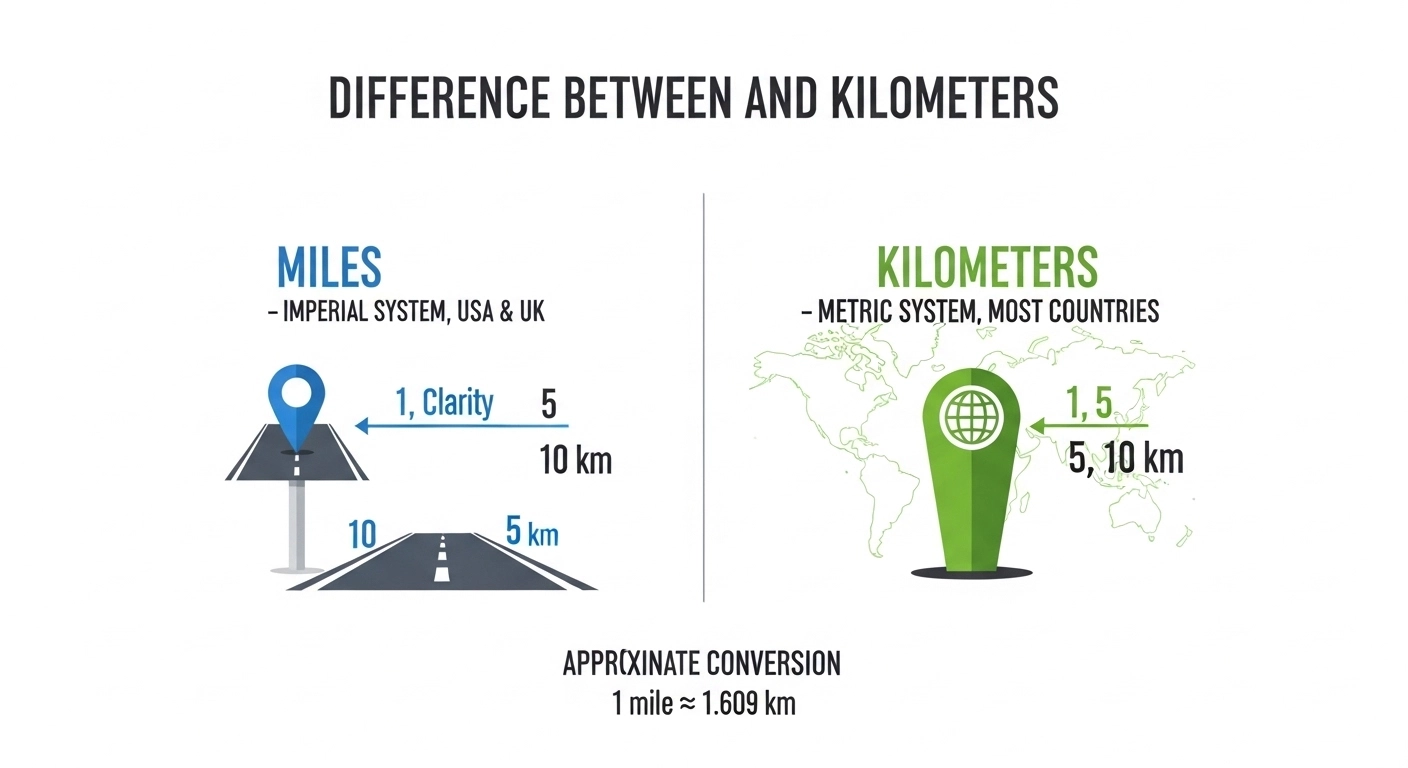
Both miles and kilometers measure distance, but they are used differently around the world. Miles are more common in the United States and the UK, while kilometers dominate in most other countries.
Knowing the difference between miles and kilometers is essential not only for travelers but also for learners, engineers, and everyday decision-makers. Using them incorrectly could lead to misunderstandings or even navigation errors. In this article, we will explore the differences, examples, and practical applications of miles and kilometers.
Pronunciation:
- Miles: /maɪlz/ (US & UK)
- Kilometers: /ˈkɪləˌmiːtər/ (US), /ˈkɪləˌmiːtə/ (UK)
Let’s dive deeper into the key distinctions between these two distance measures.
Difference Between the Keywords
Here are the 10 main differences between miles and kilometers with examples:
- Unit System
- Miles belong to the Imperial system, while kilometers belong to the Metric system.
- Example 1: The US highway speed limit is 65 miles per hour.
- Example 2: In France, a car moves at 100 kilometers per hour on highways.
- Length Value
- 1 mile equals 1.609 kilometers, making miles longer than kilometers.
- Example 1: A 5-mile run equals 8.05 kilometers.
- Example 2: A 10-kilometer race equals 6.21 miles.
- Geographical Usage
- Miles are mainly used in the US and UK; kilometers are used worldwide.
- Example 1: Road signs in Texas show miles.
- Example 2: Road signs in Germany show kilometers.
- Scientific Usage
- Kilometers are preferred in scientific studies due to the metric system’s simplicity.
- Example 1: Astronomers measure distances in kilometers.
- Example 2: Engineers calculate pipeline lengths in kilometers.
- Ease of Conversion
- Kilometers convert easily to meters, centimeters, and millimeters; miles are harder to convert.
- Example 1: 3 km = 3,000 meters.
- Example 2: 3 miles = 4.827 km.
- Historical Origin
- Mile comes from Latin “mille passus” meaning 1,000 paces; kilometer comes from Greek “kilo” (1,000) + “metron” (measure).
- Example 1: Roman soldiers measured distances in miles.
- Example 2: Modern road maps use kilometers worldwide.
- Speedometer Readings
- Cars in the US show miles per hour; European cars show kilometers per hour.
- Example 1: US car speedometer shows 60 mph.
- Example 2: German car speedometer shows 100 km/h.
- Cultural Context
- Miles are part of traditional English-speaking culture; kilometers are more global.
- Example 1: UK runners often track miles in marathons.
- Example 2: Japanese runners use kilometers for races.
- Navigation Apps
- Some GPS apps allow users to switch between miles and kilometers based on preference.
- Example 1: Google Maps in the US defaults to miles.
- Example 2: Google Maps in Europe defaults to kilometers.
- Practical Everyday Use
- Miles are used for short distances in local navigation in the US; kilometers are used in longer distance planning internationally.
- Example 1: A local US taxi fare uses miles.
- Example 2: An international train route uses kilometers.
Nature and Behavior
- Miles: Longer, traditional, culturally specific, less used in scientific context.
- Kilometers: Shorter than miles, globally recognized, easier for metric calculations, preferred in science and engineering.
Why People Are Confused
People often confuse miles and kilometers due to globalization and mixed media sources, as maps, travel apps, and international content sometimes use both interchangeably.
Miles vs Kilometers Table
| Feature | Miles | Kilometers | Similarity |
| System | Imperial | Metric | Both measure distance |
| Length | 1 mile = 1.609 km | 1 km = 0.621 miles | Convertable |
| Global Usage | US, UK | Worldwide | Used for travel and science |
| Ease of Conversion | Harder | Easier (to meters, cm, etc.) | Numeric value measurement |
| Scientific Preference | Less used | Widely used | Can measure any distance |
| Speedometer | mph | km/h | Used in vehicles |
| Historical Origin | Roman times | Metric system origin | Based on measurement units |
| Cultural Relevance | English-speaking countries | Global | Traditional & modern use |
| Daily Application | Short distances | International travel | Practical for navigation |
| Navigation Apps | Optional setting | Optional setting | Customizable in tech |
Which is Better in What Situation
- Miles: Best for local US/UK travel, historical routes, and traditional road navigation. Using miles helps travelers understand distances in familiar contexts.
- Kilometers: Best for international travel, scientific studies, and engineering projects. Kilometers are easier for conversions, calculations, and global standardization.
Metaphors and Similes
- Miles: “A mile in your shoes” – understanding someone’s experience. Positive connotation.
- Kilometers: “Running kilometers of challenges” – perseverance and endurance. Neutral to positive.
Connotative Meanings
- Miles: Positive – “going the extra mile,” “mile of memories.”
- Kilometers: Neutral/positive – “kilometers of journey,” “endless kilometers of road.”
Idioms/Proverbs
- “Go the extra mile” – effort beyond expectation.
- “A thousand miles begin with a single step” – starting small leads to great achievements.
Works in Literature
- “A Mile in the Air” – Fiction, John Smith, 2005
- “The Long Kilometer” – Travel Memoir, Emily Harris, 2010
Movies
- “500 Miles” – 2012, USA
- “Kilometer Zero” – 2005, France
Frequently Asked Questions
- What is longer, a mile or a kilometer?
- A mile is longer (1 mile = 1.609 km).
- Which countries use miles?
- Primarily the US and UK.
- Are kilometers used in the US?
- Rarely, mainly in scientific contexts.
- Can I convert miles to kilometers easily?
- Yes, multiply miles by 1.609 to get kilometers.
- Why do GPS apps use both?
- To accommodate international users and preferences.
How Both Are Useful for Surroundings
Miles and kilometers help measure distances for travel, urban planning, environmental mapping, and fitness tracking. They provide clarity, accuracy, and global compatibility.
Final Words
Both miles and kilometers are essential tools for navigation, science, and everyday life. Understanding their differences improves comprehension and prevents confusion in global communication.
Conclusion
Miles and kilometers are two critical distance measures used across the world, each with unique historical, cultural, and practical significance. While miles are primarily used in the US and UK, kilometers dominate international and scientific contexts.
Their differences in value, usage, and ease of conversion make it crucial for travelers, learners, engineers, and professionals to know when to use each unit. From road trips to global mapping, both units enrich our understanding of distance, travel, and measurement. Proper knowledge ensures accuracy, safety, and effective communication across borders.

Henry is a passionate English professor, language specialist, and the founder of SpellCompare.com. With years of academic experience and a deep understanding of grammar, vocabulary, and linguistic nuances, he has dedicated his career to helping students and writers master the English language with clarity and confidence.
As an expert in word comparisons, spelling differences, and grammar rules, Henry simplifies complex language concepts into easy-to-understand explanations. His mission is to eliminate confusion between commonly misused words and provide accurate, research-based guidance that improves writing skills for learners worldwide.
Through SpellCompare.com, Henry combines academic expertise with practical examples, creating content that is clear, reliable, and reader-friendly. His work focuses on precision, correctness, and helping others communicate effectively in both academic and professional settings.
When he’s not teaching or writing, Henry continues researching evolving language trends to ensure his content remains current, helpful, and authoritative.