Have you ever walked past a park and noticed a group of people gliding effortlessly on boards, some zooming fast while others smoothly cruising? That’s where the terms longboard and skateboard come into play. Both are boards designed for movement and fun, but they serve different purposes.
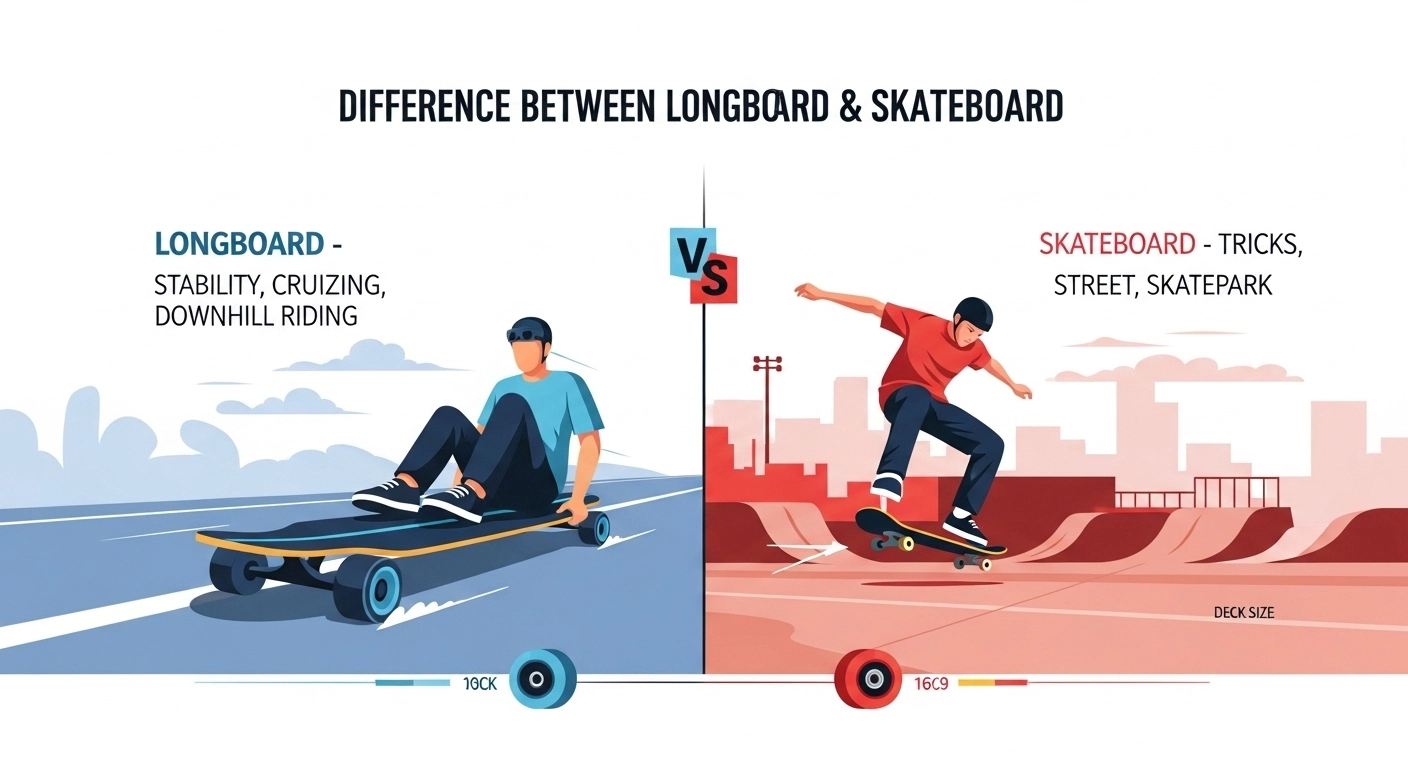
A longboard is usually longer, more stable, and perfect for smooth rides or downhill racing. A skateboard, on the other hand, is shorter, highly maneuverable, and often used for tricks at skate parks. Understanding the difference between longboard and skateboard helps beginners pick the right board, while experts refine their skills for sport or leisure. Pronounced in the US as /ˈlɔːŋˌbɔːrd/ and /ˈskeɪtbɔːrd/, and in the UK as /ˈlɒŋˌbɔːd/ and /ˈskeɪtbɔːd/, these boards offer distinct experiences.
Linking Hook: To truly appreciate their uniqueness, let’s dive deeper into the difference between longboard and skateboard.
H2: Difference Between Longboard and Skateboard
1. Length
- Longboard: Typically 33–59 inches long. Example: Riders use longboards to cruise downhill streets smoothly. Example: City commuters often choose longboards for longer rides.
- Skateboard: Usually 28–33 inches long. Example: Skaters perform tricks at the skate park with a skateboard. Example: Teens use skateboards for quick street stunts.
2. Shape
- Longboard: Often has a rounded or pintail shape. Example: Pintail longboards prevent wheel bite on sharp turns. Example: Drop-through longboards lower the center of gravity for stability.
- Skateboard: Narrower with kicktails on both ends. Example: Kicktails allow ollies and flips. Example: Street skaters use kicktails to jump curbs.
3. Wheel Size
- Longboard: Bigger and softer wheels (65–75 mm). Example: Soft wheels absorb bumps on uneven streets. Example: Smooth ride downhill racing.
- Skateboard: Smaller and harder wheels (50–60 mm). Example: Hard wheels are ideal for tricks on ramps. Example: Skatepark skaters prefer precise control.
4. Deck Flexibility
- Longboard: Flexible, allowing smoother rides. Example: Bamboo decks flex for long rides. Example: Flex helps in carving turns.
- Skateboard: Stiffer for better trick performance. Example: Maple decks resist bending during flips. Example: Stiff decks provide strong support for jumps.
5. Purpose
- Longboard: Designed for cruising and downhill speed. Example: Longboarders often commute on campus. Example: Used in long-distance downhill races.
- Skateboard: Designed for tricks and stunts. Example: Skateboarders grind rails. Example: Perform kickflips at skateparks.
6. Stability
- Longboard: More stable due to larger deck and wheelbase. Example: Beginners feel confident cruising on longboards. Example: Less wobble during high-speed rides.
- Skateboard: Less stable, prioritizing maneuverability. Example: Skilled skaters enjoy performing flips. Example: Quick turns on skateboards for tricks.
7. Trick Capability
- Longboard: Limited tricks due to size and flexibility. Example: Mostly carving or sliding. Example: Downhill racing slides.
- Skateboard: Excellent for tricks. Example: Ollies, kickflips, and grinds. Example: Skateboarding competitions showcase trick skills.
8. Transportation Use
- Longboard: Ideal for commuting longer distances. Example: College students ride to classes. Example: City riders prefer smoother rides.
- Skateboard: Mostly for short distances and tricks. Example: Skaters move between skate parks. Example: Quick street maneuvers.
9. Learning Curve
- Longboard: Easier for beginners due to stability. Example: New riders practice cruising confidently. Example: Less fear of falling.
- Skateboard: Steeper learning curve for tricks. Example: Requires balance for ollies. Example: Street tricks take months to master.
10. Cost
- Longboard: Usually more expensive. Example: Quality bamboo boards cost $150+. Example: Durable wheels for long rides.
- Skateboard: Slightly cheaper. Example: Standard maple skateboard $80–120. Example: Affordable for teens learning tricks.
Nature and Behaviour
- Longboard: Smooth, stable, leisurely, and speed-oriented. Best for cruising and downhill rides.
- Skateboard: Quick, agile, stunt-oriented, and compact. Best for tricks and skate park performances.
Why People Get Confused
Many beginners confuse them because both are flat boards with wheels. However, their purpose, design, and riding style differ significantly.
Comparison Table: Longboard vs Skateboard
| Feature | Longboard | Skateboard | Similarity |
| Length | 33–59 inches | 28–33 inches | Both have deck & wheels |
| Shape | Rounded / pintail | Narrow, kicktails | Flat boards for riding |
| Wheels | Large, soft (65–75 mm) | Small, hard (50–60 mm) | Both have four wheels |
| Deck Flexibility | Flexible | Stiff | Used for riding |
| Purpose | Cruising, downhill | Tricks, stunts | Movement & recreation |
| Stability | High | Low | Both require balance |
| Tricks | Limited | Extensive | Both allow some movement fun |
| Transportation | Long distances | Short distances | Both portable |
| Learning Curve | Easy for beginners | Challenging for beginners | Both learnable |
| Cost | Higher | Moderate | Both purchasable |
Which is Better in What Situation?
Longboard: Ideal for commuters, downhill racers, and casual riders. The stability and smooth ride make it perfect for long distances and beginners.
Skateboard: Better for skatepark enthusiasts, street skaters, and trick lovers. Its compact design and kicktails make it superior for stunts and agile maneuvers.
Use in Metaphors and Similes
- Longboard: “Gliding like a longboard down the city street.” (Smooth, effortless)
- Skateboard: “He flipped through problems like a skateboard flipping rails.” (Agile, daring)
Connotation:
- Longboard: Positive – smooth, leisurely.
- Skateboard: Neutral to positive – energetic, skillful.
Idioms/Proverbs
- “Roll with the punches” – similar to skateboarding agility.
- “Go with the flow” – longboard cruising metaphor.
Literature Mentions
- Longboard: “Longboarding Life” (Non-fiction, J. Smith, 2018)
- Skateboard: “Skateboarding Days” (Fiction, M. Turner, 2005)
Movies
- Longboard: “Longboard Legends” (2016, USA)
- Skateboard: “Lords of Dogtown” (2005, USA)
FAQs
- Can I use a longboard for tricks?
Mostly no; it’s designed for cruising, not stunts. - Is a skateboard good for commuting?
Only for short distances due to size and stability limits. - Which is safer for beginners?
Longboard, due to its stability and larger deck. - Do longboards cost more?
Yes, typically higher due to materials and size. - Can you perform ollies on a longboard?
Rarely; longboards are too flexible for standard tricks.
Environmental Use
Both encourage non-motorized transportation, reducing carbon emissions in cities. Longboards are ideal for daily commuting, while skateboards promote urban active lifestyles.
Final Words
Both longboard and skateboard offer unique experiences. Longboards are serene cruisers; skateboards are energetic stunt boards. Choosing depends on purpose, skill, and environment.
Conclusion
Understanding the difference between longboard and skateboard is essential for enthusiasts, beginners, and urban commuters. While longboards excel in stability and long rides, skateboards dominate in tricks and agility. Recognizing their features ensures safety, enjoyment, and better skill development. Both boards have influenced culture, literature, and sports, reflecting creativity and freedom. By knowing their differences, riders can pick the board that fits their style, needs, and terrain perfectly.

SwiftHarbor is a dedicated English professor, language researcher, and the founder of SpellCompare.com. With years of academic experience in English grammar, vocabulary development, and linguistic comparison, SwiftHarbor specializes in simplifying complex language rules into clear, practical explanations.
As an expert in word usage, spelling differences, and commonly confused terms, SwiftHarbor has helped thousands of learners improve their writing accuracy and communication skills. Through SpellCompare.com, he provides detailed comparisons, easy examples, and research-based insights that make English learning accessible for students, writers, and professionals worldwide.
Known for a clear teaching style and structured explanations, SwiftHarbor focuses on eliminating confusion between similar words, improving grammar confidence, and promoting precise communication. His mission is simple: to make English easier, clearer, and more powerful for everyone.