In molecular biology, understanding the difference between introns and exons is essential for decoding how genes work inside living organisms. The difference between introns and exons explains how genetic information is stored and edited before becoming proteins. Scientists often study the difference between introns and exons to understand diseases, evolution, and gene expression. In simple terms, these two elements are parts of DNA and RNA that decide what information is kept and what is removed.
Imagine a factory producing a final product. Some instructions are essential, while others are removed before the final assembly. Similarly, genes contain both useful and non-coding sections. This is where the difference between introns and exons becomes important. Introns are non-coding segments removed during RNA processing, while exons are coding segments that remain. Learning the difference between introns and exons helps students, researchers, and medical experts understand how proteins are made and how genetic disorders occur.
Pronunciation
- Introns:
- US: /ˈɪn.trɑːnz/
- UK: /ˈɪn.trɒnz/
- Exons:
- US: /ˈek.sɑːnz/
- UK: /ˈek.sɒnz/
Linking Hook
Now that we understand the basic meaning, let’s explore the difference between introns and exons in detail and see how they function inside genes.
Difference Between Introns and Exons
1. Definition
- Introns: Non-coding DNA sequences removed during RNA splicing.
- Example 1: Human insulin gene introns
- Example 2: Plant gene introns in maize
- Exons: Coding sequences that remain and form proteins.
- Example 1: Hemoglobin gene exons
- Example 2: Growth hormone gene exons
2. Function
- Introns regulate gene expression.
- Example: Alternative splicing in immune cells
- Example: Regulation in plant stress response
- Exons code for proteins.
- Example: Enzymes in digestion
- Example: Structural proteins in skin
3. Presence in mRNA
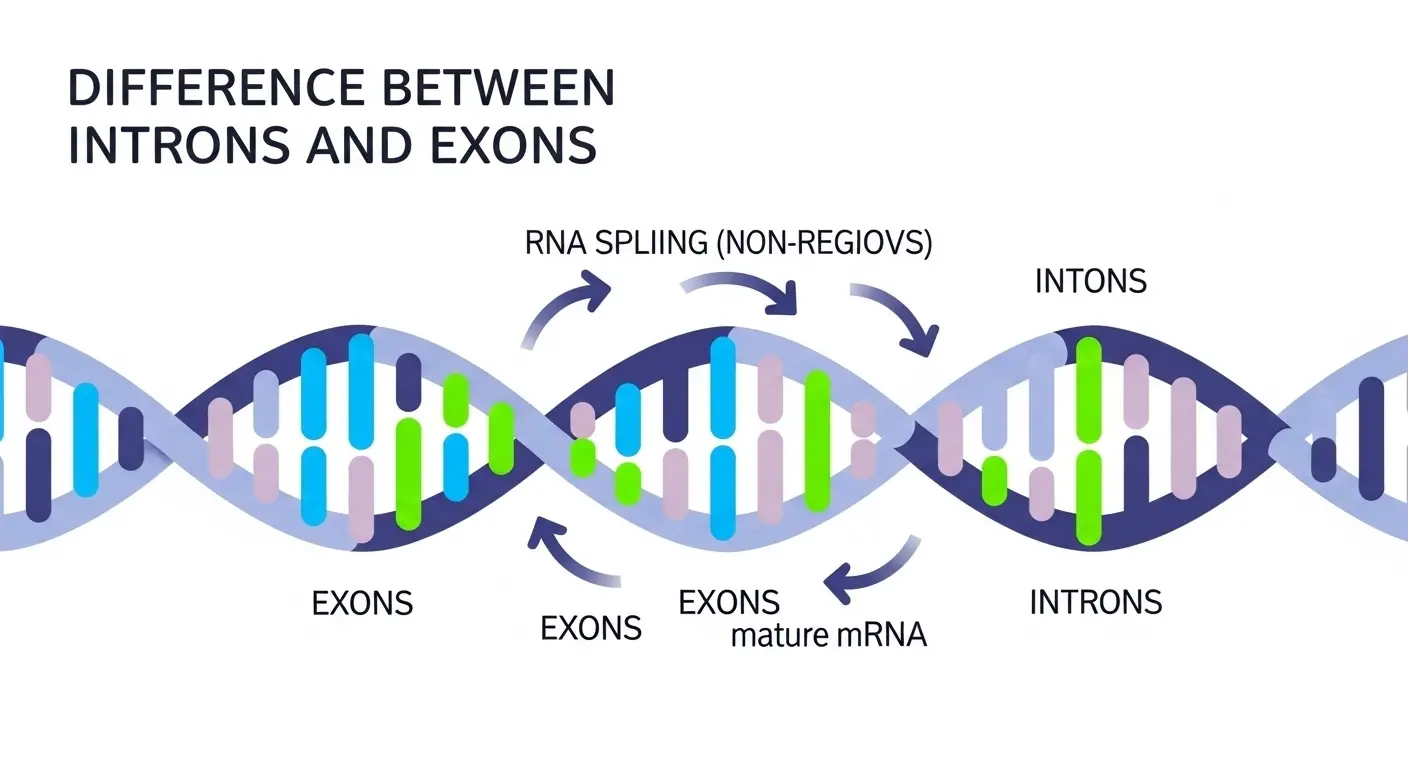
- Introns are removed from pre-mRNA.
- Example: Human liver cells processing RNA
- Example: Yeast RNA splicing
- Exons remain in mature mRNA.
- Example: Brain protein synthesis
- Example: Muscle protein formation
4. Role in Protein Synthesis
- Introns do not directly code proteins.
- Example: Non-coding regions in DNA
- Example: Regulatory sequences in plants
- Exons directly form amino acid sequences.
- Example: Collagen production
- Example: Insulin formation
5. Evolutionary Importance
- Introns allow genetic variation.
- Example: Evolution in vertebrates
- Example: Plant adaptation mechanisms
- Exons preserve essential genetic code.
- Example: Conserved hemoglobin genes
- Example: Essential enzyme genes
6. Length
- Introns are usually longer.
- Example: Human gene introns (thousands of bases)
- Example: Drosophila large introns
- Exons are shorter.
- Example: Coding regions in bacteria-like genes
- Example: Human exon segments
7. Location in Gene
- Introns are located between exons.
- Example: Eukaryotic gene structure
- Example: Human BRCA1 gene
- Exons are arranged in the final sequence.
- Example: Protein-coding genes
- Example: Antibody genes
8. Removal Process
- Introns are removed by splicing.
- Example: Spliceosome activity in humans
- Example: RNA editing in plants
- Exons are joined together.
- Example: Mature mRNA formation
- Example: Protein assembly instructions
9. Mutational Impact
- Introns mutations are often less harmful.
- Example: Silent intron mutation
- Example: Non-coding variation in plants
- Exon mutations can cause diseases.
- Example: Sickle cell anemia
- Example: Cystic fibrosis
10. Biological Importance
- Introns help gene regulation.
- Example: Tissue-specific expression
- Example: Developmental gene control
- Exons define functional proteins.
- Example: Enzymes in metabolism
- Example: Hormones like insulin
Nature and Behaviour
- Introns behave like regulatory “interrupters” that are removed before translation. They influence how genes are expressed but do not form proteins directly.
- Exons behave like “information carriers” that directly code for proteins, forming the final blueprint used by cells.
Why People Get Confused
People confuse introns and exons because both are part of the same gene sequence. Additionally, both appear in pre-mRNA before splicing, making it difficult to distinguish their roles without molecular understanding.
Table: Difference and Similarity
| Feature | Introns | Exons |
| Coding ability | Non-coding | Coding |
| Role | Regulatory | Protein formation |
| Presence in mRNA | Removed | Retained |
| Length | Longer | Shorter |
| Function | Gene regulation | Protein synthesis |
Similarity: Both are parts of eukaryotic genes and are transcribed into pre-mRNA.
Which is Better in What Situation?
Introns are more important when gene regulation and evolutionary flexibility are needed. They allow organisms to adapt by enabling alternative splicing, which creates multiple proteins from one gene.
Exons are more important when direct protein production is required. Without exons, cells cannot build enzymes, hormones, or structural proteins. Therefore, exons are essential for survival and biological function, while introns are essential for diversity and regulation.
Metaphors and Similes
- Introns are like “rough drafts in editing,” removed before the final book is printed.
- Exons are like “final printed pages” that carry the real message.
- Genes with introns are like movies with deleted scenes.
- Exons are like the final cut of a film.
Connotative Meaning
- Introns: Neutral to slightly negative (seen as “non-coding” or “extra sequences”)
- Example: “junk DNA” misconception (scientifically outdated)
- Exons: Positive (essential and functional)
- Example: “protein-coding backbone of life”
Idioms or Proverbs
There are no direct idioms or proverbs about introns and exons. However, we can relate:
- “Cut the unnecessary parts” → relates to intron removal
- Example: Scientists “cut the unnecessary parts” during RNA splicing.
Works in Literature (Scientific Studies)
- “Split Genes” discovery (1977) – Phillip A. Sharp (Nobel Prize-winning research on introns)
- Richard J. Roberts’ work on gene structure (1977) – discovery of introns in adenovirus genes
- Genre: Molecular Biology Research Papers
- Year: 1977–1978
Movies Related to Genetics Theme
There are no movies directly based on introns and exons, but genetics is featured in:
- Gattaca (1997, USA) – genetic engineering theme
- Jurassic Park (1993, USA) – DNA manipulation concept
- Splice (2009, Canada/France) – gene editing fiction
Frequently Asked Questions
1. What is the main difference between introns and exons?
Introns are non-coding, while exons code for proteins.
2. Are introns used in protein synthesis?
No, introns are removed before protein synthesis.
3. Why do genes have introns?
They help in regulation and genetic diversity.
4. Can mutations in exons cause disease?
Yes, exon mutations can directly affect proteins and cause disorders.
5. Are introns useless?
No, they play important regulatory roles.
How Both Are Useful for Surroundings
Introns support genetic diversity, helping organisms adapt to environmental changes. Exons ensure proper protein production, which is essential for all biological functions such as growth, immunity, and metabolism. Together, they maintain balance in living systems and support evolution and survival.
Final Words
Both introns and exons are essential parts of genetic architecture. Introns act as regulators and editors, while exons serve as the final code that builds life. Without introns, genetic diversity would be limited; without exons, life could not function. Their combined roles make gene expression precise, flexible, and evolutionarily powerful.
Conclusion
The difference between introns and exons is fundamental to understanding how genes work in all living organisms. Introns are removed during RNA processing, while exons are expressed in proteins. This difference explains how one gene can produce multiple proteins and how genetic regulation occurs.
By studying the difference between introns and exons, scientists gain insights into evolution, genetic diseases, and biotechnology advancements. Both elements are essential for life, working together in a highly organized system that ensures survival, adaptation, and biological complexity in every organism.

SwiftHarbor is a dedicated English professor, language researcher, and the founder of SpellCompare.com. With years of academic experience in English grammar, vocabulary development, and linguistic comparison, SwiftHarbor specializes in simplifying complex language rules into clear, practical explanations.
As an expert in word usage, spelling differences, and commonly confused terms, SwiftHarbor has helped thousands of learners improve their writing accuracy and communication skills. Through SpellCompare.com, he provides detailed comparisons, easy examples, and research-based insights that make English learning accessible for students, writers, and professionals worldwide.
Known for a clear teaching style and structured explanations, SwiftHarbor focuses on eliminating confusion between similar words, improving grammar confidence, and promoting precise communication. His mission is simple: to make English easier, clearer, and more powerful for everyone.