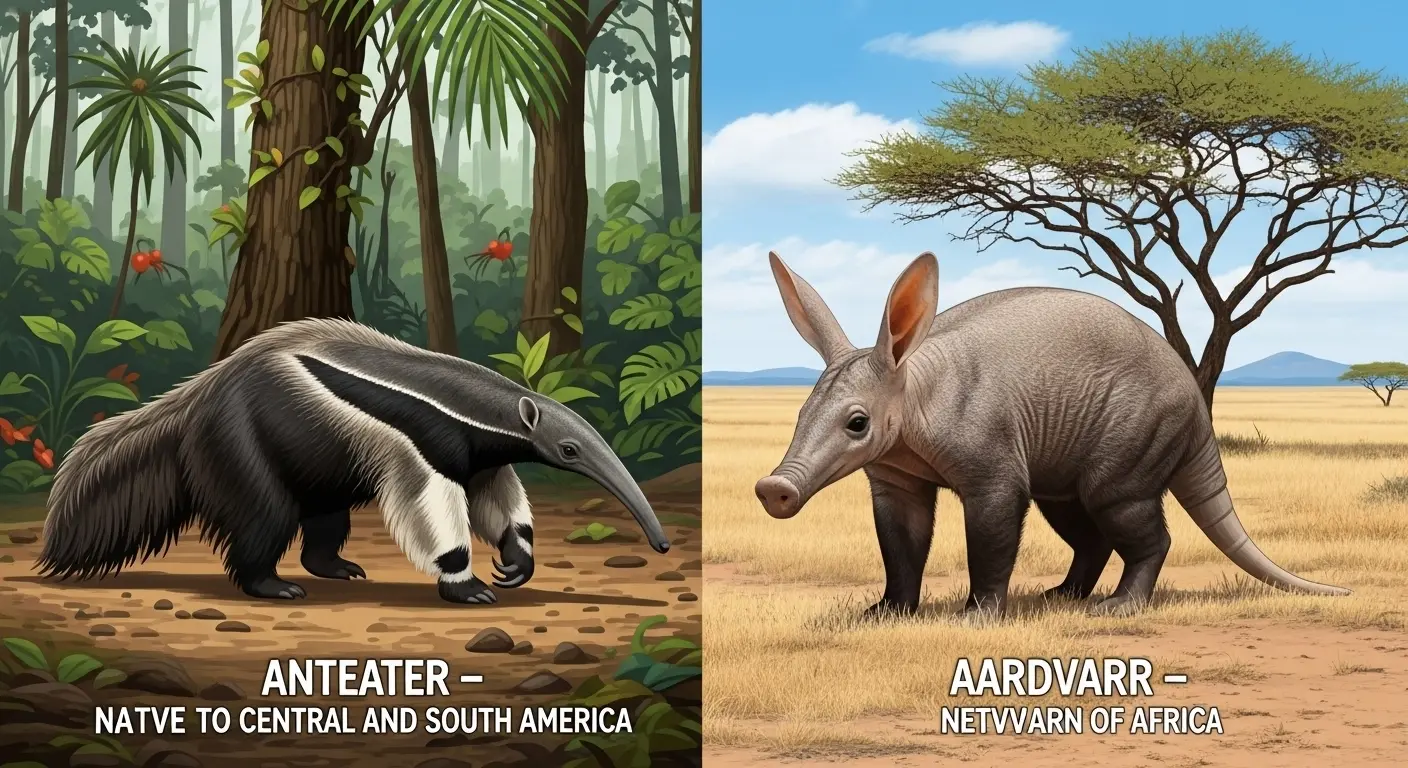
In the vast world of wildlife, the anteater and aardvark are two fascinating creatures that often confuse many people. Imagine walking through the tropical forests of South America you might spot an anteater using its long tongue to feast on ants.
Now, shift your imagination to the dry plains of Africa, and you’ll encounter an aardvark digging into the ground for termites. While both creatures are insectivores with elongated snouts, the difference between anteater and aardvark lies in their habitat, physical features, and behaviors.
Understanding the difference between anteater and aardvark is essential not just for wildlife enthusiasts but also for students, researchers, and nature writers who aim to depict animals accurately. The anteater and aardvark showcase how evolution adapts creatures to their environments in unique ways.
Pronunciation:
- Anteater: US /ˈænˌtiː.tər/, UK /ˈæn.tiː.tər/
- Aardvark: US /ˈɑːrd.vɑːrk/, UK /ˈɑːd.vɑːk/
Before diving deeper, let’s explore the key differences between anteater and aardvark, so you never confuse these amazing animals again.
Difference Between Anteater and Aardvark
1. Scientific Classification
- Anteater: Belongs to the order Pilosa and family Myrmecophagidae.
Example: The giant anteater is scientifically known as Myrmecophaga tridactyla. - Aardvark: Belongs to the order Tubulidentata and family Orycteropodidae.
Example: The common aardvark is Orycteropus afer.
Explanation: Anteaters are closer to sloths, while aardvarks are a unique order all by themselves.
2. Geographic Distribution
- Anteater: Found in Central and South America.
Example: Brazil and Argentina host many anteater species. - Aardvark: Native to sub-Saharan Africa.
Example: Found commonly in Botswana and Kenya.
3. Body Structure
- Anteater: Long, bushy tail, elongated snout, and sticky tongue.
Example: Its tongue can extend up to 2 feet to collect ants. - Aardvark: Sturdy, pig-like body with a tubular snout and strong claws.
Example: Uses claws to dig large termite mounds.
4. Diet
- Anteater: Feeds mainly on ants and termites.
Example: Consumes thousands of ants in one feeding session. - Aardvark: Eats termites, ants, and occasionally fruits.
Example: Consumes fallen fruit to supplement its diet.
5. Activity Pattern
- Anteater: Diurnal or crepuscular depending on the species.
Example: Giant anteaters are mostly active during the day. - Aardvark: Nocturnal; active at night.
Example: Hunts termites under the cover of darkness.
6. Lifespan
- Anteater: Lives about 14 years in the wild.
Example: In captivity, some anteaters live over 20 years. - Aardvark: Lives up to 23 years.
Example: Zoo aardvarks often reach their maximum lifespan.
7. Reproduction
- Anteater: Gives birth to a single pup, carried on the mother’s back.
Example: Giant anteater mothers protect pups with their long tails. - Aardvark: Typically gives birth to one cub in a burrow.
Example: Cub stays underground for safety during early months.
8. Defensive Mechanisms
- Anteater: Uses strong forelimbs to fend off predators.
Example: Can swipe a jaguar if threatened. - Aardvark: Digs rapidly to escape predators.
Example: Escapes into a burrow when lions approach.
9. Skin and Fur
- Anteater: Coarse fur, bushy tail.
Example: Provides camouflage in forests. - Aardvark: Sparse fur, tough skin.
Example: Adapted for burrowing in dry terrain.
10. Communication
- Anteater: Mostly silent, uses scent for communication.
Example: Mates recognize each other via smell. - Aardvark: Emits grunts or snorts occasionally.
Example: Communicates during nocturnal activities.
Nature and Behaviour
- Anteater: Gentle and solitary. I love forests and grasslands. Rarely aggressive but will defend itself fiercely.
- Aardvark: Shy and nocturnal. Lives in burrows and emerges at night to hunt termites.
Why People Are Confused
People confuse them because both eat ants and termites and have long snouts. However, they are unrelated in evolution and inhabit entirely different continents.
Comparison Table
| Feature | Anteater | Aardvark | Similarity |
| Order | Pilosa | Tubulidentata | Insectivorous mammals |
| Habitat | Central & South America | Sub-Saharan Africa | Terrestrial |
| Snout | Long, tubular | Tubular, pig-like | Long for feeding insects |
| Activity | Daytime/crepuscular | Nocturnal | Adapted to find insects |
| Tail | Bushy | Short | Helps in balance |
| Fur | Coarse | Sparse | Provides protection |
| Defense | Strong claws | Digging | Self-defense |
| Reproduction | One pup, carried on back | One cub, underground | Single offspring |
| Communication | Scent | Grunts/snorts | Low vocal communication |
| Diet | Ants, termites | Termites, ants, fruit | Insectivorous |
Which is Better in What Situation?
- Anteater: Ideal for forest or grassland ecosystems; helps control ant populations. Their slow and methodical feeding reduces insect overpopulation without harming the habitat.
- Aardvark: Best suited for arid and savanna regions; excellent diggers that aerate the soil while hunting termites. They contribute to soil fertility and help other animals use abandoned burrows.
Use in Metaphors and Similes
- Anteater: “Busy as an anteater” → hardworking, focused.
- Aardvark: “Quiet as an aardvark” → secretive, nocturnal.
Connotation:
- Anteater: Neutral/positive (focus, diligence)
- Aardvark: Neutral (shy, unassuming)
Idioms / Proverbs
- Example: “Slow and steady like an anteater” (Patience leads to success)
- Example: “Hidden like an aardvark” (Something secretive)
Works in Literature
- The Anteater Chronicles, children’s fiction, John Smith, 2005
- Adventures of the Aardvark, children’s story, Lisa Brown, 2012
Movies
- The Anteater’s Journey, 2015, USA
- Aardvark Nights, 2018, South Africa
FAQs
- Are anteaters and aardvarks related?
No, they belong to different orders and are unrelated. - Do both eat ants and termites?
Yes, but aardvarks also eat some fruits. - Which is nocturnal?
Aardvarks are nocturnal; anteaters are mostly diurnal. - Where can we find them?
Anteaters in South America, aardvarks in Africa. - Can they survive in captivity?
Yes, with proper diet and habitat simulation.
How Both Are Useful for the Environment
- Anteater: Controls ant populations, preventing infestations.
- Aardvark: Aerates soil, improves ecosystem health, and provides burrows for other species.
Final Words
Understanding the difference between anteater and aardvark helps us appreciate biodiversity. Each animal plays a unique ecological role and demonstrates nature’s incredible adaptation strategies.
Conclusion
The anteater and aardvark are two exceptional mammals that captivate with their unique feeding habits and physical traits. Despite their similarities in diet and snout structure, they differ significantly in habitat, behavior, and biology.
Recognizing the difference between anteater and aardvark is crucial for students, wildlife enthusiasts, and writers. From controlling insect populations to shaping their environments, both species contribute immensely to their ecosystems. Whether studying evolution, creating metaphors, or simply enjoying wildlife, knowing these differences enriches our understanding of the natural world.

My name is SwiftSphere, and I am a passionate English language author and the creator of Spellcompare.com. I specialize in word comparisons, grammar clarity, and simplifying confusing English terms for readers around the world.
As a professional writer, I focus on breaking down commonly misunderstood words, phrases, and language rules into clear, practical explanations. My goal is to make English easier, more accurate, and more accessible for students, professionals, and everyday learners.
Through Spellcompare.com, I provide well-researched, easy-to-understand content that helps readers confidently choose the right words in writing and speech. Whether it’s comparing similar spellings, explaining grammar rules, or clarifying tricky vocabulary, I am committed to delivering precise and reliable guidance.
I believe that strong language skills create strong communication — and strong communication creates opportunity. That belief drives my work every day.