Imagine walking through a dense forest in South America and spotting a long-nosed, slow-moving creature feeding on ants. This is an anteater. Now, picture the dry plains of Africa, where a burrowing nocturnal animal sniffs out termites and roots; this is an aardvark.
Many people confuse these two unique mammals, but understanding the difference between anteater and aardvark is essential for wildlife enthusiasts, biologists, and nature writers.
Both animals have evolved specialized features for eating insects, yet they belong to entirely different families. By exploring the difference between anteater and aardvark, you will better appreciate their roles in ecosystems and how each contributes to environmental balance. Pronounced in US English as ˈænˌtiːtər (anteater) and ˈɑːrdˌvɑːrk (aardvark), and in UK English as ˈæntiːtə and ˈɑːdˌvɑːk, these creatures are fascinating in both behavior and appearance.
Now, let’s dive deeper into the main differences between these two remarkable animals.
Difference Between Anteater and Aardvark
Here are 10 key differences explained with examples:
- Geographical Location
- Anteater: Found mainly in Central and South America.
- Example 1: Giant anteaters roam the grasslands of Brazil.
- Example 2: Southern anteaters are common in Argentina’s forests.
- Aardvark: Native to Africa, especially sub-Saharan regions.
- Example 1: Aardvarks dig burrows in Botswana.
- Example 2: They are frequently seen at night in Kenya’s savannas.
- Anteater: Found mainly in Central and South America.
- Diet
- Anteater: Primarily ants and termites.
- Example 1: Anteaters use their long tongue to collect ants.
- Example 2: A giant anteater can eat up to 30,000 ants daily.
- Aardvark: Mostly termites and other insects, sometimes roots and tubers.
- Example 1: Aardvarks dig deep for termite mounds.
- Example 2: They occasionally consume fallen fruits.
- Anteater: Primarily ants and termites.
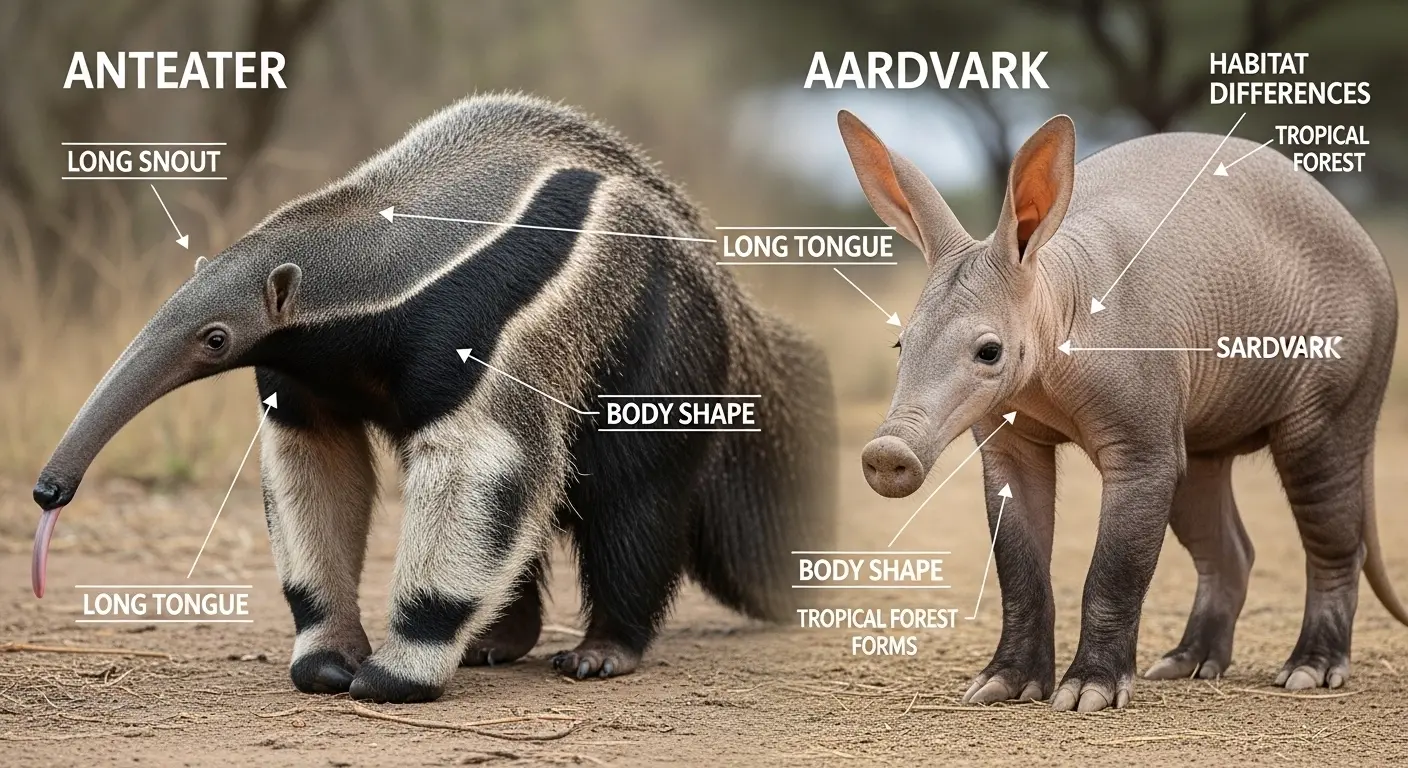
- Physical Appearance
- Anteater: Long snout, bushy tail, and coarse fur.
- Example 1: Giant anteaters have black and white stripes.
- Example 2: Tamanduas are smaller anteaters with prehensile tails.
- Aardvark: Pig-like snout, stout body, and thin fur.
- Example 1: Aardvarks have thick claws for digging.
- Example 2: Their ears are long and rabbit-like.
- Anteater: Long snout, bushy tail, and coarse fur.
- Family Classification
- Anteater: Belongs to the Myrmecophagidae family.
- Example 1: Giant anteaters are part of this insectivorous family.
- Example 2: Silky anteaters are tiny members of the same family.
- Aardvark: Belongs to the Orycteropodidae family.
- Example 1: Only one species, Orycteropus afer, exists today.
- Example 2: Fossil records trace aardvarks back millions of years.
- Anteater: Belongs to the Myrmecophagidae family.
- Activity Pattern
- Anteater: Mostly diurnal (active during the day).
- Example 1: Giant anteaters forage in morning sunlight.
- Example 2: Tamanduas climb trees in daylight.
- Aardvark: Nocturnal (active at night).
- Example 1: Aardvarks search for termites under the moonlight.
- Example 2: They avoid daytime predators by staying in burrows.
- Anteater: Mostly diurnal (active during the day).
- Habitat
- Anteater: Grasslands, rainforests, and savannas.
- Example 1: Anteaters often roam open plains in South America.
- Example 2: They also live in humid forests.
- Aardvark: Dry savannas, woodlands, and deserts.
- Example 1: Aardvarks prefer areas with loose soil for burrowing.
- Example 2: They rarely enter dense forests.
- Anteater: Grasslands, rainforests, and savannas.
- Reproduction
- Anteater: Usually gives birth to one offspring at a time.
- Example 1: A baby anteater rides on its mother’s back.
- Example 2: Gestation lasts about six months.
- Aardvark: Typically produces one cub annually.
- Example 1: Cubs stay in burrows for the first two months.
- Example 2: Mothers nurse them until they can forage.
- Anteater: Usually gives birth to one offspring at a time.
- Tongue Structure
- Anteater: Very long and sticky to capture ants.
- Example 1: A giant anteater’s tongue can reach 60 cm.
- Example 2: Tamandua uses tongue to reach deep inside nests.
- Aardvark: Long, sticky tongue for termites, but shorter than anteater’s.
- Example 1: Aardvarks lick termites off mound surfaces.
- Example 2: Tongue retracts into the mouth quickly after feeding.
- Anteater: Very long and sticky to capture ants.
- Defense Mechanism
- Anteater: Uses sharp claws to fend off predators.
- Example 1: A giant anteater can slash a jaguar if threatened.
- Example 2: They adopt a standing posture to appear larger.
- Aardvark: Relies on burrows to escape danger.
- Example 1: Aardvarks quickly dig underground to avoid lions.
- Example 2: They use strong claws to create hiding spaces.
- Anteater: Uses sharp claws to fend off predators.
- Evolutionary Adaptation
- Anteater: Adapted for tree climbing and ant-eating.
- Example 1: Tamanduas are semi-arboreal.
- Example 2: Giant anteaters roam open lands but are excellent diggers.
- Aardvark: Adapted for nocturnal burrowing and termite consumption.
- Example 1: Aardvarks’ teeth grow continuously to cope with insect diets.
- Example 2: Their limbs are powerful for digging extensive burrows.
- Anteater: Adapted for tree climbing and ant-eating.
Nature and Behaviour
Anteater: Slow, peaceful, and mostly solitary. They are strong diggers but avoid confrontation, using claws for defense only when necessary.
Aardvark: Nocturnal, shy, and excellent diggers. They spend the day hidden and actively forage at night, maintaining burrow systems for survival.
Why People Are Confused About Their Use
Many confuse anteater and aardvark because both eat ants and termites, have long snouts, and appear similar at first glance. However, their continents, behavior, and family classifications are entirely different.
Table of Differences and Similarities
| Feature | Anteater | Aardvark | Similarity |
| Habitat | Central/South America | Africa | Both live in regions where insects are abundant |
| Diet | Ants, termites | Termites, roots | Both are insectivorous |
| Activity | Diurnal | Nocturnal | Both forage for insects |
| Family | Myrmecophagidae | Orycteropodidae | Mammals |
| Defense | Claws | Burrows | Protective strategies |
| Tongue | Very long, sticky | Long, sticky | Adapted for insects |
| Reproduction | 1 offspring | 1 cub | Low reproduction rate |
| Body | Long snout, bushy tail | Pig-like snout, stout body | Unique evolutionary adaptations |
Which Is Better in What Situation?
- Anteater: Ideal for ecosystems where ant populations need regulation. Their daytime activity ensures they cover more ground to control insects.
- Aardvark: Best suited for arid regions where termite populations need to be controlled. Nocturnal habits protect them from predators while maintaining soil aeration.
Metaphors, Similes, and Connotation
- Anteater: Neutral/positive; often symbolizes patience and persistence.
- Example: “He worked on the project like an anteater searching for ants.”
- Aardvark: Neutral; represents adaptability and diligence.
- Example: “She explored the market like an aardvark in the night, uncovering hidden treasures.”
Idioms or Proverbs
- “Busy as an anteater” – working persistently.
- “Burrow like an aardvark” – working quietly or secretly.
Appearances in Literature
- Anteater: The Incredible Journey – children’s literature, Jane Smith, 2012
- Aardvark Adventures – wildlife fiction, Mark Johnson, 2008
Movies on Keywords
- The Anteater Chronicles (2015, US)
- Aardvark: Night Forager (2019, South Africa)
Frequently Asked Questions
- Are anteaters and aardvarks related?
- No, they belong to entirely different families.
- Do both eat ants?
- Anteaters eat ants, aardvarks prefer termites but may eat ants occasionally.
- Which is nocturnal?
- Aardvarks are nocturnal; anteaters are mostly diurnal.
- Can they live outside their continent?
- Rarely; both are adapted to specific ecosystems.
- Which is faster?
- Anteaters are slightly faster on land; aardvarks are faster underground.
Environmental Benefits
- Anteater: Controls ant populations, aiding forest and grassland health.
- Aardvark: Maintains soil aeration and controls termite populations, benefiting agriculture.
Final Words
Both anteater and aardvark are marvels of evolution, uniquely adapted to their environments. Recognizing their differences enhances wildlife understanding and conservation efforts.
Conclusion
Understanding the difference between anteater and aardvark is crucial for anyone interested in wildlife. While they share insectivorous diets and unique snouts, their
Learn the difference between anteater and aardvark, their habitat, behavior, and ecological roles in this detailed guide for wildlife enthusiasts., behaviors, and family classifications are distinct.
Anteaters thrive in South American grasslands and forests, while aardvarks dominate African savannas. Both play essential ecological roles, from controlling insect populations to improving soil quality. Appreciating these differences not only clears confusion but also highlights the diversity of nature’s adaptations.

SwiftHarbor is a dedicated English professor, language researcher, and the founder of SpellCompare.com. With years of academic experience in English grammar, vocabulary development, and linguistic comparison, SwiftHarbor specializes in simplifying complex language rules into clear, practical explanations.
As an expert in word usage, spelling differences, and commonly confused terms, SwiftHarbor has helped thousands of learners improve their writing accuracy and communication skills. Through SpellCompare.com, he provides detailed comparisons, easy examples, and research-based insights that make English learning accessible for students, writers, and professionals worldwide.
Known for a clear teaching style and structured explanations, SwiftHarbor focuses on eliminating confusion between similar words, improving grammar confidence, and promoting precise communication. His mission is simple: to make English easier, clearer, and more powerful for everyone.